Quranic Answer
Hypocrisy, often defined as the practice of claiming to have moral standards or beliefs to which one's own behavior does not conform, emerges as a focal point of condemnation in the Holy Quran. Through its verses, the Quran articulates a profound understanding of the detrimental effects of hypocrisy, not only in spiritual terms but also in its practical implications for society. This article delves into the concept of hypocrisy as outlined in the Quran, examining its nuances and the broader consequences it brings to personal integrity, societal dynamics, and community trust. In Surah Al-Baqarah, verses 8 to 16, Allah lays bare the characteristics and motivations of hypocrites. The verses declare, "And among the people are some who say, ‘We believe in Allah and the Last Day,’ but they are not believers. They seek to deceive Allah and those who believe, but they deceive not except themselves." This verse serves as a pointed critique of those who project faith and allegiance while nurturing disbelief and insincerity within. The stark message here reveals that hypocrisy ultimately leads to a form of self-deception; the hypocrite is entangled in their duplicities and, in attempting to deceive others, they primarily inflict harm upon themselves. The wisdom imparted in the Quran extends beyond mere identification of hypocritical behavior. Allah's admonition indicates that hypocrisy engenders a cycle of mistrust, discord, and ultimately societal breakdown. By failing to be authentic in their beliefs, hypocrites contribute to an environment where transparency and integrity are compromised. This deterioration poses risks not only to individual souls but also to the broader community, as trust forms the cornerstone of any relationship, be it personal or societal. Furthermore, hypocrisy is not an isolated phenomenon within the verses but is often linked to other detrimental attributes. In Surah At-Tawbah, verse 67, Allah reminds the faithful that "The hypocrite men and hypocrite women are of one another," implying that such characteristics are socially contagious. One person's hypocrisy can embolden others to act similarly, creating a web of deceit that can infiltrate entire communities. The resultant dynamic becomes a collective disarray, fraught with misunderstanding and lack of cooperation, leading to a weakened community structure. The scripture warns that the unity of believers can be at risk due to these wretched traits, emphasizing the need for communal vigilance against the insidious spread of hypocrisy. The Quran does not shy away from reinforcing the consequences of hypocritical behavior. In Surah Al-Ahzab, verses 60 to 61, Allah offers a stern caution: "If the hypocrites and those with disease in their hearts and the alarmists in the city do not cease, We will surely incite you against them." Here, Allah's message indicates that the presence of hypocrisy poses a direct threat to the safety and cohesion of the society. It highlights an escalatory approach to counteracting hypocrisy, suggesting that active measures may be necessary to curb its influence. This dire warning underscores the law of cause and effect—permitting doubted intentions and deceptive behaviors to flourish can lead to unrest and conflict. Effective confrontation of hypocrisy, therefore, becomes pivotal in safeguarding the ethical fabric of a community. The Quranic perspective champions a proactive stance: one that encourages individuals to embody sincerity, honesty, and authenticity. By fostering such qualities, a society can nurture a culture of trust, where individuals are empowered to be open and transparent in their interactions. In a broader context, the principles laid forth regarding hypocrisy in the Quran resonate beyond Islamic teachings, offering universal lessons about human conduct. Societies plagued by hypocrisy face fundamental challenges. These challenges manifest as divisions, controversies, and strife, which arise when members prioritize deceit over authenticity. The symbolism of duality that hypocrisy invokes transforms personal relationships and social networks into arenas of suspicion where collaborations become fraught with doubt. This ultimately can lead to widespread implications, ranging from institutional failures to escalations of strife among differing social groups. In conclusion, the nuanced explanations of hypocrisy found in the Holy Quran serve not only as moral guidance for individuals but also as a foundational aspect of social cohesion. By addressing hypocrisy head-on, the Quranic verses articulate a multifaceted approach to integrity that is essential for both individual spiritual growth and communal harmony. Encouraging sincerity and transparency while warning against deceitful behavior is as relevant today as it was upon the revelation of these verses. From fostering personal integrity to cultivating trust within communities, combating hypocrisy is fundamental for creating a peaceful, united, and thriving society. Ultimately, the lessons gleaned from these sacred texts can continually inspire both individuals and communities to strive for a higher moral standard, one that fosters genuine connections and ultimately strengthens the overall framework of human relationships.
Related Verses
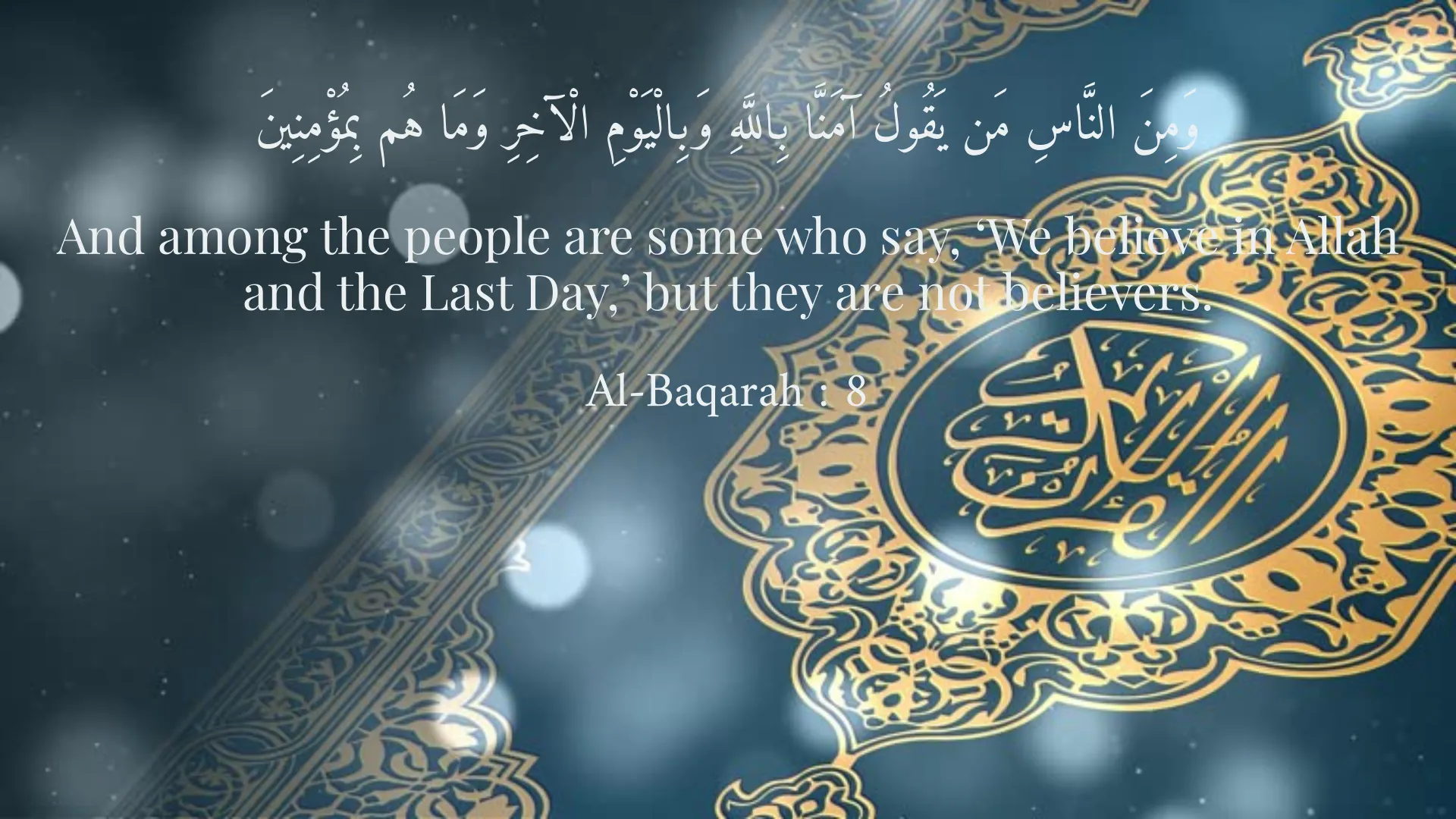
وَمِنَ النَّاسِ مَن يَقُولُ آمَنَّا بِاللَّهِ وَبِالْيَوْمِ الْآخِرِ وَمَا هُم بِمُؤْمِنِينَ
And among the people are some who say, ‘We believe in Allah and the Last Day,’ but they are not believers.
Al-Baqarah : 8
وَالمُنافقُونَ وَالمُنافقاتُ بَعضُهُم أَوالياءُ بَعضٍ
The hypocrite men and hypocrite women are of one another.
At-Tawbah : 67
لَئِن لَم يَنتَهِ المُنافِقُونَ وَالَّذِينَ في قُلُوبِهِم مَّرضٌ وَلَمُرَجِّفُونَ في الْمَدِينَةِ لَأُغْرِيَنَّكَ بِهِم
If the hypocrites and those with disease in their hearts and the alarmists in the city do not cease, We will surely incite you against them.
Al-Ahzab : 60
Short Story
Once upon a time, a man named Hamid lived in a town where hypocrisy and duplicity were common. He would show others with his words that he was a believer, but in practice, he displayed the opposite. One day, a friend noticed this behavior and urged him to reflect and change within himself. Hamid realized the bitter truth of hypocrisy and decided to change. After some time, he worked on himself and led his life toward goodness and honesty.