Quranic Answer
The Holy Quran, as a comprehensive and complete guide for human life, lays down principles in many of its verses that directly and indirectly prevent individuals from falling into the trap of intellectual polarization and division. Polarization, in this context, refers to the division of society into two hostile factions with opposing and often extreme viewpoints, which can lead to conflict, animosity, and the loss of social cohesion. The Quran, through its profound and practical concepts, offers solutions to overcome this pervasive challenge. One of the most central Quranic teachings that acts as a strong barrier against polarization is the concept of "Tawhid" (Oneness of God) and "Unity." The Quran invites humanity to worship the One God, and this singularity of God lays the foundation for human unity. When all people, regardless of their race, language, culture, or social class, recognize themselves as servants of the same Creator, the groundwork for mutual acceptance and peaceful coexistence is established. This perspective renders meaningless racist, extreme nationalist, or sectarian views, which are often the root causes of polarization. The Quran repeatedly emphasizes that division and discord are the result of forgetting God and succumbing to selfish desires. Surah Al-Imran, verse 103, states: "And hold firmly to the rope of Allah all together and do not become divided. And remember the favor of Allah upon you when you were enemies and He brought your hearts together in affection, so you became by His grace brothers." This divine rope can encompass the Quran itself, the Sunnah (traditions) of the Prophet, and the fundamental principles of the religion, providing a sanctuary for convergence and preventing humanity from falling into pits of separation. The annual Hajj pilgrimage serves as a powerful practical manifestation of this unity, where millions of Muslims from diverse backgrounds gather in similar attire with a shared purpose, transcending superficial differences. Another crucial principle is "moderation" or "Wasatiyyah." The Quran describes the Muslim community as a "justly balanced nation" (Surah Al-Baqarah, verse 143: "Thus We have made you a justly balanced nation, that you may be witnesses over the people and the Messenger may be a witness over you"). This implies avoiding extremes in all aspects of life, including beliefs, values, rituals, and social interactions. Extremism, whether in the form of religious fanaticism that leads to excommunication and exclusion of others, or in the form of absolute indifference and secular radicalism, invariably paves the way for polarization and deep societal rifts. By advocating for a middle path rooted in reason and wisdom, the Quran prevents individuals from making hasty judgments and adopting rigid, uncompromising stances. This moderate approach creates an environment conducive to dialogue and mutual understanding, as no single group considers itself absolutely right and the other absolutely wrong. In this framework, intellectual flexibility and a readiness to accept truth from any source, even from an opponent, are encouraged. The Quran teaches believers to constantly seek growth and perfection and to shun blind bigotry. Furthermore, the Quran places significant emphasis on "justice" and "fairness," which are fundamental in preventing polarization. Surah Al-Ma'idah, verse 8, clearly states: "O you who have believed, be persistently standing firm for Allah, witnesses in justice, and let not the hatred of a people prevent you from being just. Be just; that is nearer to righteousness. And fear Allah; indeed, Allah is Acquainted with what you do." This verse explicitly instructs believers not to let animosity towards any group lead them to act unjustly. When polarization occurs, each group tends to perceive the other as entirely evil and invalid, unwilling to acknowledge any truth or merit in their opponent's stance. The Quran firmly rejects this perspective, teaching that everyone, even those with whom we profoundly disagree, must be treated with justice and fairness. This approach helps to de-escalate tensions and find common ground, rather than deepening societal divisions. It promotes objectivity and prevents the demonization of the "other," which is a hallmark of polarized environments. "Respect for differences" and "encouragement of dialogue" are also crucial Quranic strategies. The Quran considers the diversity of languages and colors among humanity as signs of God's power and wisdom (Surah Ar-Rum, verse 22: "And of His signs is the creation of the heavens and the earth and the diversity of your languages and your colors. Indeed in that are signs for those of knowledge"). This inherently signifies the acceptance of natural variations in creation. These differences should not be a cause for division but rather a source of cultural and intellectual enrichment. The Quran instructs believers to engage in dialogue with the People of the Book (Christians and Jews) in the best possible manner (Surah Al-Ankabut, verse 46: "And do not argue with the People of the Scripture except in the best manner"). This emphasis on dialogue, even with those holding different beliefs, underscores the importance of mutual understanding, avoiding prejudice, and creating a platform for reconciliation. When individuals are willing to listen to each other and comprehend the arguments of the opposing side, a space for resolving misunderstandings and reaching common ground emerges, preventing the solidification of extreme positions. Moreover, the Quran strictly forbids "spying" (seeking out others' hidden faults), "backbiting" (speaking ill of others behind their backs), "slander," and "following ill-conceived suspicions." These moral ailments are rampant in polarized environments. When each group begins to speak ill of the other, assigning negative labels, and making baseless accusations, the possibility of understanding and coexistence vanishes. Instead, hostility and distrust prevail. By explicitly prohibiting these behaviors (Surah Al-Hujurat, verses 11 and 12), the Quran teaches believers to have good opinions of one another, to avoid judging based on rumors, and to respect the human dignity of all individuals. This approach helps to rebuild broken bridges of communication between people and groups. Finally, the Quran places significant emphasis on "knowledge," "reason," and "intellectual discernment." The Quran repeatedly invites humanity to reflect, ponder upon divine signs, and use their intellect, while warning against blind imitation of ancestors and traditions (Surah Al-Baqarah, verse 170: "And when it is said to them, 'Follow what Allah has revealed,' they say, 'Rather, we will follow that which we found our fathers doing.' Even though their fathers understood nothing, nor were they guided?"). When individuals make decisions based on logic, reason, and the pursuit of truth, they are less likely to fall prey to group biases, propaganda, and baseless dichotomies. The Quran urges individuals to investigate and research for themselves, rather than merely accepting what others say. This promotion of rational thought, argumentation, and independent thinking strengthens individuals' intellectual foundations and prevents them from absolute reliance on a specific ideology that can lead to extremism and polarization. In summary, by establishing the core principles of Tawhid (Oneness) and unity, moderation, justice, respect for differences, encouragement of dialogue, prohibition of divisive moral ills, and emphasis on knowledge and reason, the Holy Quran provides a comprehensive and effective framework for building a cohesive, balanced society free from intellectual polarization. These teachings serve not only as individual moral guides but also as a clear blueprint for a stable and peaceful social structure where diversity is acknowledged, and unity is preserved based on shared divine principles.
Related Verses
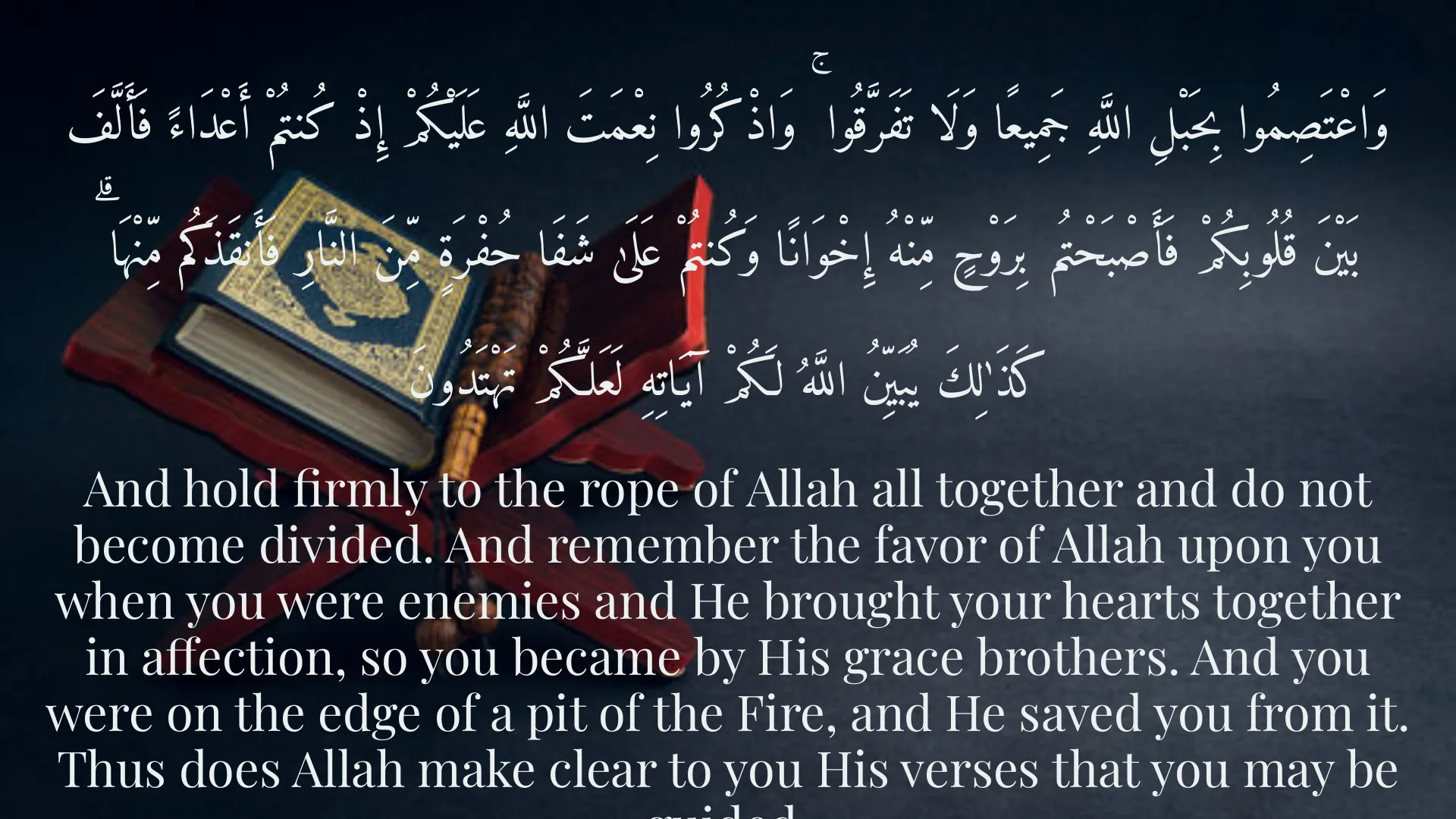
وَاعْتَصِمُوا بِحَبْلِ اللَّهِ جَمِيعًا وَلَا تَفَرَّقُوا ۚ وَاذْكُرُوا نِعْمَتَ اللَّهِ عَلَيْكُمْ إِذْ كُنتُمْ أَعْدَاءً فَأَلَّفَ بَيْنَ قُلُوبِكُمْ فَأَصْبَحْتُم بِرَوْحٍ مِّنْهُ إِخْوَانًا وَكُنتُمْ عَلَىٰ شَفَا حُفْرَةٍ مِّنَ النَّارِ فَأَنقَذَكُم مِّنْهَا ۗ كَذَٰلِكَ يُبَيِّنُ اللَّهُ لَكُمْ آيَاتِهِ لَعَلَّكُمْ تَهْتَدُونَ
And hold firmly to the rope of Allah all together and do not become divided. And remember the favor of Allah upon you when you were enemies and He brought your hearts together in affection, so you became by His grace brothers. And you were on the edge of a pit of the Fire, and He saved you from it. Thus does Allah make clear to you His verses that you may be guided.
Al-Imran : 103
يَا أَيُّهَا الَّذِينَ آمَنُوا كُونُوا قَوَّامِينَ لِلَّهِ شُهَدَاءَ بِالْقِسْطِ ۖ وَلَا يَجْرِمَنَّكُمْ شَنَآنُ قَوْمٍ عَلَىٰ أَلَّا تَعْدِلُوا ۚ اعْدِلُوا هُوَ أَقْرَبُ لِلتَّقْوَىٰ ۖ وَاتَّقُوا اللَّهَ ۚ إِنَّ اللَّهَ خَبِيرٌ بِمَا تَعْمَلُونَ
O you who have believed, be persistently standing firm for Allah, witnesses in justice, and let not the hatred of a people prevent you from being just. Be just; that is nearer to righteousness. And fear Allah; indeed, Allah is Acquainted with what you do.
Al-Ma'idah : 8
إِنَّ الَّذِينَ فَرَّقُوا دِينَهُمْ وَكَانُوا شِيَعًا لَّسْتَ مِنْهُمْ فِي شَيْءٍ ۚ إِنَّمَا أَمْرُهُمْ إِلَى اللَّهِ ثُمَّ يُنَبِّئُهُم بِمَا كَانُوا يَفْعَلُونَ
Indeed, those who have divided their religion and become sects - you [O Muhammad] are not [associated] with them in anything. Their affair is only with Allah; then He will inform them about what they used to do.
Al-An'am : 159
Short Story
It is narrated that in a bygone era, in a renowned city, two wise men engaged in a fierce dispute over the interpretation of a verse from the Holy Scripture. One was a literalist, and the other delved into esoteric meanings; each insisted on his own view and deemed the other mistaken. Their argument escalated, and their heated discussion threatened to sow discord. Neither was willing to listen to the other, nor was either inclined to seek a path to peace. This contention created fear that the bonds of affection among the people would be severed. At this juncture, a luminous and aged elder, whose face bore the marks of time and whose eyes radiated wisdom, stepped forward. In a calm and gentle tone, he addressed them: "O wise ones! You both drink from the same spring and pray towards the same direction. Does one who sees with the eye of wisdom truly prefer the branches over the roots? Should details be prioritized over universals?" He continued, "The essence of faith lies in the unity of hearts and the performance of good deeds, not in endlessly disputing a meaning to create thousands of divisions and distances between our hearts. Does not the Creator call you towards unity through His Oneness? If you adhere to this undeniable principle, perhaps minor differences, like dust on a mirror, will vanish, and the truth of unity will shine forth." The wise men, hearing the elder's words, repented of their actions and realized that persistence in bigotry and avoidance of empathy led to error and separation. They shook hands, teaching both themselves and those present a lesson in unity. Thus, bitterness vanished, and rationality and kindness replaced contention.