Quranic Answer
The Holy Quran, a central religious text in Islam, reveals profound insights regarding the significance of knowledge throughout human life. Its verses resonate with the idea that the pursuit of knowledge is not merely an intellectual exercise but an integral part of spiritual and ethical growth. Among the many verses that highlight this theme, Surah Al-Alaq (Chapter 96), verses 1 to 5, stand out profoundly. In these verses, Allah commands the Prophet Muhammad (peace be upon him) to 'Read in the name of your Lord who created, created man from a clot. Read, and your Lord is the most Generous – Who taught by the pen. Taught man that which he knew not.' This exhortation to 'read' marks not only the commencement of revelation but also serves as a powerful reminder of the importance of learning and understanding in a believer's life. The initial verses of Surah Al-Alaq establish a clear connection between the act of reading and the creation of knowledge. By instructing the Prophet to read, Allah emphasizes the value of acquiring knowledge through written words, a formalized way of learning that has carried forward through generations. The act of reading is intertwined with the divine mission and reflects the inherent value that knowledge holds in Islam. These verses frame knowledge as a divine gift, wherein Allah, the most Generous, teaches humanity through the power of the pen. This not only highlights the importance of written knowledge but also underscores the role of literacy and education in communities. Beyond the initial command to read, the significance of knowledge in the Quran is further accentuated in Surah Az-Zumar (Chapter 39), verse 9, where Allah states, 'Is one who knows equal to one who does not know?' This rhetorical question serves as a strong assertion that knowledge brings a level of superiority and distinction among individuals. The wisdom embedded within this verse clarifies that knowledge is a key driver in distinguishing between individuals and their capacities. Knowing is posited not just as a privilege but as a responsibility, marking a critical difference in how one navigates life's complexities. The Quran encourages believers to reflect on the world around them, to seek understanding and wisdom. It teaches that knowledge enables individuals to make informed decisions, fosters critical thinking, and promotes a deeper understanding of faith and existence. Through knowledge, individuals are better equipped to address societal issues, contribute positively to their communities, and achieve personal growth. Thus, gaining knowledge becomes an inherent duty for every Muslim, encapsulated well in the prophetic saying: 'Seeking knowledge is an obligation upon every Muslim male and female.' This statement broadens the mandate for knowledge, making it an inclusive pursuit that extends to all members of the Muslim community. It illustrates that knowledge is not gendered but is vital for the holistic development of both men and women. Moreover, the teachings of Islam encapsulated within the Quran extend the dialogue on knowledge beyond mere academics. It encompasses moral, spiritual, and social aspects of life. Knowledge in Islam is viewed as a pathway to righteousness, guiding believers to act ethically and to perform their duties toward themselves and society. Understanding the essence of Islam requires knowledge, as it illuminates one’s path to fulfilling the obligations of worship and community service. This highlights the correlation between knowledge and duty; the more one knows, the better equipped they are to fulfill their obligations as a member of society. Furthermore, the pursuit of knowledge is not limited to traditional forms of education but is depicted as an ongoing journey throughout one’s life. In various Hadiths (sayings of the Prophet Muhammad), there are numerous references that endorse life-long learning. The Prophet's teachings encourage Muslims to seek knowledge from the cradle to the grave, reinforcing the idea that education and self-improvement should not cease at any stage of life. The emphasis on knowledge in Islam also carries societal implications. A knowledgeable society is a strong society. When individuals prioritize learning and education, they contribute to a knowledgeable community. This collective knowledge leads to advancements in various fields such as science, philosophy, and socio-economics, which are necessary for societal progress. Thus, the quest for knowledge intertwines personal development with the collective improvement of society, as individuals who learn and grow can uplift those around them. Historically, the Islamic Golden Age serves as a testament to the remarkable contributions made by Muslim scholars in fields such as mathematics, astronomy, medicine, and philosophy. This period showcases how the pursuit of knowledge can lead to innovation and societal advancements. It also highlights the responsibility of contemporary Muslims to continue this legacy by actively pursuing knowledge, not just for personal benefit, but for the betterment of society and in service of humanity. In conclusion, the Quran and the teachings of the Prophet Muhammad (peace be upon him) collectively portray knowledge as a fundamental pillar of human life. The divine command to 'Read' in Surah Al-Alaq highlights the sacred nature of seeking knowledge, urging believers to embark on a lifelong journey of learning. In seeking knowledge, Muslims are not only fulfilling an obligation but are also contributing to their self-improvement and the betterment of society. This intertwining of personal growth with communal advancement underscores the holistic approach to knowledge in Islam. The true essence of knowledge in the light of the Quran encourages Muslims to pursue learning diligently, embodying the principles of wisdom, understanding, and ethical conduct. Seeking knowledge, therefore, is not just about intellectual acquisition but is also a significant undertaking that shapes one's identity, actions, and ultimately, their contribution to society.
Related Verses
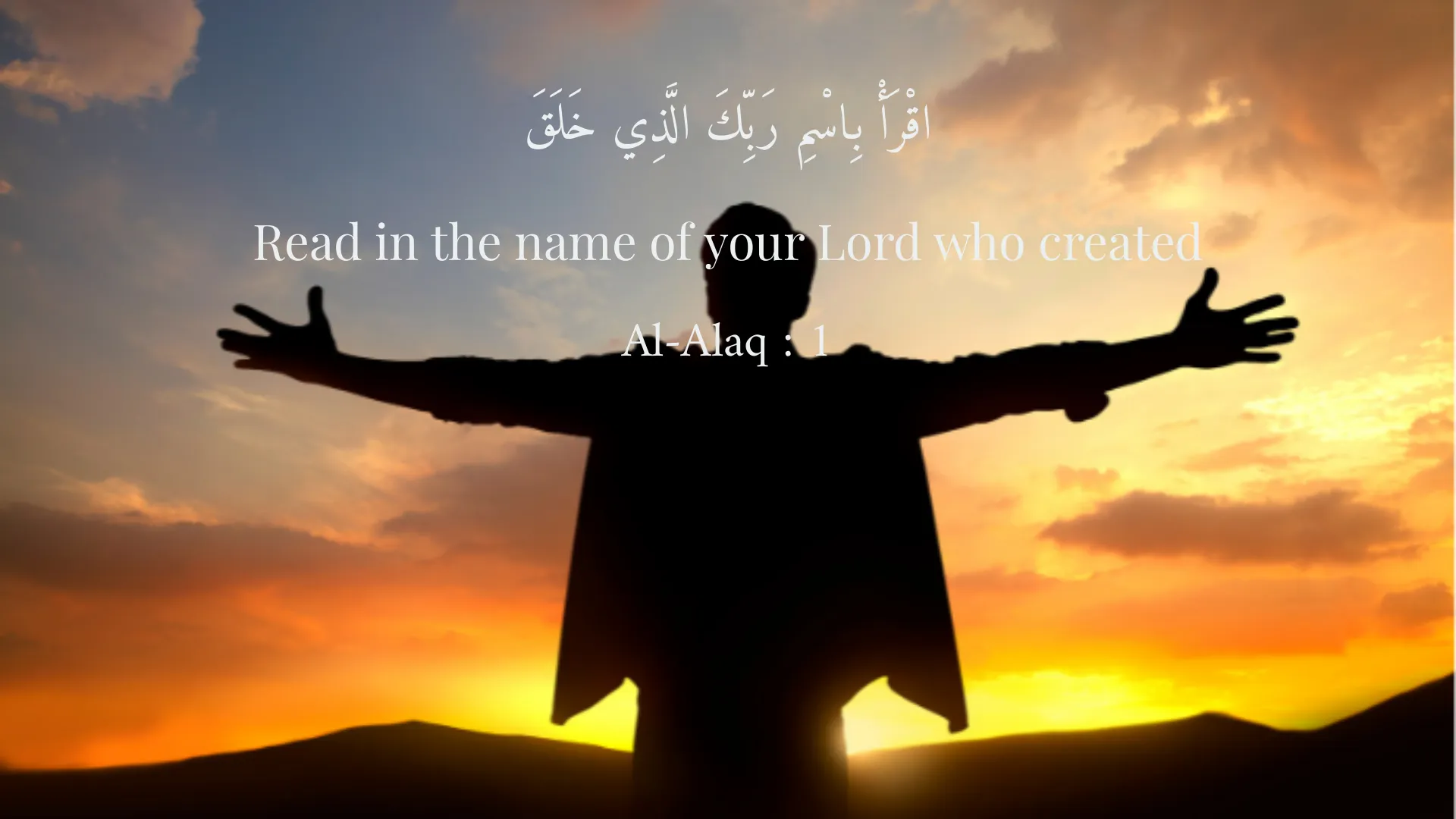
اقْرَأْ بِاسْمِ رَبِّكَ الَّذِي خَلَقَ
Read in the name of your Lord who created
Al-Alaq : 1
عَلَّمَ الْإِنْسَانَ مَا لَمْ يَعْلَمْ
Taught man that which he knew not
Al-Alaq : 5
قُلْ هَلْ يَسْتَوِي الَّذِينَ يَعْلَمُونَ وَالَّذِينَ لَا يَعْلَمُونَ
Say, 'Are those who know equal to those who do not know?'
Az-Zumar : 9
Short Story
One day, a man named Ali decided to excel in the realm of knowledge and science. He began by reading the Quran and reflecting on its verses, realizing that the pursuit of knowledge is obligatory for every Muslim. In a short time, he succeeded in acquiring knowledge in various fields and was able to teach others as well. Ali soon became not only a knowledgeable person but also a beloved teacher in the community.