Quranic Answer
The Holy Quran emphasizes the significance and value of time, presenting it as a divine trust that requires prudent management. Throughout various verses, it imparts a warning to humankind about the proper utilization of this precious resource. The consciousness of the value of time is not merely an act of piety but is deeply entrenched in the concept of accountability in the afterlife. Among the remarkable examples of this emphasis is found in Surah Al-Asr, where Allah states: 'By time, indeed, mankind is in loss, except for those who have believed and done righteous deeds and advised each other to truth and advised each other to patience.' (Al-Asr: 1-3). This verse is a profound commentary on the human condition, underscoring that all human beings are in a state of loss regarding the usage of their time, with the exception of those who meet certain criteria. This verse's profound nature lies in its articulation of a three-tiered approach to the righteous use of time. It calls upon individuals not only to believe in God but also to engage in righteous actions. This means utilizing time to perform acts of worship and good deeds that align with Islamic teachings. Furthermore, the exhortation to advise one another towards truth and patience reflects the importance of community and mutual encouragement in making the best use of time. Thus, the verse elucidates a framework connecting time management, personal faith, social responsibility, and moral obligation. By highlighting this interconnectedness, it instills a sense of urgency on believers to make a conscious effort to utilize their time wisely, both individually and collectively. Moreover, the Quran presents time as a limited resource that can be squandered. The fleeting nature of time and the transient state of human life remind people that life is constructed with moments that should be cherished and utilized for meaningful pursuits. Time wasted cannot be regained, a fact emphasized throughout religious teachings. Therefore, the Quranic emphasis on the passage of time is a call to action—to develop a sense of responsibility towards one's own actions and the impact they have in this world and the next. An additional verse that contributes to this understanding is found in Surah Al-Mulk, verse 15, which states: 'It is He who made the earth subservient to you, so walk among its slopes and eat of the sustenance provided.' This verse implicitly urges individuals to make use of their time to explore, learn, and grow. The encouragement to navigate the earth and partake in lawful sustenance is a direct invitation to the faithful to utilize the talents, skills, and intellect bestowed upon them by God. Each moment spent in exploration and learning contributes to personal development and spiritual fulfillment. The Quran thus acknowledges the necessity of engaging with the world, but it couples this acknowledgment with a lexical reminder of lawful engagement. Not all pursuits are created equal; the Quran suggests that the right use of time must align with moral integrity and divine guidance, reinforcing that ethical considerations play a critical role in how one spends their time. Time is characterized as a precious asset within the Quran, and this understanding is compounded by its implications on the spiritual and moral landscape of human life. As the religious text further expounds, neglecting time for trivial or sinful matters can have dire consequences. Engaging in frivolous activities detracts from the pursuit of knowledge and good deeds. Life is replete with opportunities to engage spiritually, educationally, and socially, but these opportunities often go unnoticed amidst distractions and social upheaval. Additionally, the Quran acknowledges different contexts in which time operates. There is the cyclical time of day-to-day experiences, the linear progression of life stages, and the eternal consideration of the hereafter. In recognizing these various dimensions of time, believers are encouraged to reflect not just on daily actions, but also on their life overall, continually assessing their path in accordance with divine expectations and the ultimate accountability they will encounter. The collective teachings emphasize the need for mindfulness in every moment. Time is both a gift and a test; it offers opportunities to attain knowledge, perform acts of charity, and engage in self-improvement. In instances where individuals are aware of their time-sensitive responsibilities, they become motivated to make better choices and thus minimize regret. Therefore, the Quran presents a holistic approach to time management, where spiritual growth, ethical living, and social welfare intertwine to create a fulfilling life experience. In conclusion, the Quran’s recurring exhortation to respect and utilize time judiciously is a cornerstone of its moral framework. Life’s essence is intertwined with the conscientious use of time, as is evident in the verses analyzed. The call towards belief, righteous deeds, mutual support, and seeking lawful sustenance creates a guiding principle for individuals striving for both personal and communal success. By fostering an appreciation for time, the Quran not only instructs individuals on the path to spiritual fulfillment but also enhances the human experience through collective betterment. Ultimately, it upholds the idea that time, when devoted to acts of goodness and community, transforms lives far beyond the temporal realm, aspiring for eternity in the hereafter. This message resonates across cultures and religions as a universal truth, inviting deeper introspection and purpose-driven living.
Related Verses
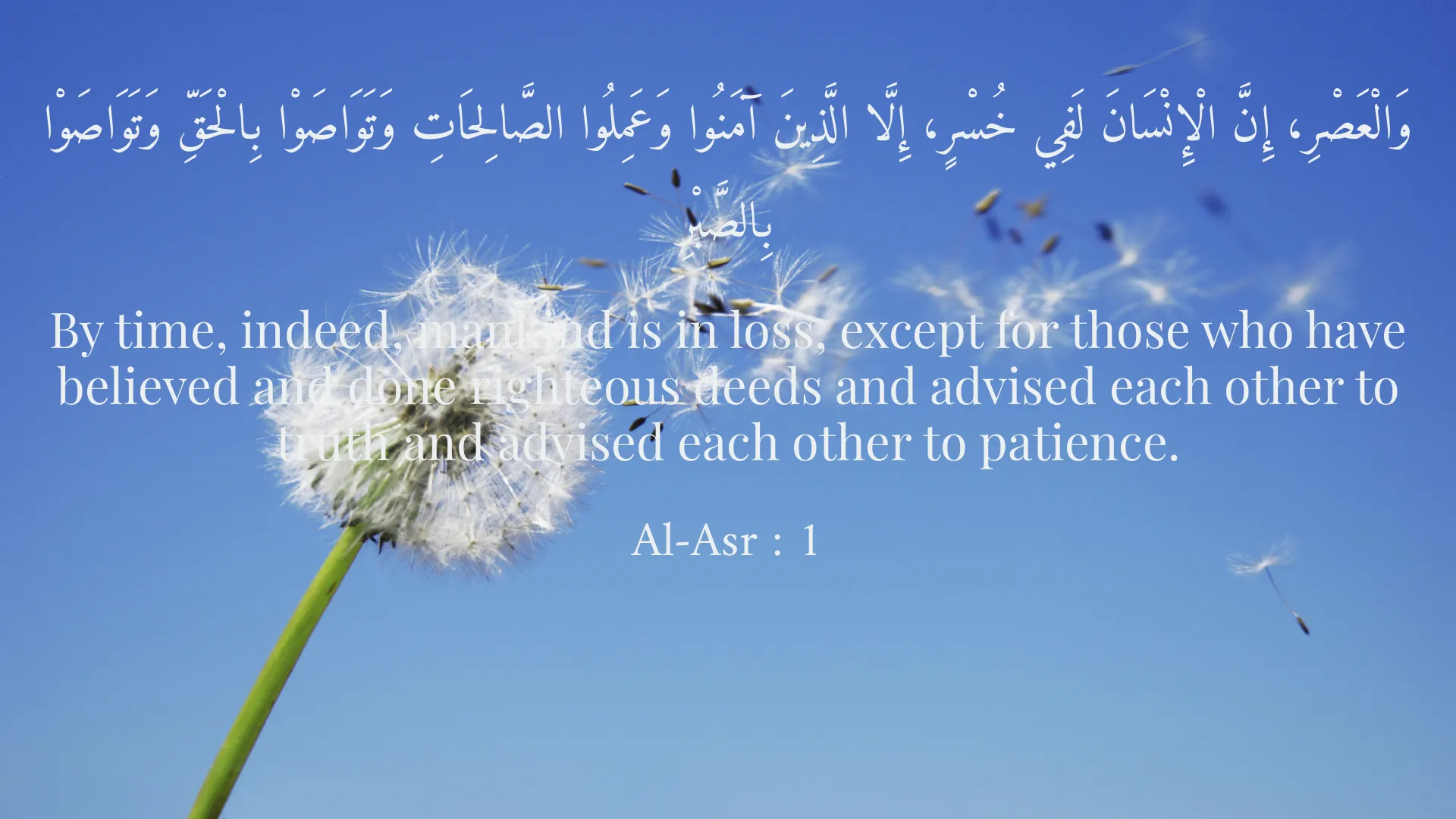
وَالْعَصْرِ، إِنَّ الْإِنْسَانَ لَفِي خُسْرٍ، إِلَّا الَّذِينَ آمَنُوا وَعَمِلُوا الصَّالِحَاتِ وَتَوَاصَوْا بِالْحَقِّ وَتَوَاصَوْا بِالصَّبْرِ
By time, indeed, mankind is in loss, except for those who have believed and done righteous deeds and advised each other to truth and advised each other to patience.
Al-Asr : 1
هُوَ الَّذِي جَعَلَ لَكُمُ الْأَرْضَ ذَلُولًا فَامْشُوا فِي مَنَاكِبِهَا وَكُلُوا مِن رِّزْقِهِ
It is He who made the earth subservient to you, so walk among its slopes and eat of the sustenance provided.
Al-Mulk : 15
Short Story
One day, a man named Mahdi had a conversation with his friends about time and its value. He told them that if they wanted to succeed in life, they must use time correctly. Mahdi encouraged his friends with Quranic verses emphasizing the importance of time to make the most of their moments and step towards righteousness and goodness. All his friends were influenced and decided that from that day on, they would devote their time to useful and benevolent activities.