Quranic Answer
In the Holy Quran, the status of neighbors and the importance of good treatment towards them are addressed in a profound and comprehensive manner, reflecting Islam's elevated vision for human relationships and the structure of a healthy society. Islam's view of neighborliness is not merely about physical proximity; rather, it encompasses a broad network of rights and responsibilities founded on kindness (Ihsan), affection (Mawaddah), and mutual cooperation. These teachings form the cornerstone of a faithful society where individuals not only think of themselves and their families but also feel a deep responsibility towards the well-being and peace of others, especially those living in their vicinity. The most pivotal verse in this regard is Surah An-Nisa, verse 36, which explicitly commands kindness to neighbors. In this verse, Allah Almighty, after commanding monotheism and worshipping none but Him, immediately refers to kindness towards parents, relatives, orphans, the needy, and then to near neighbors, distant neighbors, and companions. This sequence highlights the special importance of neighborly rights, placing them alongside other fundamental rights. The mention of both near and distant neighbors clearly demonstrates the wide scope of this command; meaning, whether a neighbor is a relative, a stranger, or even someone of a different religion or creed, all are included in the command for good treatment. "Al-Jaar dhi al-Qurba" refers to a neighbor who is physically close and also related by kinship or familiarity. "Al-Jaar al-Junub" refers to a neighbor who is a stranger or distant from relatives. This classification shows that the circle of responsibility towards neighbors is very wide, and no one should be excluded from the scope of a Muslim's grace and kindness. Kindness to neighbors in the Quran encompasses both material and spiritual dimensions. Materially, it includes helping them in need, lending, giving, and paying attention to their circumstances. If a neighbor goes to bed hungry while one is full, this is disapproved of in Islam. Spiritually, kindness includes observing etiquette, respect, refraining from causing harm (whether verbal or physical), keeping secrets, visiting them when sick, offering condolences in times of sorrow, congratulating them in times of joy, and participating in neighborhood charity work. Not harming one's neighbor is a fundamental principle; even if the neighbor is non-Muslim, there is no right to harm them, and they must be treated with justice and kindness. The verse "And do not turn your cheek [in contempt] toward people" (Luqman: 18), which emphasizes refraining from arrogance and indifference towards people, also applies here, as neighbors are the first people one interacts with daily, and arrogant or disrespectful behavior towards them can damage social relations. The Holy Quran, by emphasizing kindness to neighbors, not only strengthens individual relationships but also lays the foundation for a stable and secure society. In a community where neighbors trust each other and support one another in times of need, psychological and social security increases. The verse "But seek, through that which Allah has given you, the home of the Hereafter; and [yet], do not forget your share of the world; and do good as Allah has done good to you" (Al-Qasas: 77), although not directly mentioning neighbors, introduces the general principle of doing good to others, which undoubtedly includes neighbors. This verse teaches that one should use divine blessings for the betterment of the Hereafter, but at the same time, not neglect legitimate worldly enjoyment and do good to others, just as Allah has done good to us. This perspective teaches humanity that every action, including behavior towards neighbors, can lead to divine pleasure and eternal bliss. The importance of neighborliness in the Quran is such that some commentators have interpreted "As-Sahib bil-Janb" in An-Nisa's verse to mean a temporary neighbor, a colleague at work, or a travel companion. This indicates that Islam's view of "proximity" extends beyond mere house-to-house adjacency and includes any kind of closeness and companionship in life that requires mutual rights to be observed. This broad concept extends the circle of kindness to all individuals with whom one interacts, increasing one's responsibility towards all people. In summary, the Quranic teachings regarding neighbors lay the foundations of a civilized and ethical society. These teachings go beyond mere duties, focusing on fostering deep and friendly relationships among individuals. Since neighbors are often the first and closest point of contact in daily life, they can play a vital role in creating peace, solidarity, and well-being in society. This emphasis on kindness and good treatment of neighbors is not just an ethical command; it is a fundamental pillar for achieving a good life (Hayat Tayyibah) and an exemplary society from the perspective of Islam. Observing these rights is considered one of the signs of true faith and piety, leading to a deeper connection with God and increased blessings in life.
Related Verses
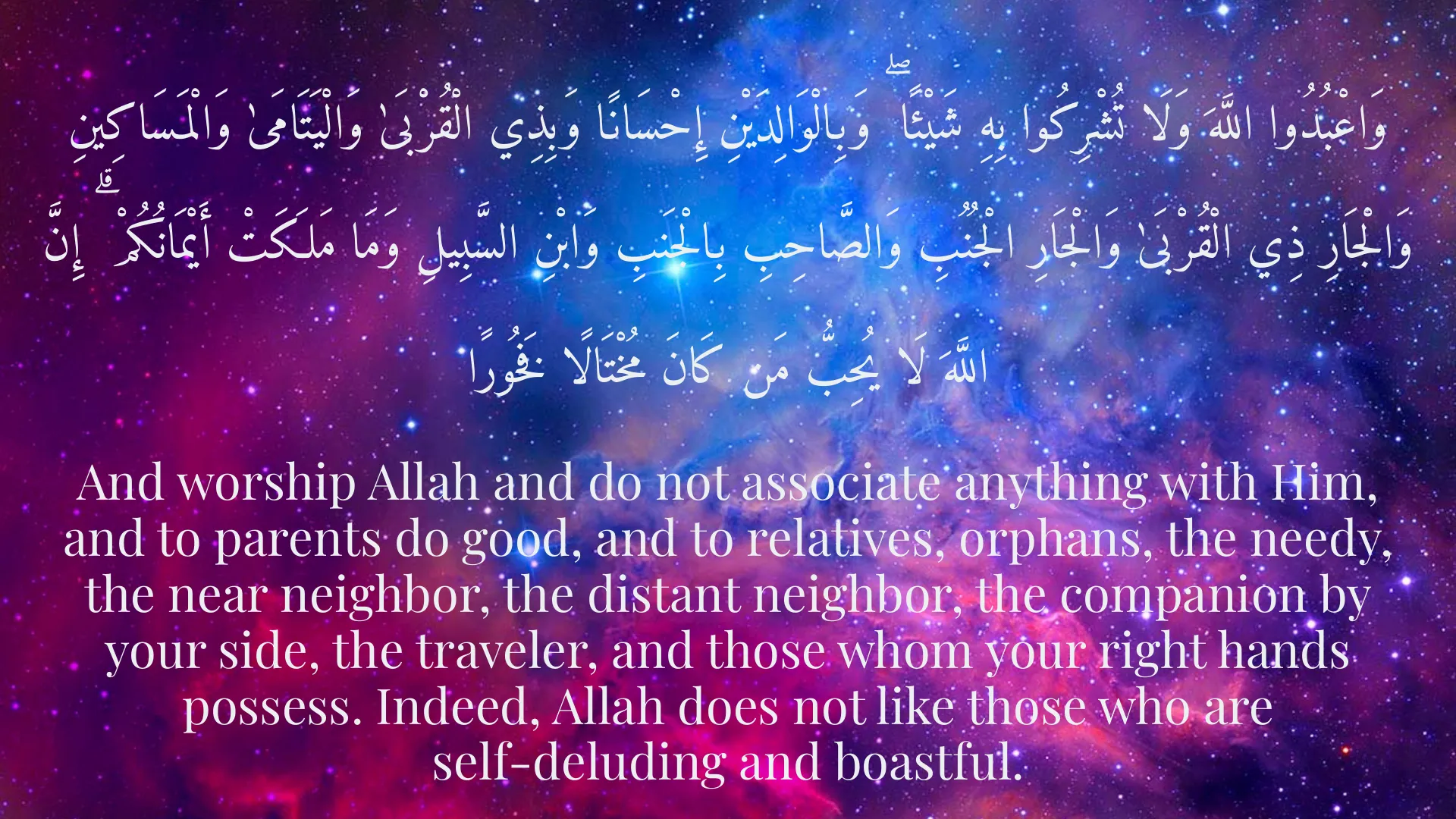
وَاعْبُدُوا اللَّهَ وَلَا تُشْرِكُوا بِهِ شَيْئًا ۖ وَبِالْوَالِدَيْنِ إِحْسَانًا وَبِذِي الْقُرْبَىٰ وَالْيَتَامَىٰ وَالْمَسَاكِينِ وَالْجَارِ ذِي الْقُرْبَىٰ وَالْجَارِ الْجُنُبِ وَالصَّاحِبِ بِالْجَنبِ وَابْنِ السَّبِيلِ وَمَا مَلَكَتْ أَيْمَانُكُمْ ۗ إِنَّ اللَّهَ لَا يُحِبُّ مَن كَانَ مُخْتَالًا فَخُورًا
And worship Allah and do not associate anything with Him, and to parents do good, and to relatives, orphans, the needy, the near neighbor, the distant neighbor, the companion by your side, the traveler, and those whom your right hands possess. Indeed, Allah does not like those who are self-deluding and boastful.
An-Nisa : 36
وَابْتَغِ فِيمَا آتَاكَ اللَّهُ الدَّارَ الْآخِرَةَ ۖ وَلَا تَنسَ نَصِيبَكَ مِنَ الدُّنْيَا ۖ وَأَحْسِن كَمَا أَحْسَنَ اللَّهُ إِلَيْكَ ۖ وَلَا تَبْغِ الْفَسَادَ فِي الْأَرْضِ ۖ إِنَّ اللَّهَ لَا يُحِبُّ الْمُفْسِدِينَ
But seek, through that which Allah has given you, the home of the Hereafter; and [yet], do not forget your share of the world; and do good as Allah has done good to you. And do not seek corruption in the land. Indeed, Allah does not like corrupters.
Al-Qasas : 77
وَلَا تُصَعِّرْ خَدَّكَ لِلنَّاسِ وَلَا تَمْشِ فِي الْأَرْضِ مَرَحًا ۖ إِنَّ اللَّهَ لَا يُحِبُّ كُلَّ مُخْتَالٍ فَخُورٍ
And do not turn your cheek [in contempt] toward people and do not walk through the earth exultantly. Indeed, Allah does not like everyone self-deluded and boastful.
Luqman : 18
Short Story
It is narrated that in ancient times, two men were neighbors in a district: one a wealthy merchant, and the other a simple craftsman. Despite his great fortune, the merchant was often anxious and weary in his pursuit of more wealth, while the craftsman, despite his meager daily earnings, always lived cheerfully and with a smile. One day, the merchant asked the craftsman, 'O neighbor, how is it that despite your scarcity, your heart is overflowing with joy, while I, with all my possessions, always find myself burdened?' The craftsman replied with a kind smile: 'O Master, perhaps my joy comes from the small acts of kindness I perform daily for my neighbors. When I share a piece of my daily bread with them, or extend a helping hand to someone in need, my heart fills with warmth and gratitude. And my neighbors, in turn, are quick to offer solace in my sorrows and share their joys with me. This human connection, more than any gold, brings true contentment. What good is a magnificent palace if the hearts around it are barren?' The merchant pondered these words deeply, realizing that true happiness lay not in accumulating possessions but in cultivating virtuous relationships, especially with those closest by.