Quranic Answer
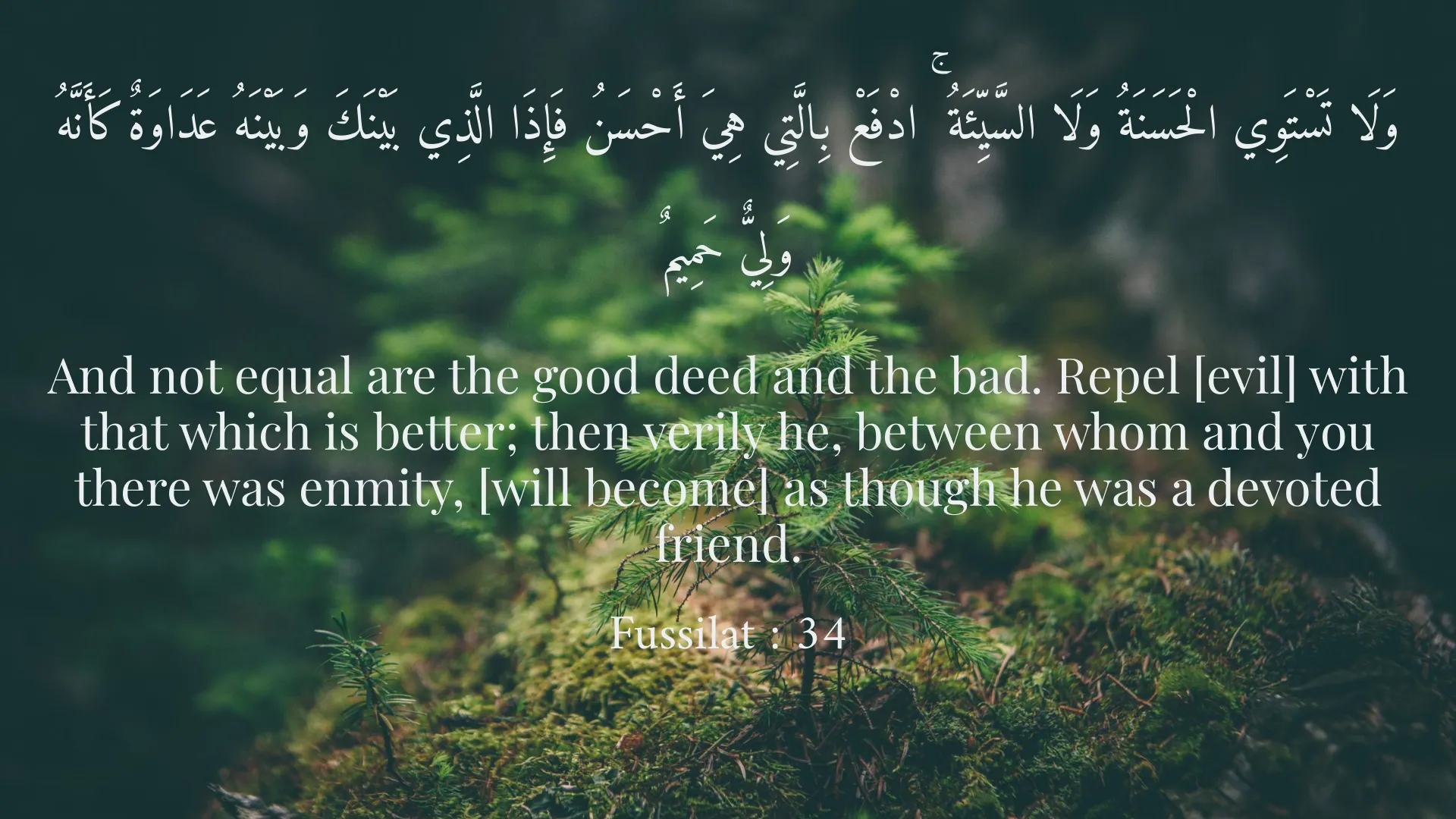
Encountering individuals with undesirable or destructive behaviors is a common challenge in our social lives. The Holy Quran, with its profound and wise approach, offers invaluable guidance for navigating such situations. A key point in understanding these guidelines is that the Quran focuses less on labeling individuals and more on the nature of our behavior and reactions to their actions. This approach helps us maintain control over our responses and prevents others' negativity from disturbing our inner peace and disrupting the tranquility of our lives. In essence, the Quran teaches us how to leverage these challenges as opportunities for our spiritual growth and elevation, opting for a more constructive and spiritual path instead of merely retaliating. The first and perhaps most significant principle taught by the Quran in this regard is the concept of 'repelling evil with good.' In Surah Fussilat, verse 34, Allah says: "And not equal are the good deed and the bad. Repel [evil] with that which is better; then verily he, between whom and you there was enmity, [will become] as though he was a devoted friend." This verse presents a powerful and transformative strategy. 'That which is better' here does not merely mean refraining from retaliation but responding with kindness, forgiveness, patience, and even prayers for the person. Suppose someone treats you poorly or says something unpleasant. Your response could be dignified silence, a gentle smile, or even an attempt to understand the root of their behavior. This approach can not only surprise the other person, prompting them to reflect, but more importantly, it prevents your heart from being contaminated by resentment and hatred, aiding you in the purification of your soul. This method is effective not only for changing others' behavior but also for protecting our own soul and psyche from negative and toxic energies that might emanate from these individuals. Sometimes, the best response is dignified silence and turning away gracefully, because engaging in every idle talk only leads to a waste of energy, a disturbance of one's mental space, and a loss of peace. The second principle is the importance of patience (sabr) and forgiveness (afw). The Quran repeatedly calls believers to patience in the face of hardship and forgiveness for others' mistakes. In Surah Al-A'raf, verse 199, we read: "Show forgiveness, enjoin what is good, and turn away from the ignorant." This verse presents three crucial directives together: 'afw (forgiveness), enjoining what is good, and turning away from the ignorant. Forgiveness is a liberating force that frees us from the burden of resentment and revenge, enabling us to escape the prison of negative emotions. This forgiveness does not necessarily mean complete forgetfulness or repeating negative experiences but releasing the anger and distress that consume our hearts and hinder our progress. Patience is the ability to endure adversity and maintain inner tranquility. When dealing with a difficult person, patience helps you avoid reacting impulsively and allows time for conditions to improve or for a suitable solution to emerge. This patience is not passivity or weakness, but an active and conscious resistance against the urge to retaliate or sink into anger and sorrow, which in turn empowers you internally. The third Quranic guidance is to avoid idle gatherings and turn away from the ignorant. In Surah Al-Furqan, verse 63, in describing 'Ibad-ur-Rahman' (the special servants of the Most Merciful), it states: "And the servants of the Most Merciful are those who walk upon the earth easily, and when the ignorant address them [with ill-spoken words], they say, 'Peace.'" This verse teaches us that we do not need to participate in every useless argument or respond to every insult. Sometimes, the best reaction is no reaction, maintaining one's self-dignity. 'Saying 'Peace'' here means ending the interaction respectfully and avoiding engagement in a fruitless quarrel that only wastes your time and energy. This does not mean shying away from social responsibilities or remaining silent in the face of injustice; rather, it means avoiding personal and futile disputes that only lead to wasted time and energy and the creation of animosity. The goal is to consciously distance ourselves from environments and relationships that harm our spirit and faith, and instead, dedicate our time and energy to constructive relationships and more spiritual environments. Fourthly, the Quran emphasizes wisdom and good counsel (Maw'izah Hasana) in enjoining good and deterring evil. Even when confronting Pharaoh, who symbolized tyranny, Allah instructed Moses and Aaron (peace be upon them) to speak to him with "gentle words" (Surah Taha: 44). This indicates that even the most stubborn individuals should initially be approached with gentleness and logic. Although this verse concerns inviting to faith, its principles apply to any interaction: striving for a positive impact using kind words and wise, appealing methods. This approach reminds us that even in the toughest situations, one can open a path for justice by maintaining decorum and logic. Ultimately, the Quran reminds us that our primary focus should be on reforming ourselves and fulfilling our duties towards Allah. We cannot change everyone or control every situation, but we can control our reactions and our inner state. Dealing with difficult individuals is an opportunity to practice patience, forbearance, forgiveness, and reliance on Allah. This approach helps us, even in the face of negative behaviors, to become a source of inner peace and strength, which originates from faith and reliance on Allah, instead of sinking into anger and despair. Let us remember that the main goal is to preserve our spiritual and mental well-being, and the Quran provides solutions that assist us on this path, without forcing us to expend energy on futile conflicts or allowing others' negativity to overcome the good within us. With this perspective, even seemingly 'bad' people can become teachers for our spiritual growth and help us on the path to perfection.
Related Verses
وَلَا تَسْتَوِي الْحَسَنَةُ وَلَا السَّيِّئَةُ ۚ ادْفَعْ بِالَّتِي هِيَ أَحْسَنُ فَإِذَا الَّذِي بَيْنَكَ وَبَيْنَهُ عَدَاوَةٌ كَأَنَّهُ وَلِيٌّ حَمِيمٌ
And not equal are the good deed and the bad. Repel [evil] with that which is better; then verily he, between whom and you there was enmity, [will become] as though he was a devoted friend.
Fussilat : 34
خُذِ الْعَفْوَ وَأْمُرْ بِالْعُرْفِ وَأَعْرِضْ عَنِ الْجَاهِلِينَ
Show forgiveness, enjoin what is good, and turn away from the ignorant.
Al-A'raf : 199
وَعِبَادُ الرَّحْمَٰنِ الَّذِينَ يَمْشُونَ عَلَى الْأَرْضِ هَوْنًا وَإِذَا خَاطَبَهُمُ الْجَاهِلُونَ قَالُوا سَلَامًا
And the servants of the Most Merciful are those who walk upon the earth easily, and when the ignorant address them [with ill-spoken words], they say, 'Peace.'
Al-Furqan : 63
Short Story
In Saadi's Gulistan, it is related that a certain king saw a man verbally abusing him with harsh words. The king became enraged and ordered him to be punished. However, a wise vizier present there said to the king: "O King, if someone throws a stone at you, give them a flower. For a flower has a sweet fragrance that a stone never has, and it softens the heart." The king was pleased with this wise counsel and said, "You speak truly. Responding to ill-treatment with kindness is better." So, he pardoned the man. This story teaches us that the best way to confront evil is to respond with goodness and forbearance, for this approach not only softens hearts but also brings peace and magnanimity to ourselves.