Quranic Answer
In the rich teachings of the Holy Quran and the Sunnah of Prophet Muhammad (peace be upon him), the concept of anger is meticulously examined. While the precise term 'holy anger' (or 'sacred wrath') is not explicitly used for human emotions in its common interpretation, Quranic principles offer a clear framework to distinguish between anger rooted in truth and justice and personal anger driven by ego and self-interest. The Quran repeatedly urges believers to control their anger, suppress their rage, and practice forgiveness and pardon. At the same time, it mentions the wrath of Allah upon wrongdoers and disbelievers, indicating the existence of a righteous wrath within the cosmic order, stemming from wisdom and justice. The distinction between these two types of anger lies in their intention, source, objective, and consequences. Personal Anger (Blameworthy and Self-Driven): Personal anger is that form of wrath that originates from selfish desires, pride, vengefulness, jealousy, self-interest, or the loss of personal benefits. This anger is often sudden, irrational, and uncontrolled, potentially leading to harsh words, violent actions, severed relationships, and deep regrets. In the Quran and Islamic traditions, believers are strongly cautioned against this type of anger. Allah praises those who suppress their anger (Al-Kaazimeena Al-Ghayth) and pardon people's faults. This advice not only contributes to individual and social peace but also signifies the pinnacle of piety and self-mastery. Personal anger blinds one's vision and deviates them from the path of justice and fairness. This type of anger is a fruit of weak faith and lack of control over one's inner faculties, pushing an individual towards oppression and injustice, even if they initially perceive themselves to be in the right. Many familial disputes, social conflicts, and ill-advised decisions stem from this uncontrolled anger. The Quran explicitly states that Satan gains control over humans through this type of anger, leading them to sin. Therefore, striving to control personal anger is considered a significant part of the 'greater jihad' (jihad al-akbar) and self-purification in Islam. It is a continuous battle against the lower self, seeking to align one's emotions with divine guidance rather than fleeting impulses. Righteous Indignation or Divine Wrath (Related to Holy Anger): This type of anger, in contrast to personal anger, is rooted in the defense of truth, justice, God's religion, confronting oppression and corruption, and supporting the oppressed. This anger does not arise from personal gain but from religious zeal (ghirah), deep faith, and love for Allah. The Holy Quran speaks of Allah's wrath upon those who disbelieve, oppress, break covenants, and spread corruption. This Divine wrath is a sign of His absolute justice, serving to establish order and repel evil. Similarly, when a believer experiences a fervent zeal for God's religion, the rights of the oppressed, or divine values, leading to protest, confrontation of injustice, and struggle in the way of Allah (within legal Islamic frameworks), it can be considered a form of righteous indignation. This anger differs fundamentally from personal and ego-driven anger: 1. Source and Motivation: The source of personal anger is the commanding self (nafs al-ammara) and selfishness, whereas righteous indignation originates from piety, faith, love for God, and the pursuit of justice. The motivation in righteous indignation is to gain Allah's pleasure and uphold His word, not personal benefit or revenge. It is an altruistic emotion, driven by a desire for good to prevail. 2. Objective: The objective of personal anger is often retaliation, emotional venting, or self-assertion. However, in righteous indignation, the objective is to eliminate oppression, defend truth, rectify affairs, or prevent corruption. This anger is constructive, not destructive. It aims for a positive change or correction, even if it involves severity. 3. Control and Restraint: The most crucial difference is that personal anger is uncontrollable and leads an individual astray; however, righteous indignation, despite its intensity, remains under the control of intellect and Islamic law. A believing individual, even at the peak of zeal and anger for Allah, never oversteps the boundaries of religious law and reason, and does not commit injustice. They understand that even in the most severe reactions, they must be just and not transgress limits. Prophets, too, when faced with the disobedience of their people, would become angry, but this anger was accompanied by wisdom, patience, and efforts toward guidance. Their anger was a means to an end, not an end in itself. 4. Outcome and Consequence: Personal anger leads to regret, broken relationships, and sin. But righteous indignation, when accompanied by control and wisdom, can lead to societal reform, the establishment of justice, and the aid of the oppressed, thereby earning divine pleasure. It fosters positive outcomes, even if challenging. Practical Tips for Distinction and Management: To distinguish these two types of anger in daily life, one must constantly examine their intention and objective: Is this anger for myself, my pride, or my worldly interests? Or is it for defending the truth, confronting oppression, or helping the oppressed, where, in the name of God and justice, I feel a response is necessary? If the anger is for oneself, it must be suppressed with all one's might, one must find peace through the remembrance of Allah, and reflect on the reward for restraining anger. However, if the anger stems from religious zeal and a desire for justice, it must be expressed in a controlled, wise manner, within the bounds of Islamic law and reason, so that it leads to reform and good, rather than corruption and ruin. The Quran teaches us that even hatred for a people should not prevent us from being just. This is the ultimate level of control and spiritual maturity, to uphold fairness even against an enemy. Ultimately, true strength lies not in the eruption of anger, but in mastering it. The true believer is one who channels their anger for the sake of Allah and uses it for righteous causes, not wasting it on personal desires and whims. This Quranic insight helps us understand the fine line between constructive and destructive anger, enabling us to progress on our spiritual journey. Controlling personal anger is a great jihad itself, bringing one closer to the status of Allah's beloved servants, while anger for truth and justice, though seemingly intense, originates from faith and wisdom and leads to good and righteousness. This distinction is the main key to understanding and properly managing this powerful force within the human being. The ultimate goal is to achieve inner and outer peace, which is only possible by adhering to Quranic principles regarding emotional management.
Related Verses
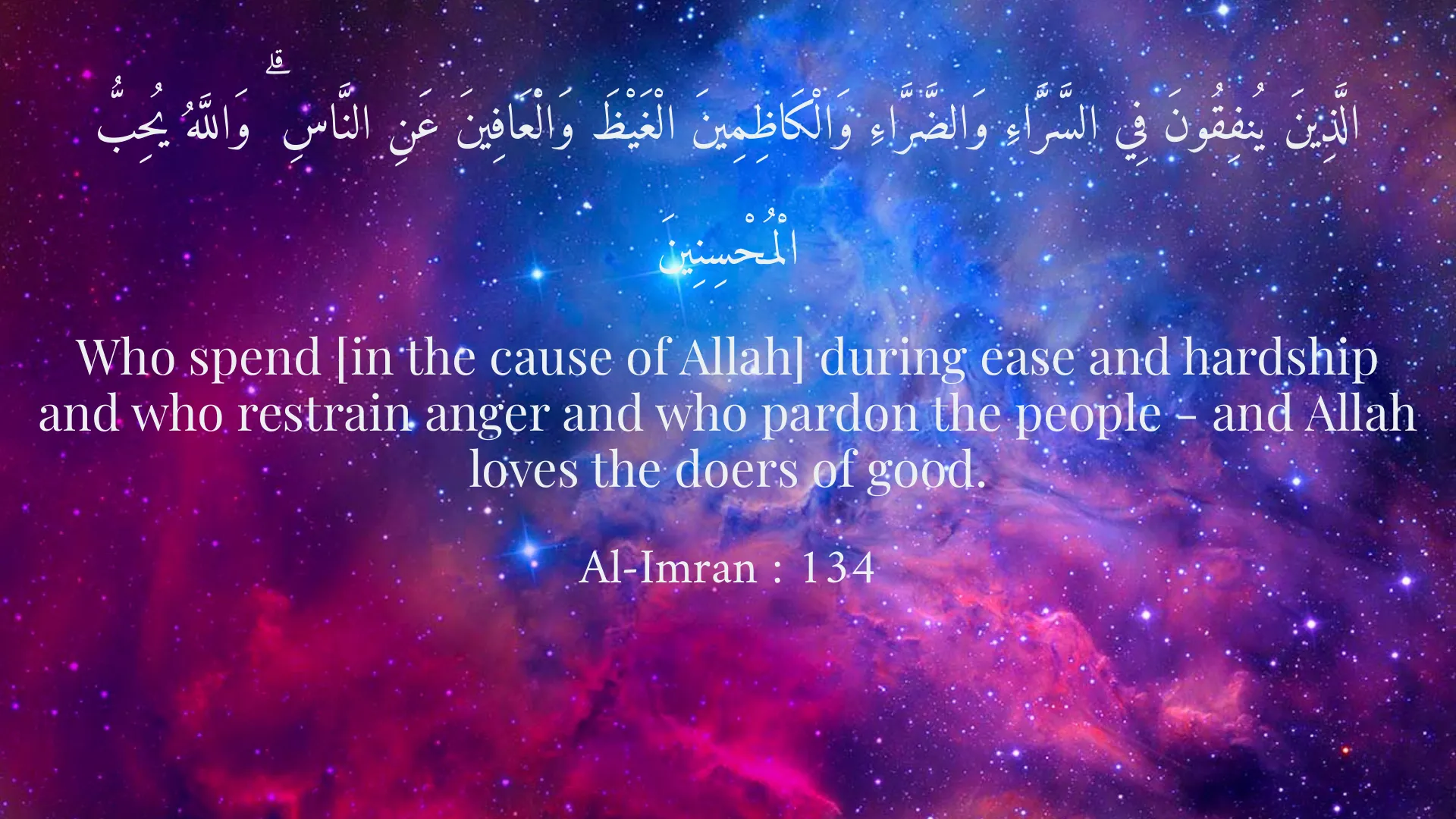
الَّذِينَ يُنفِقُونَ فِي السَّرَّاءِ وَالضَّرَّاءِ وَالْكَاظِمِينَ الْغَيْظَ وَالْعَافِينَ عَنِ النَّاسِ ۗ وَاللَّهُ يُحِبُّ الْمُحْسِنِينَ
Who spend [in the cause of Allah] during ease and hardship and who restrain anger and who pardon the people - and Allah loves the doers of good.
Al-Imran : 134
يَا أَيُّهَا الَّذِينَ آمَنُوا كُونُوا قَوَّامِينَ لِلَّهِ شُهَدَاءَ بِالْقِسْطِ ۖ وَلَا يَجْرِمَنَّكُمْ شَنَآنُ قَوْمٍ عَلَىٰ أَلَّا تَعْدِلُوا ۚ اعْدِلُوا هُوَ أَقْرَبُ لِلتَّقْوَىٰ ۖ وَاتَّقُوا اللَّهَ ۚ إِنَّ اللَّهَ خَبِيرٌ بِمَا تَعْمَلُونَ
O you who have believed, be persistently standing firm for Allah, witnesses in justice, and do not let the hatred of a people prevent you from being just. Be just; that is nearer to righteousness. And fear Allah; indeed, Allah is Acquainted with what you do.
Al-Ma'idah : 8
وَلَمَن صَبَرَ وَغَفَرَ إِنَّ ذَٰلِكَ لَمِنْ عَزْمِ الْأُمُورِ
But whoever is patient and forgives - indeed, that is of the matters [requiring] determination.
Ash-Shura : 43
Short Story
It is narrated that a king, consumed by wrath, commanded the execution of a minister. A wise man present there gently remarked: 'O King of the World, know that anger is a spark of hellfire that, when ignited in the heart, blinds the eyes and shrouds the intellect. Whoever makes a decision in the heat of anger will surely be followed by regret.' The king, hearing the wise man's profound words, paused for a moment and felt remorse for his action. He pardoned the minister and said: 'This momentary anger almost led me to eternal ruin. Truly, controlling one's anger is a sign of true sovereignty.'