Quranic Answer
My dear friend, establishing healthy boundaries in human relationships – be they with family, friends, colleagues, or within the broader community – is a fundamental cornerstone for a tranquil life filled with mutual respect. The Holy Quran, this divine guiding book, offers comprehensive and profound strategies for regulating relationships and preserving human rights and dignity. These strategies help us create boundaries that are firm yet flexible in our interactions. Such boundaries not only benefit the individual who upholds them but also significantly contribute to the stability, intimacy, and health of relationships. Quranic boundaries are not walls that separate people; rather, they are sacred fences that protect relationships from harm, misunderstandings, and transgressions of mutual rights, fostering the spiritual and moral growth of both parties. The foundation of all healthy relationships in the Quran rests upon "Taqwa" (God-consciousness) and "Tawhid" (monotheism). When a person places God as the central axis of their life and practices piety, they naturally observe certain considerations in their interactions with others that are derived from divine commands. This perspective teaches us that there is always an Observer of our actions, and this awareness prevents us from encroaching upon the rights of others and encourages us to adhere to divine limits. Our primary and ultimate boundary is always defined in relation to the Almighty God; no relationship, no matter how deep and cherished, should ever take God's place in our hearts and minds or cause us to neglect our divine duties. This is the first and most crucial boundary that the Quran draws for us: "No one and nothing should be worshipped or loved more than Allah and His Messenger." This fundamental principle reminds us that even at the peak of affection for others, we must maintain balance and never deviate from the path of servitude and obedience to God. One of the most important aspects of establishing healthy boundaries in relationships is respecting individuals' "privacy." The Quran emphatically stresses that one should not enter others' private spaces without permission and knowledge. In Surah An-Nur, verse 27, we read: "O you who have believed, do not enter houses other than your own houses until you ask permission and greet their people. That is better for you, perhaps you may be reminded." And in verse 28 of the same surah, it adds: "And if you find no one therein, do not enter them until permission has been given you. And if it is said to you, 'Go back,' then go back; it is purer for you. And Allah is Knowing of what you do." These verses not only emphasize respect for people's physical space but also implicitly refer to respecting their psychological and spiritual space. This means we should not intrude on others' personal affairs, spy on them, or enter their solitude without invitation. This is the basis of trust and security in relationships and demonstrates respect for individuals' autonomy and independence, preventing many disputes and discomforts arising from undue nosiness. Communication and verbal boundaries are also of particular importance. The Quran strongly prohibits "backbiting," "slander," "mockery," and "suspicion." In Surah Al-Hujurat, verses 11 and 12, Allah says: "O you who have believed, let not a people ridicule [another] people; perhaps they may be better than them; nor let women ridicule [other] women; perhaps they may be better than them. And do not insult one another and do not call each other by [offensive] nicknames... O you who have believed, avoid much [negative] assumption. Indeed, some assumption is sin. And do not spy on one another or backbite one another." These verses explicitly set boundaries for our speech and judgment concerning others. Any speech that causes harm to reputation, self-esteem, or a relationship is forbidden. Instead, the Quran advises "Qawlan Sadeeda" (a sound and upright word) and "Qawlan Kareema" (a noble word with respect), which are essential components of a healthy and well-bounded relationship. Choosing appropriate words, refraining from humiliation, and avoiding spreading rumors all contribute to maintaining individual and collective dignity, creating an atmosphere of mutual respect essential for relationships to flourish. In relationships between men and women, the Quran also sets clear boundaries to prevent any misunderstanding, discord, and deviation. The command to "lower gazes" (ghadd al-basar) for both men and women, "appropriate covering" (hijab), and avoiding any actions that lead to "fahisha" (indecency) and "immorality" are among these boundaries. In Surah Al-Isra, verse 32, we read: "And do not approach unlawful sexual intercourse. Indeed, it is ever an immorality and is evil as a way." This verse not only prohibits unlawful sexual intercourse but also forbids "approaching" it, which includes any behavior, gaze, or speech that might pave the way for it. This ruling defines clear boundaries in sexual and emotional relationships outside the framework of marriage to preserve the moral health of society and ensure that marital relationships maintain their sanctity and security. These boundaries are for preserving modesty, chastity, and dignity of both genders, protecting society from moral decay. Respecting mutual rights is also one of the foundations for establishing healthy boundaries. The Quran repeatedly emphasizes the "rights of parents," "rights of children," "rights of spouses," and "rights of neighbors." Each of these rights defines a type of boundary for the parties that should not be transgressed. For instance, in family relationships, despite closeness and affection, respecting individual autonomy and decisions, especially for adult children, is essential. Parents should not, under the pretext of concern, dominate all aspects of their children's lives, and children, in turn, must maintain necessary boundaries with their parents with utmost respect and kindness. In Surah Luqman, verses 14 and 15, while emphasizing kindness to parents, a clear boundary is set: "But if they endeavor to make you associate with Me that of which you have no knowledge, do not obey them but accompany them in [this] world with appropriate kindness." This verse shows that even with the closest individuals, ideological and divine boundaries should not be broken. This means that respect for divine and individual boundaries takes precedence even in the deepest relationships. Finally, "fulfilling covenants" and "upholding trusts" also play a key role in establishing healthy boundaries. When individuals adhere to their promises and do not betray each other's trust, an environment of confidence and security is fostered in relationships. This adherence clarifies expectations and prevents misunderstandings, which in itself is a form of transparent boundary setting in relationships. In Surah Al-Ma'idah, verse 1, Allah says: "O you who have believed, fulfill [all] contracts." This includes all types of agreements, including verbal commitments in relationships, which define the boundaries of responsibility and expectation. This principle clearly shows that transparency and honesty in word and deed are the backbone of healthy and stable relationships, helping each individual to know what is expected of them and what they can expect from others. In summary, the Holy Quran, by providing a comprehensive ethical and legal system, teaches us how to create clear and respectful boundaries in our relationships with others while maintaining intimacy and affection. These boundaries are not for separation and distance, but rather for preserving dignity, mutual respect, preventing harm and abuse, and ultimately for individual and societal growth and elevation. By adhering to these Quranic principles, we can experience deeper, more stable, and more spiritual relationships rooted in divine satisfaction and blessings, leading to peace and prosperity in this world and the hereafter.
Related Verses
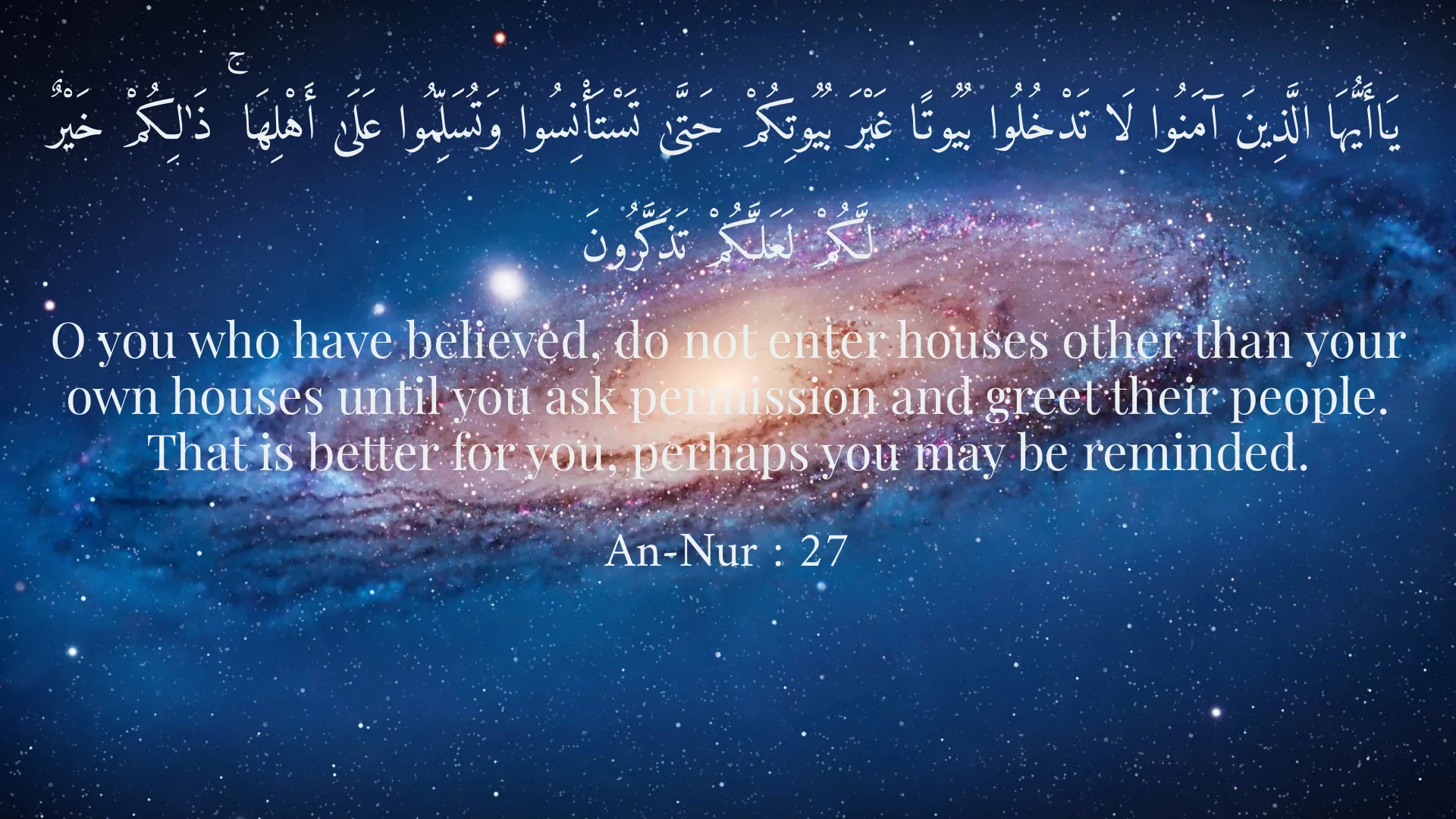
يَاأَيُّهَا الَّذِينَ آمَنُوا لَا تَدْخُلُوا بُيُوتًا غَيْرَ بُيُوتِكُمْ حَتَّىٰ تَسْتَأْنِسُوا وَتُسَلِّمُوا عَلَىٰ أَهْلِهَا ۚ ذَٰلِكُمْ خَيْرٌ لَّكُمْ لَعَلَّكُمْ تَذَكَّرُونَ
O you who have believed, do not enter houses other than your own houses until you ask permission and greet their people. That is better for you, perhaps you may be reminded.
An-Nur : 27
يَا أَيُّهَا الَّذِينَ آمَنُوا لَا يَسْخَرْ قَوْمٌ مِّن قَوْمٍ عَسَىٰ أَن يَكُونُوا خَيْرًا مِّنْهُمْ وَلَا نِسَاءٌ مِّن نِّسَاءٍ عَسَىٰ أَن يَكُنَّ خَيْرًا مِّنْهُنَّ ۖ وَلَا تَلْمِزُوا أَنفُسَكُمْ وَلَا تَنَابَزُوا بِالْأَلْقَابِ ۖ بِئْسَ الِاسْمُ الْفُسُوقُ بَعْدَ الْإِيمَانِ ۚ وَمَن لَّمْ يَتُبْ فَأُولَٰئِكَ هُمُ الظَّالِمُونَ
O you who have believed, let not a people ridicule [another] people; perhaps they may be better than them; nor let women ridicule [other] women; perhaps they may be better than them. And do not insult one another and do not call each other by [offensive] nicknames. Wretched is the name of disobedience after [one's] faith. And whoever does not repent - then it is those who are the wrongdoers.
Al-Hujurat : 11
وَلَا تَقْرَبُوا الزِّنَىٰ ۖ إِنَّهُ كَانَ فَاحِشَةً وَسَاءَ سَبِيلًا
And do not approach unlawful sexual intercourse. Indeed, it is ever an immorality and is evil as a way.
Al-Isra : 32
Short Story
It is narrated in Sa'di's Bustan that a wise man advised a novice youth: "If you desire esteem and respect among people, do not come so close that they take you lightly, nor go so far that you vanish from their hearts." This anecdote beautifully illustrates that setting boundaries in relationships is not about distance or indifference, but about maintaining balance and dignity. One must keep a reasonable distance to preserve both intimacy and respect, just like sunlight which burns if we get too close and offers no benefit if we are too far. So, in your relationships, observe this moderation to be both loved and respected.