Quranic Answer
The question "How to forgive but not forget?" touches upon a profound human dilemma rooted in painful experiences and heartbreaks. In the sublime teachings of the Holy Quran, this topic is addressed with a wise and comprehensive approach. Islam calls us to forgive, but not a forgiveness born of heedlessness or indifference. Rather, it is a conscious and powerful forgiveness that leads to spiritual liberation and peace of heart, while simultaneously learning valuable lessons from past experiences and retaining them for the future. This balance is the essence of Quranic wisdom in navigating the challenges of human relationships, demonstrating that one can achieve tranquility while acting prudently to avoid falling into past traps. Forgiveness in the Quranic Perspective: Individual and Societal Liberation and Salvation The Holy Quran repeatedly emphasizes the virtue of forgiveness (afw) and overlooking (safh). Forgiveness is not merely a sign of magnanimity and strength of character; it is also a path to emulate divine attributes. Allah Almighty Himself is "Al-Ghafour" (The Forgiving) and "Ar-Rahim" (The Merciful), and He calls upon His servants to embody divine characteristics. In Surah An-Nur, verse 22, Allah explicitly states: "And let them pardon and overlook. Would you not like that Allah should forgive you? And Allah is Forgiving and Merciful." This verse clearly indicates that forgiving others is not only a moral act but also a means to attain divine forgiveness. It is a divine transaction: the more forgiving we are towards others, the more we can hope for Allah's forgiveness for us and for our sins to be pardoned. This divine recommendation serves as a foundation for building a society based on mercy and empathy, where individuals, instead of harboring grudges, move towards reconciliation and compromise. From the Quranic perspective, forgiveness means letting go of the heavy burden of resentment, anger, and hatred that wears down the human soul and spirit. Holding onto grudges is akin to drinking poison and expecting the other person to die; this not only fails to harm the other person but, more importantly, harms the grudge-holder first. Forgiveness, in essence, is a great kindness one bestows upon oneself. This act allows negative energies to depart from one's being, making way for tranquility, peace, and positive thinking. When we forgive, we liberate ourselves from the prison of the past and the captivity of pain and suffering. This freedom empowers individuals to continue life with renewed spirit and overcome challenges. Forgiveness does not mean condoning the wrongdoing, but rather relinquishing the desire for retaliation; it means entrusting the wrongdoer's judgment to Allah and freeing oneself from the burden of retribution. Surah Ash-Shura, verse 40, states: "The recompense for an evil deed is an evil deed the like thereof; but whoever pardons and makes reconciliation - his reward is [due] from Allah. Indeed, He does not like wrongdoers." This verse also emphasizes the immense reward for forgiveness from Allah, showing how valuable this act is in the sight of the Almighty and how it contributes to peace and reconciliation in society. The Meaning of "Not Forgetting" from a Quranic Viewpoint: Wisdom, Insight, and Learning Lessons However, the second part of the question, "not forgetting," by no means implies holding onto grudges, constantly replaying past pains, or reliving painful memories with the aim of revenge. From a Quranic perspective, "not forgetting" means "taking a lesson" (ibrat) and "learning" from past experiences. The Quran repeatedly recounts stories of past nations and historical events so that people may draw lessons from them and avoid a similar fate. For instance, in Surah Yusuf, verse 111, we read: "There was certainly in their stories a lesson for those of understanding." This indicates that Allah desires us to learn from events, rather than consigning them to oblivion and repeating the same mistakes and adverse consequences. "Not forgetting" in this sense means developing insight, vigilance, and wisdom (hikmah). By analyzing unpleasant occurrences, one better understands one's own weaknesses and those of others. This understanding helps one act more cautiously in the future, establish healthy boundaries in relationships, and prevent the recurrence of similar mistakes. This memory is not a memory of pain, suffering, or hatred, but rather a memory of lessons and insight. For example, if someone has been harmed due to misplaced trust in a person, forgiving that person does not mean trusting them with the same naivety again or repeating the harmful situation. Rather, it means freeing one's heart from the burden of resentment towards them, while one's mind has registered this experience as a profound lesson to act with greater caution and awareness when encountering similar individuals or situations in the future. This approach saves a person from heedlessness and naivety. Wisdom dictates that we learn something from every experience, whether bitter or sweet, gradually becoming a more mature and knowledgeable person. The Prophet Muhammad (PBUH) said: "The believer is astute, intelligent, and cautious." This noble Hadith perfectly aligns with the concept of "not forgetting for the sake of drawing lessons." A Muslim should be vigilant, analyze events, and use them to improve their individual and social life, preventing the repetition of harmful patterns in their relationships. Combining Forgiveness and Not Forgetting: A Path to Perfection and Spiritual Growth As explained, forgiveness and not forgetting are not contradictory; rather, they are complementary and pave the way for true growth. Forgiveness belongs to the heart and soul, purifying them from the defilements of resentment and creating space for inner peace. Not forgetting pertains to the mind and intellect, inoculating it against the repetition of mistakes and falling into harmful situations. This balance allows a person to achieve both inner peace and intellectual and practical growth. When we forgive, a door to freedom and liberation opens. That bitter experience no longer consumes our energy or occupies our minds. Instead, by recalling the lessons from that event, we can build a better future and healthier relationships for ourselves. This approach demonstrates the strength of one's character; someone who can forgive and be free from negative emotions, yet learn from their experience and prevent themselves from being exploited again or falling into a similar trap. This power not only protects them from further harm but also enables them to build bridges of growth and perfection from bitter experiences. Practical Steps to Achieve Forgiveness and Not Forgetting: 1. Acknowledge and Accept the Pain: The first step is to genuinely acknowledge and accept the pain you have experienced. Denying or suppressing emotions prevents true and deep forgiveness. Allow yourself to understand your feelings. 2. Entrust Matters to Allah: In Islam, believers are encouraged to seek refuge in Allah during hardships. By entrusting matters to Allah and relying on Him, a heavy burden is lifted, and inner peace is attained. Prayer and supplication to the Almighty can be very helpful in this process and provide the necessary inner strength for forgiveness. 3. Consciously Choose Forgiveness: Forgiveness is a conscious decision, not merely an emotion that arises spontaneously. This means you consciously choose to release the burden of resentment and hatred, even if your feelings have not fully healed. This choice initiates the healing process. 4. Analyze and Learn Lessons: After deciding to forgive, it is time to calmly analyze the incident. What led to this event? What weaknesses were present in you or the other party? What could you have done differently? This analysis is crucial for extracting future lessons and helps you understand patterns of events. 5. Set Healthy Boundaries: Based on the lessons learned, establish new boundaries in your relationships. These boundaries will serve as a safeguard against potential future harm and help you establish healthier and safer relationships. 6. Focus on Growth and the Future: Direct your energy towards personal growth, positive goals, and building a better future, instead of dwelling on the past and harboring resentment. This helps you move from being a victim to becoming a powerful individual who shapes their future. Conclusion: From the Quranic perspective, forgiveness is not only a moral virtue but also a spiritual and psychological necessity that liberates individuals from the past, granting them peace and strength. "Not forgetting," in turn, signifies vigilance, drawing lessons, and utilizing experiences to build a safer and wiser future. These two concepts, hand in hand, guide us toward a spiritual and fulfilling life, rich in inner peace and insight. With this approach, a person will be able to learn from their past without carrying the burden of resentment, and step towards the future with clear vision. This is the Quranic wisdom that leads humanity towards perfection and prosperity, bringing forth a balanced and blessed life.
Related Verses
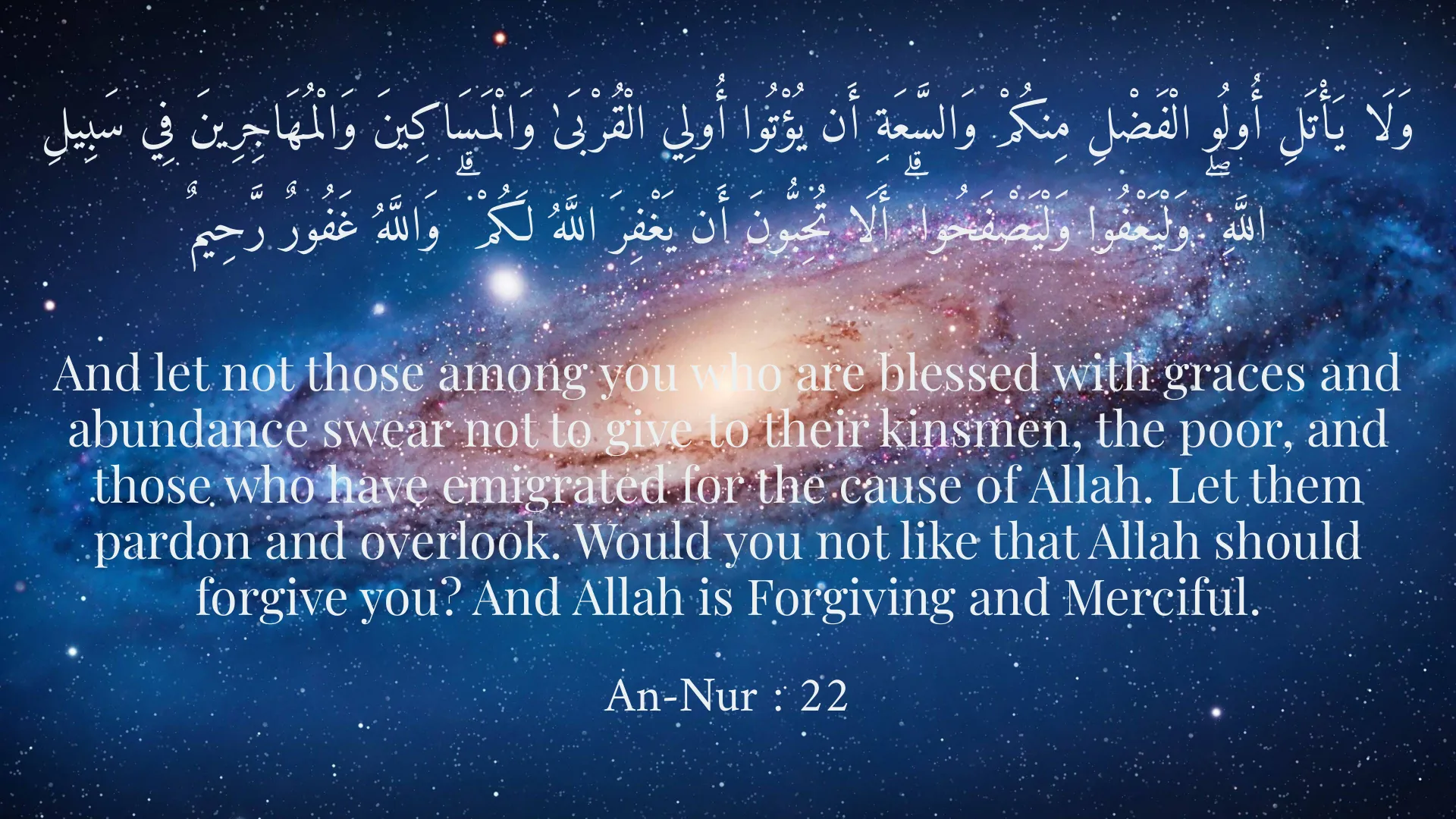
وَلَا يَأْتَلِ أُولُو الْفَضْلِ مِنكُمْ وَالسَّعَةِ أَن يُؤْتُوا أُولِي الْقُرْبَىٰ وَالْمَسَاكِينَ وَالْمُهَاجِرِينَ فِي سَبِيلِ اللَّهِ ۖ وَلْيَعْفُوا وَلْيَصْفَحُوا ۗ أَلَا تُحِبُّونَ أَن يَغْفِرَ اللَّهُ لَكُمْ ۗ وَاللَّهُ غَفُورٌ رَّحِيمٌ
And let not those among you who are blessed with graces and abundance swear not to give to their kinsmen, the poor, and those who have emigrated for the cause of Allah. Let them pardon and overlook. Would you not like that Allah should forgive you? And Allah is Forgiving and Merciful.
An-Nur : 22
وَجَزَاءُ سَيِّئَةٍ سَيِّئَةٌ مِّثْلُهَا ۖ فَمَن عَفَا وَأَصْلَحَ فَأَجْرُهُ عَلَى اللَّهِ ۚ إِنَّهُ لَا يُحِبُّ الظَّالِمِينَ
The recompense for an evil deed is an evil deed the like thereof; but whoever pardons and makes reconciliation - his reward is [due] from Allah. Indeed, He does not like wrongdoers.
Ash-Shura : 40
خُذِ الْعَفْوَ وَأْمُرْ بِالْعُرْفِ وَأَعْرِضْ عَنِ الْجَاهِلِينَ
Take what is given freely, enjoin what is good, and turn away from the ignorant.
Al-A'raf : 199
لَقَدْ كَانَ فِي قَصَصِهِمْ عِبْرَةٌ لِّأُولِي الْأَلْبَابِ ۗ مَا كَانَ حَدِيثًا يُفْتَرَىٰ وَلَٰكِن تَصْدِيقَ الَّذِي بَيْنَ يَدَيْهِ وَتَفْصِيلَ كُلِّ شَيْءٍ وَهُدًى وَرَحْمَةً لِّقَوْمٍ يُؤْمِنُونَ
There was certainly in their stories a lesson for those of understanding. Never was it a narration invented, but [it is] a confirmation of what was before it and a detailed explanation of all things and guidance and mercy for a people who believe.
Yusuf : 111
Short Story
It is said that a wise man was traveling in a city. On his way, a person harassed him and spoke unpleasant words. The wise man's disciples became angry and wanted to confront that person. The wise man smiled and said: 'My good men, a verbal wound is no less than a sword wound; but a sword rends the body, and a tongue, the soul. I forgave him, for forgiveness is the peace of my heart and lifts a heavy burden from my shoulders.' The disciples asked: 'Will you forget this ugly speech?' The wise man replied: 'I forgave him, but I learned a lesson from his action. This incident made me aware that not everyone is worthy of companionship, and I must be more vigilant in choosing my friends and companions. Thoughtless forgetting is throwing oneself back into the trap of error, but remembering with wisdom is taking heed for the future.' The disciples learned a great lesson from this wise saying.