Quranic Answer
In the Holy Quran, a profound emphasis is placed on the virtues of compassion, forgiveness, and the purification of the heart from negative emotions such as hatred and enmity. These themes resonate throughout various verses, illustrating a clear roadmap for believers to cleanse their hearts from malice and embrace love and understanding. This article will explore these Quranic teachings, focusing on the significance of forgiveness and patience in the journey toward a purified heart. One of the significant verses that encapsulate the essence of forgiveness is found in Surah An-Nur, verse 22, which states: 'And let not those of you who possess wealth and abundance swear not to give to their relatives and the needy and the emigrants in the cause of Allah. And let them pardon and overlook. Would you not love that Allah should forgive you? And Allah is Forgiving and Merciful.' In this verse, Allah clearly indicates that those who are blessed with wealth should not allow the grudges they hold to come in the way of fulfilling their social and moral responsibilities. The core message here is the need to pardon others as a prerequisite for receiving pardon from the Almighty. This underscores the reciprocal nature of forgiveness in Islam, where believers are encouraged to act as channels of mercy in their communities. Forgiveness in Islam is not merely an act of dismissing grievances but also a profound emotional cleansing that facilitates personal growth and healing. Holding onto resentment can poison one’s heart, leading to emotional burdens that hinder the ability to develop a loving and kind disposition. The act of forgiving is thus portrayed as a means of liberating oneself from the shackles of past grievances, enabling individuals to foster a spirit of generosity, empathy, and understanding. Another verse that speaks volumes about the characteristics of the righteous is Surah Al-Imran, verse 134, which highlights: 'And those who spend in the cause of Allah in ease and hardship and who restrain anger and who pardon the people; and Allah loves the doers of good.' This verse presents a composite picture of a believer's character marked by altruism, patience, and forgiveness. It shows that true believers do not only act kindly during favorable circumstances but also exhibit strength and restraint in times of hardship. Restraint of anger is a significant aspect of achieving a purified heart. Islam teaches that anger, when unchecked, can lead to negative actions and thoughts that further corrupt the heart. The teachings of the Prophet Muhammad (peace be upon him) beautifully complement this notion. He illustrated that the strong person is not the one who overpowers others in moments of fury, but rather the one who controls their anger and finds peaceful resolutions in conflicts. This aligns seamlessly with the Quranic exhortation on forgiving and overlooking, encouraging believers to approach interpersonal encounters with compassion and patience. Moreover, the act of spending in the cause of Allah, elaborated in Surah Al-Baqarah, verse 261, states: 'The example of those who spend their wealth in the way of Allah is like a seed that produces seven ears, in every ear there is a hundred grains. And Allah multiplies [His reward] for whom He wills.' Here, Allah draws a beautiful analogy to depict the manifold rewards of good deeds, which also serve to purify the heart. Engaging in charitable actions not only uplifts those in need but also fosters a sense of community and belonging among individuals, healing the wounds of enmity and hatred. When individuals actively contribute to the betterment of society, it naturally nurtures feelings of love and compassion, which are vital for a pure heart. The importance of focusing on the good in others cannot be understated in the quest for a clean heart. Negative feelings often stem from a singular focus on perceived faults and wrongdoings. By choosing to accentuate the positive qualities in others, believers can cultivate an atmosphere conducive to harmony and peace. The Quran encourages a mindset of kindness and recognizing the humanity in others, even when faced with challenges. Practicing gratitude and acknowledging the virtues of those around us allows us to rise above negative feelings and build bridges instead of walls. Furthermore, the practice of remembering Allah plays a central role in purifying the heart. Engaging in daily prayers, reciting Quranic verses, and reflecting on the attributes of Allah serves to remind believers of His mercy, compassion, and ever-forgiving nature. Such reminders act as a guiding light that encourages individuals to internalize these qualities and implement them in their daily lives, thereby distancing themselves from the toxicity of hatred and resentment. In conclusion, the path to purifying the heart of hatred and enmity is beautifully articulated in the Quran through teachings on forgiveness, altruism, and focusing on the positive. The verses discussed reveal the intertwined nature of these concepts, emphasizing that true believers exemplify patience, mercy, and kindness, both towards themselves and others. As we navigate through life's challenges, embracing forgiveness and nurturing the good within us and in those around us will significantly contribute to a heart that is pure and reflective of Allah's divine attributes. Thus, let us strive to embody these values and cultivate an inner peace that radiates through our actions and interactions with the world.
Related Verses
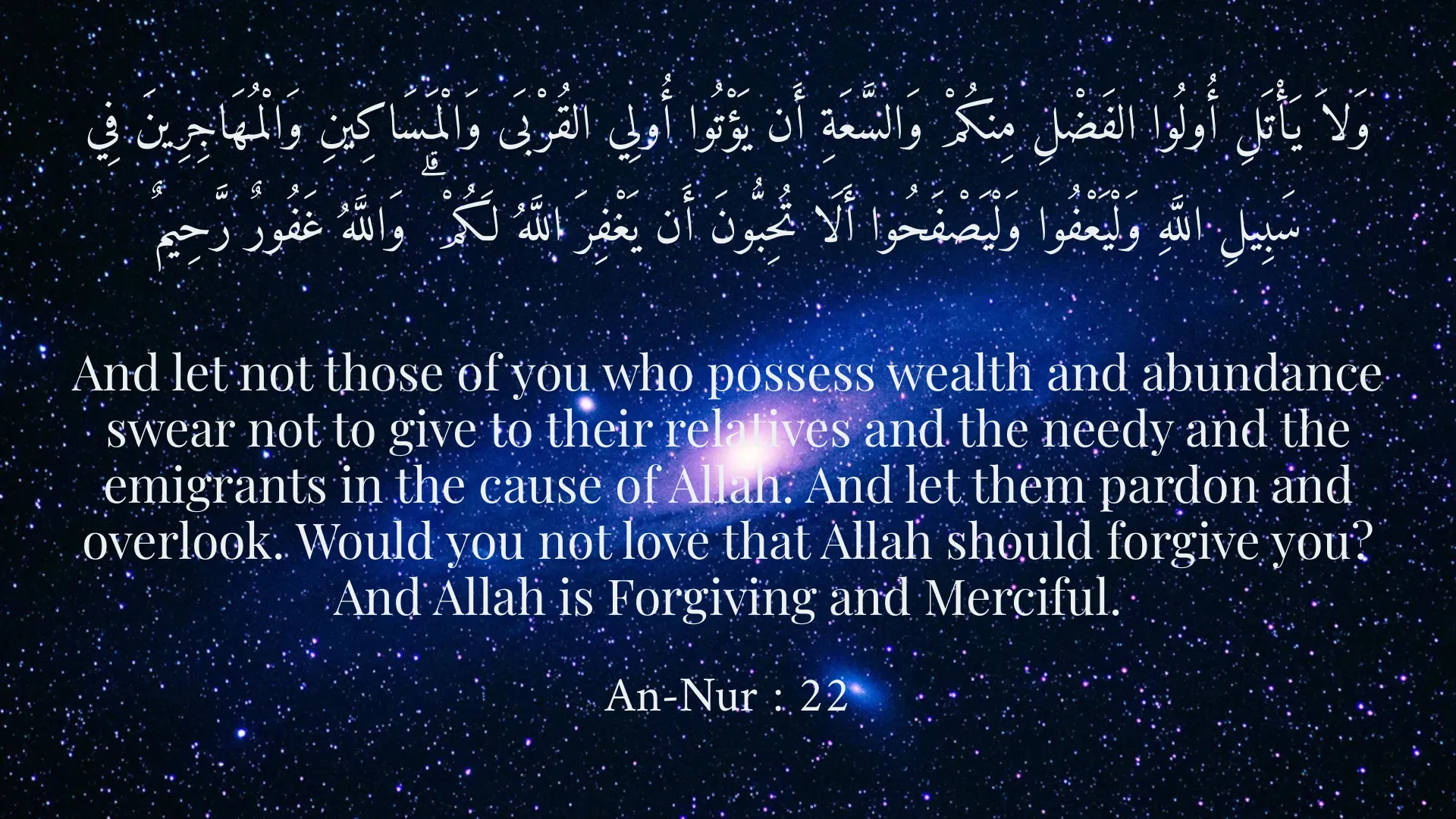
وَلاَ يَأْتَلِ أُولُوا الفَضْلِ مِنكُمْ وَالسَّعَةِ أَن يَؤْتُوا أُولِي القُرْبَى وَالْمَسَاكِينِ وَالْمُهَاجِرِينَ فِي سَبِيلِ اللَّهِ وَلْيَعْفُوا وَلْيَصْفَحُوا أَلَا تُحِبُّونَ أَن يَغْفِرَ اللَّهُ لَكُمْ ۗ وَاللَّهُ غَفُورٌ رَّحِيمٌ
And let not those of you who possess wealth and abundance swear not to give to their relatives and the needy and the emigrants in the cause of Allah. And let them pardon and overlook. Would you not love that Allah should forgive you? And Allah is Forgiving and Merciful.
An-Nur : 22
وَالَّذِينَ يُنفِقُونَ فِي السَّرَّاء وَالضَّرَّاء وَالْكَاظِمِينَ الْغَيْظَ وَالْعَافِينَ عَنِ النَّاسِ ۗ وَاللَّهُ يُحِبُّ الْمُحْسِنِينَ
And those who spend in the cause of Allah in ease and hardship and who restrain anger and who pardon the people; and Allah loves the doers of good.
Al-Imran : 134
مَثَلُ الَّذِينَ يُنفِقُونَ أَمْوَالَهُمْ فِي سَبِيلِ اللَّهِ كَمَثَلِ حَبَّةٍ أَنبَتَتْ سَبْعَ سُنبُلَاتٍ...
The example of those who spend their wealth in the way of Allah is like a seed that produces seven ears...
Al-Baqarah : 261
Short Story
Once there was a man named Hasan who suffered from a grudge he held in his heart. He remembered the verses of the Quran and decided to forgive those who had wronged him. Hasan said to himself, 'Why should I carry the burden of this hatred?' He joined his friends and shared his story with them. His friends encouraged him to cleanse his heart from sorrow and grudges. After some time, Hasan felt lighter and more at peace, realizing that by forgiving, he had also liberated himself.