Quranic Answer
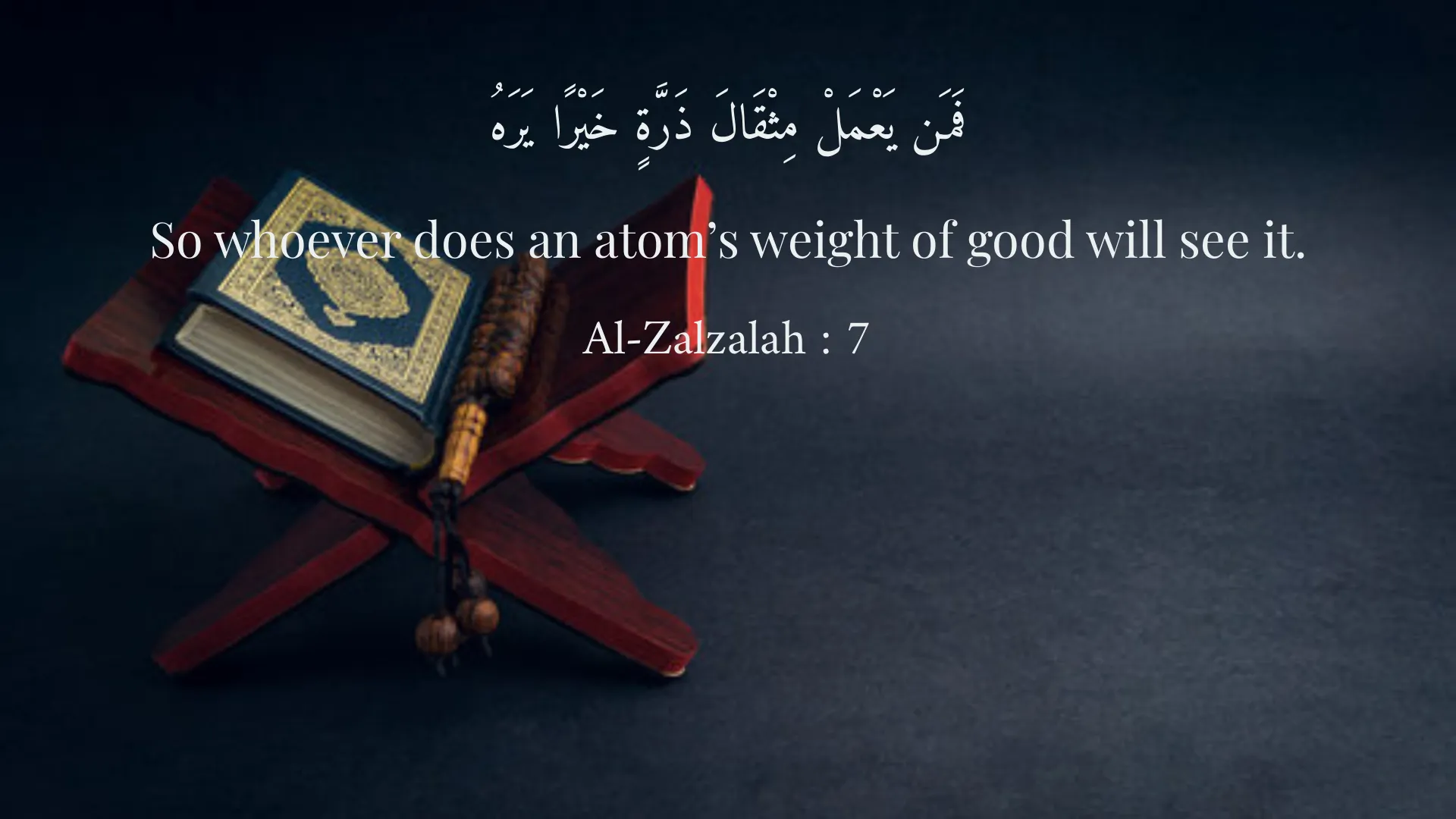
The Holy Quran, the central religious text of Islam, is a rich source of guidance for millions of believers worldwide. Among the various themes that emerge throughout its verses, the value of good deeds and charitable actions stands out prominently. This notion is not only pivotal to Islamic teachings but serves as a guide for ethical behavior in everyday life. Within the Quran, Allah provides numerous admonitions and encouragements concerning the significance of virtuous actions. One such mention can be found in Surah Al-Zalzalah, verse 7, where Allah states, 'So whoever does an atom's weight of good will see it.' This powerful verse encapsulates the idea that every good deed, regardless of its size, is acknowledged and rewarded by Allah. The essence of this verse indicates that even the smallest act of kindness or virtue possesses weight and value in the sight of God, emphasizing that good deeds are not to be measured by their visibility or grandeur. Instead, the Quran teaches us that what truly matters is the intention behind these actions. In a world where social recognition and visible accomplishments often dominate our motivations, it’s essential for individuals, especially Muslims, to internalize the fact that good works have intrinsic value. They are not merely a means to garner social validation or attention from others. Instead, they should arise from a desire to please Allah and contribute positively to the world around us. Moreover, the significance of intention is further highlighted in Surah Al-Baqarah, verse 177. Here, the Quran broadens the definition of righteousness, emphasizing that true righteousness is found in beliefs: faith in Allah, the Last Day, angels, scriptures, and messengers. This verse underscores that the worth of an action is not solely dependent on its visibility but rather on the purity and sincerity behind it. Thus, the Quran compels us to adopt a holistic approach to goodness. It stresses that one can neither claim to be righteous purely based on outward actions nor can one define their worth without considering intention. It is important to differentiate between the intention behind good deeds and their outward effect. For instance, a charitable act performed in public view may generate applause and admiration, but if it's done solely for seeking recognition, its spiritual value diminishes tremendously. In contrast, a silent, unseen act of kindness—like helping a neighbor or donating anonymously—may not attract public recognition but is cherished in the eyes of Allah. Such deeds resonate with sincerity and purity of heart, aligning with the Quranic teaching that emphasizes the importance of genuine intention over external validation. In a practical sense, understanding this principle can revolutionize the way individuals approach good deeds. Many people fall into the trap of performing good actions with the expectation of receiving something in return—whether it's social status, recognition, or even reward from Allah. However, the true test of a believer lies in acting selflessly, without any anticipation of external rewards. This selflessness enriches the spirit and allows for a deeper connection to God. Furthermore, the Quran continually stresses that good deeds are not confined to significant, monumental actions. Acts of kindness can be as simple as a smile, assisting someone in need, or even maintaining patience in challenging situations. This diversity in the classification of good deeds reflects the Quran's understanding of human behavior and the various contexts in which goodness can be exhibited. It encourages individuals to remain vigilant and always on the lookout for opportunities to spread goodness, no matter how small the action might seem. Another important aspect to consider is how the Sunnah—the teachings and practices of the Prophet Muhammad—complements the Quran’s injunctions about good deeds. The Prophet Muhammad exemplified a life dedicated to righteousness, guiding his followers to engage in charitable actions and fostering a spirit of community and compassion. His life serves as a practical demonstration of the ideals highlighted in the Quran, encouraging believers to live out the values of goodwill and altruism. Moreover, the Quran's emphasis on good deeds instills a sense of accountability in believers. The idea that every action, no matter how small, will be observed and compensated lays the groundwork for personal growth. When individuals recognize that their deeds contribute to their overall standing in the sight of Allah, they become more deliberate in their choices and actions. This principle of accountability can serve as a motivator for positive behaviour and can result in significant impact on society as individuals strive to uphold righteousness in their daily lives. In conclusion, the principles laid out in the Holy Quran regarding good deeds hold profound implications for individual behaviour and societal ethics. The persistent message is clear: the significance of our actions lies in our intentions and the sincerity with which we approach them. Each act of kindness, no matter how seemingly insignificant, holds value in the eyes of Allah if performed with a pure heart. Therefore, it is paramount for individuals to cultivate a mindset that appreciates the importance of good deeds—not for visibility or affirmation but for the sake of pleasing Allah. By doing so, they are not only enriching their spiritual lives but also contributing positively to the community and world around them. The essence of goodness in the Quran continues to foster a legacy of altruism and reinforces the timeless understanding that true success is measured by one's character and intentions.
Related Verses
فَمَن يَعْمَلْ مِثْقَالَ ذَرَّةٍ خَيْرًا يَرَهُ
So whoever does an atom’s weight of good will see it.
Al-Zalzalah : 7
لَيْسَ الْبِرَّ أَن تَوَلُّوا وَجُوهَكُمْ قِبَلَ الْمَشْرِقِ وَالْمَغْرِبِ وَلَـٰكِنَّ الْبِرَّ مَن آمَنَ بِاللَّهِ وَالْيَوْمِ الْآخِرِ وَالْمَلَائِكَةِ وَالْكِتَـٰبِ وَالْمُرْسَلِينَ
Righteousness is not that you turn your faces toward the east or the west, but [true] righteousness is in one who believes in Allah, the Last Day, the Angels, the Book, and the Prophets.
Al-Baqarah : 177
Short Story
One day, in a lush garden, an old man was doing a strenuous task. He was quietly planting fruit trees. A few days later, a child saw him and asked, 'Why are you doing this? No one will be there to see these trees.' The old man replied, 'A doer of good is not merely seeking to be seen; instead, he sees the fruit of his labor in his heart. One day, these trees will bear fruit and benefit others.'