Quranic Answer
The Holy Quran, a profound and guiding text for over a billion Muslims around the world, addresses many aspects of human behavior and morality, including the critical issue of unlawful gazes towards non-mahrams, or individuals to whom one is not closely related. This is not merely a matter of legalistic restrictions; it forms a key part of a larger Islamic framework aimed at cultivating moral conduct and protecting individual spirituality. As articulated in Surah An-Nur, verse 30, Allah commands men to lower their gaze when they encounter women who are not their immediate family members or close relatives. This directive not only serves to regulate interpersonal interactions in a spiritual context but also acknowledges the inherent temptations that can arise from gazing. The instruction to lower one’s gaze indicates the importance of self-control and the recognition of one’s moral responsibilities in a social and ethical framework. In the same Surah, verse 31 further elaborates on the behavior expected from women. Allah instructs that they should not display their adornments except to those whom they are permitted to unveil such beauty (e.g., their husbands). This speaks to a broader Islamic principle of modesty that is integral to both men's and women’s conduct in society. The underlying intent of such directives is to foster an environment of respect, dignity, and piety not just between individuals but also within the wider community. The relevance of these teachings becomes particularly apparent when considering the potential consequences that arise from engaging in unlawful gazes. Gazes that are not curtailed can lead to unhealthy thoughts and desires that inevitably pull individuals away from righteous behavior. This is not merely a concern of physical interaction; rather, it encroaches upon the spiritual state of an individual. In a society rife with temptation and distractions, where instant gratification often supersedes moral integrity, the call to lower one's gaze serves as a critical reminder of the ethical obligations that every Muslim carries. Importantly, it is essential to recognize that committing sins, in the context of Islamic teachings, does not seal an individual’s fate. The concept of sincere repentance (Tawbah) is significant in Islam. Engaging in a practice of regular repentance and having the genuine intention to seek forgiveness can provide a way for individuals to return to God and mend their spiritual states. However, the issue of repeatedly engaging in unlawful gazes poses a risk of developing harmful habits. Such patterns may desensitize a person, leading them further away from their spiritual obligations and towards moral laxity. This notion stands as a critical consideration in Islamic ethics. Contrary to a perception that might suggest a lack of personal freedom or autonomy, the emphasis on controlling one’s gaze is largely about maintaining one’s own integrity and spiritual well-being. Striving toward controlling how one interacts with the world—including what they choose to gaze upon—ultimately contributes to personal spiritual growth. In practice, this involves mindfulness and awareness of one’s environment and actions, choosing to avoid scenarios that may lead to temptation and compromise ethical values. Moreover, controlling one’s gaze can be seen as part of a larger behavioral framework that goes hand in hand with other values taught in Islam, such as modesty, respect, and integrity. When individuals commit to lowering their gaze, they are also committing to a lifestyle rooted in a higher moral purpose, thus encouraging those around them to partake in similar behaviors. It promotes a culture where respect and decorum are paramount, fostering safe spaces for individuals to interact devoid of the implications of lust or impropriety. In a social context, especially in contemporary times where the lines of propriety and morality are often blurred, maintaining control over one’s gaze provides a critical foundation for the moral fabric of the community. By adhering to these teachings, Muslims are not only fulfilling a religious obligation but also contributing to a collective sense of respect and honor within society. The Islamic framework of morality acts as a protective measure, not just for individuals but for families and communities at large. In conclusion, the admonition to control one's gaze and to avoid unlawful gazes towards non-mahrams is not simply an issue of personal behavior but a rich, multifaceted directive that's imbued with profound spiritual significance. The directives of the Quran in Surah An-Nur serve as a timeless guideline for Muslims, urging them to navigate the complex social interactions in a manner that fosters moral integrity and spiritual growth. By internalizing these teachings, individuals can maintain their spiritual state, develop strong moral character, and actively contribute to the creation of a respectful and ascendant society. Therefore, it is an obligation, and a testament to one’s faith, to strive continuously in controlling one’s gaze and steering clear of sins to promote a healthier, more virtuous existence.
Related Verses
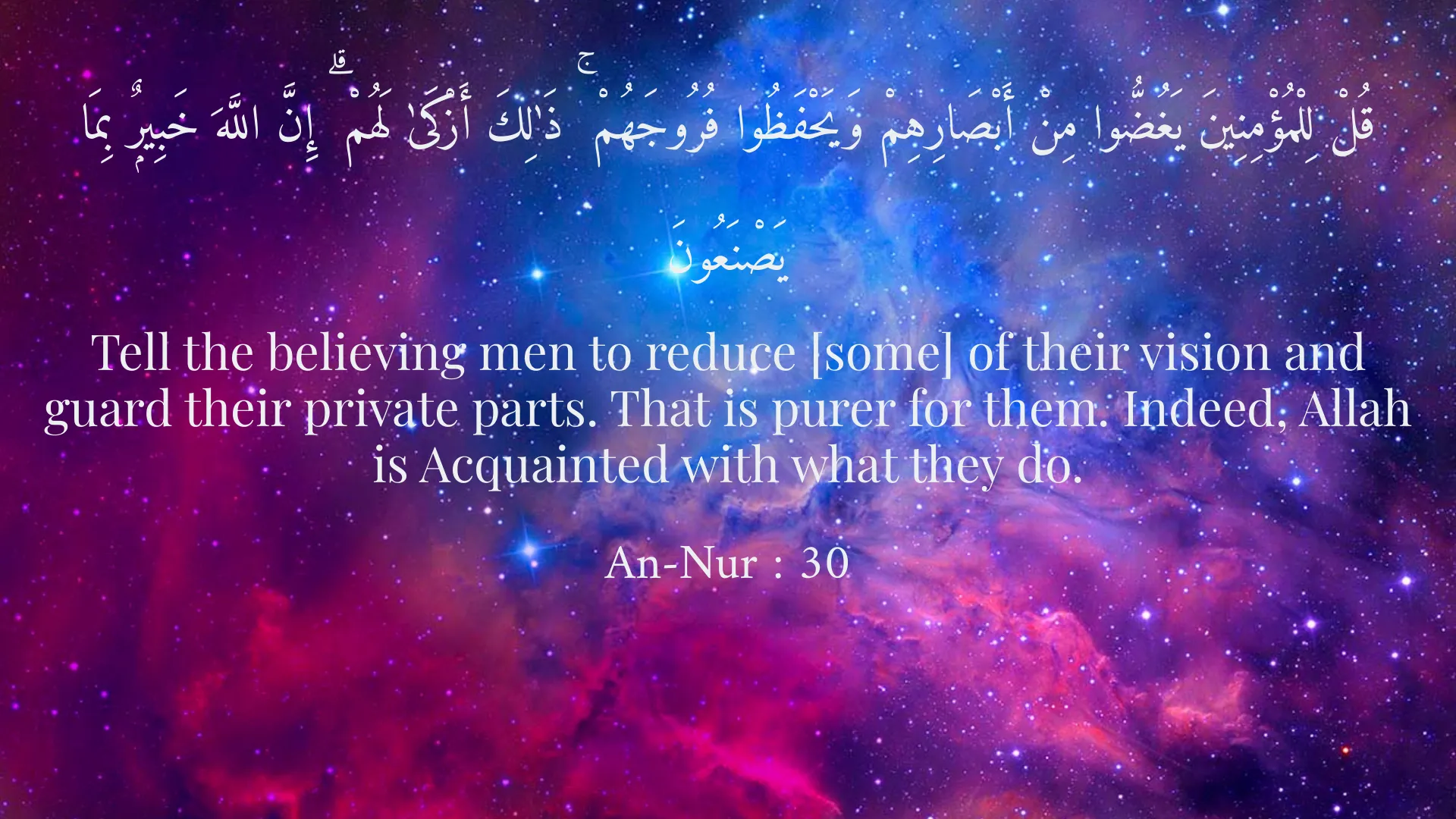
قُلْ لِلْمُؤْمِنِينَ يَغُضُّوا مِنْ أَبْصَارِهِمْ وَيَحْفَظُوا فُرُوجَهُمْ ۚ ذَٰلِكَ أَزْكَىٰ لَهُمْ ۗ إِنَّ اللَّهَ خَبِيرٌۭ بِمَا يَصْنَعُونَ
Tell the believing men to reduce [some] of their vision and guard their private parts. That is purer for them. Indeed, Allah is Acquainted with what they do.
An-Nur : 30
وَقُلْ لِلْمُؤْمِنَاتِ يَغْضُضْنَ مِنْ أَبْصَارِهِنَّ وَيَحْفَظْنَ فُرُوجَهُنَّ وَلَا يُبْدِينَ زِينَتَهُنَّ إِلَّا مَا ظَهَرَ مِنْهَا ۖ وَلْيَضْرِبْنَ بِخُمُرِهِنَّ عَلَىٰ جُيُوبِهِنَّ ۚ وَلَا يُبْدِينَ زِينَتَهُنَّ إِلَّا لِبُعُولَتِهِنَّ أَوْ آبَائِهِنَّ أَوْ آبَاءِ بُعُولَتِهِنَّ أَوْ أَبَنَائِهِنَّ أَوْ أَبْنَاءِ بُعُولَتِهِنَّ أَوْ إِخْوَانِهِنَّ أَوْ بَنَاتِ إِخْوَانِهِنَّ أَوْ بَنَاتِ أَخَوَاتِهِنَّ أَوْ نِسَائِهِنَّ أَوْ مَا مَلَكَتْ أَيْمَانُهُنَّ ۖ وَلَا يُضَرِّبْنَ بِأَرْجُلِهِنَّ لِيُعْلَمَ مَا يُخْفِينَ مِنْ زِينَتِهِنَّ ۗ وَتُوبُوا إِلَى اللَّهِ جَمِيعًا أَيُّهَا الْمُؤْمِنُونَ لَعَلَّكُمْ تُفْلِحُونَ
And tell the believing women to reduce [some] of their vision and guard their private parts and not expose their adornment except that which ordinarily appears thereof. And to draw their cloaks over their chests and not expose their adornment except to their husbands, their fathers, their fathers' fathers, their sons, their husbands' sons, their brothers, their brothers' sons, their sisters' sons, their women, or that which their right hands possess. And let them not stamp their feet to make known what they conceal of their adornment. And turn to Allah in repentance, all of you, O believers, that you might succeed.
An-Nur : 31
Short Story
One day, a young man named Hossein realized that he had been struggling with unlawful gazes towards women in public places. He decided to seek guidance from the Quran and came across the verses of Surah An-Nur that urged believers to lower their gaze. Taking this advice to heart, Hossein committed to controlling his gaze and soon noticed positive changes in his life. Over time, he felt a great sense of peace and was better prepared to face life's challenges with strength.