Quranic Answer
The pursuit of knowledge and the act of questioning occupy a pivotal position in the teachings of the Holy Quran. The divine text emphasizes the significance of seeking understanding, not merely for the sake of inquiry but as a path to enlightenment and growth. Throughout various verses, Allah encourages His followers to engage in thoughtful questioning that can lead to deeper insights and more profound connections with their faith and the world around them. This article will delve into the Quranic perspectives on questioning and knowledge acquisition, illustrating their importance in personal and spiritual development. One of the verses that strikingly highlights the importance of focused inquiry is found in Surah Al-Maidah (5:101). Allah advises believers to avoid questions that do not benefit them. At first glance, one might interpret this as a discouragement of all forms of questioning; however, it is crucial to recognize that what Allah is promoting is the value of purposeful questioning. The essence of this directive is not to stifle curiosity but rather to direct it toward questions that foster growth and understanding. This is particularly important in a world abounding with distractions and misinformation, where clarity of thought and intent can significantly enhance one's educational journey. Moreover, questioning is inherently tied to the process of learning. The educational framework within Islamic teachings often emphasizes the Socratic method, which thrives on asking questions to stimulate critical thinking. The story of Prophet Musa (Moses) and his encounter with Khidr, as narrated in Surah Al-Kahf (18:66-82), serves as a profound illustration of the effectiveness of thoughtful inquiry. When Musa meets Khidr, he is driven by a sincere desire to learn and understand actions that, at first glance, appear unjust or perplexing. His questions serve not only to satiate his thirst for knowledge but also to unravel deeper moral and philosophical truths about life and divine wisdom. This narrative encapsulates the idea that questioning, when driven by the intent to understand, elevates one's knowledge and experience. The act of asking questions is, therefore, not merely an academic exercise. Instead, it is a dynamic aspect of human character that shapes one's intellectual and spiritual journey. The Quran continually emphasizes that knowledge and inquiry are intertwined with faith and righteousness. In Surah Az-Zumar (39:9), Allah poses a rhetorical question: "Is the one who knows equal to the one who does not know?" This verse highlights the invaluable status of knowledge in Islam. Knowledge, in this context, is not an end in itself but rather a means to achieve a deeper connection with the Creator and a more profound understanding of one’s surroundings. Furthermore, the Quran suggests that the quality of the questions asked reflects the sincerity of one's intention. Good intentions behind inquiries lead to fruitful discussions and findings, while aimless questions or those rooted in immature curiosity can lead one astray. Seeking knowledge with a clear purpose is essential; it transforms mere curiosity into an enriching pursuit that ultimately enhances one's character and wisdom. In a fast-paced world where information is abundant but often misleading, the importance of cultivating good questions becomes even more potent. It is also worth noting that throughout Islamic history, scholars, and thinkers have stressed the imperative of questioning and learning as tools to challenge ignorance. For instance, the famous Islamic scholar Al-Ghazali encourages intellectual inquiry as a means to understand the complexities of existence. He believed that the relentless pursuit of knowledge is essential for both personal growth and societal betterment. Through the lens of such scholarly traditions, one can appreciate how deeply rooted the values of questioning and knowledge-seeking are in Islamic culture. In addition, engaging in discussions and debates is given a prominent place within the Quran and Islamic teachings. Allah encourages believers to reflect on their understanding, which fosters a spirit of inquiry and dialogue. This communicative dynamic allows individuals to share insights, question assumptions, and ultimately refine their own beliefs and practices. Through collective discourse, the community can grow stronger as its members contribute to the pool of knowledge in pursuit of truth. On a personal level, one gains much from questioning and seeking knowledge. The act of searching for answers not only enhances one’s understanding but also cultivates humility, as individuals come to appreciate the vastness of what remains unknown. Knowledge acquisition becomes a humbling experience in which the seekers realize that their understanding is limited and there is always more to learn. Thus, humility is inherent in the pursuit of knowledge, fostering a spirit of inquiry that is ever-present in believers' lives. Additionally, the responsibility of questioning is not solely placed upon the individual; there is a significant role for educators and mentors within this framework. The Quran implicitly acknowledges the importance of guidance in the learning process. Teachers must instill in their students the value of asking pertinent questions and pursuing knowledge with sincerity. By doing so, they cultivate a new generation of learners who approach knowledge as a lifelong journey rather than a mere destination. In conclusion, the Quranic emphasis on questioning and the pursuit of knowledge serves as a guiding principle for Muslims seeking to enrich their lives and understand their faith. Every inquiry must be grounded in good intention and purpose, directed towards meaningful advancements in one’s understanding of the truth. The narratives and verses of the Quran not only encourage curiosity but promote a structure within which individuals might navigate the labyrinth of information available in their lives. By focusing on good questions and the intent behind them, believers can undertake a transformative journey toward knowledge and enlightenment that reflects the essence of Islamic teaching. Consequently, the act of questioning becomes a vital pillar of personal development and a pathway that unites individuals with their faith and the broader community.
Related Verses
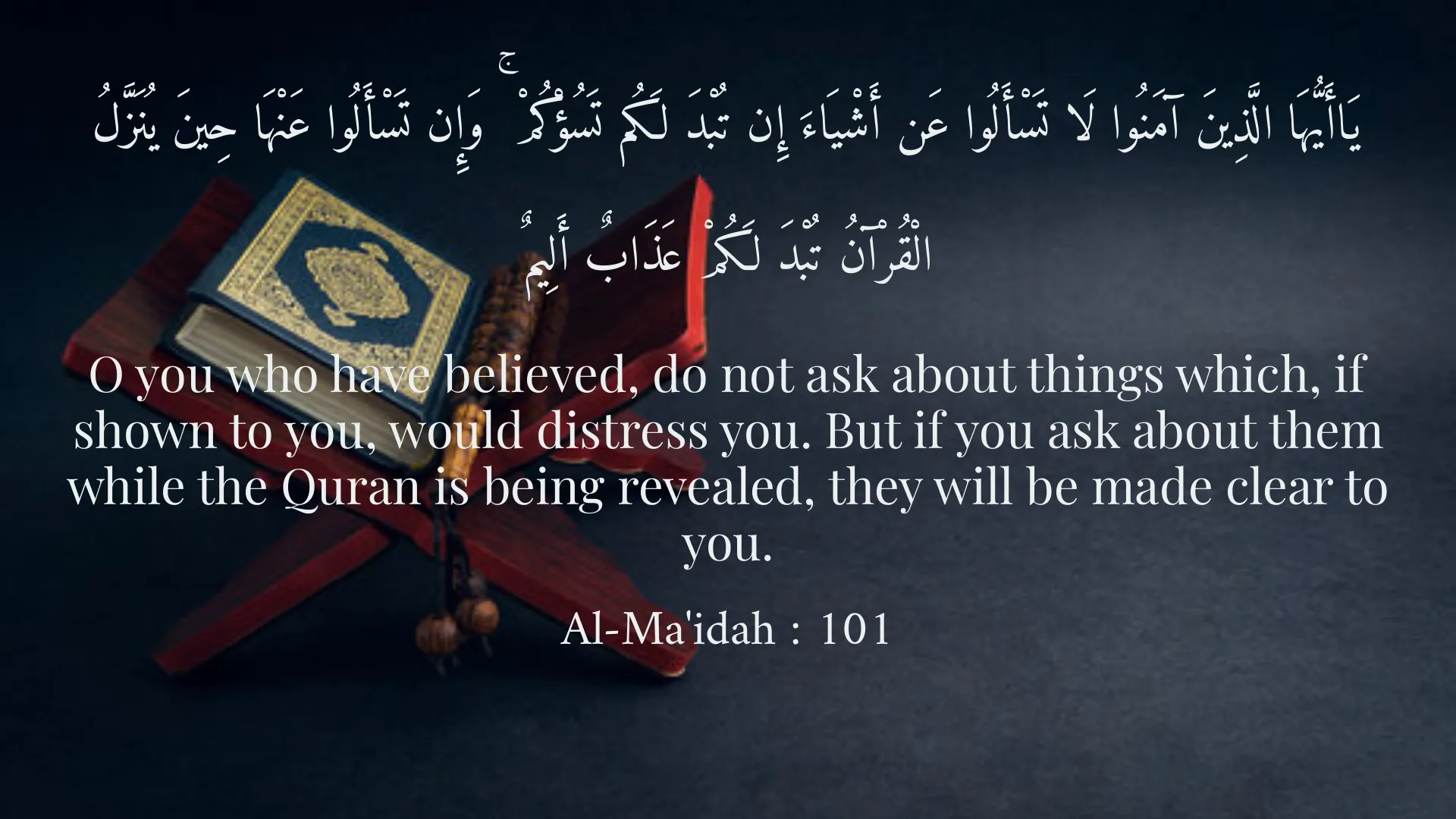
يَاأَيُّهَا الَّذِينَ آمَنُوا لَا تَسْأَلُوا عَن أَشْيَاءَ إِن تُبْدَ لَكُم تَسُؤْكُمْ ۚ وَإِن تَسْأَلُوا عَنْهَا حِينَ يُنَزَّلُ الْقُرْآنُ تُبْدَ لَكُمْ عَذَابٌ أَلِيمٌ
O you who have believed, do not ask about things which, if shown to you, would distress you. But if you ask about them while the Quran is being revealed, they will be made clear to you.
Al-Ma'idah : 101
فَوجَدَ عَبْدًا مِّنْ عِبَادِنَا آتَيْنَاهُ رَحْمَةً مِّنْ عِندِنَا وَعَلَّمْنَاهُ مِن لَّدُنَّا عِلْمًا
So he found one of Our servants, to whom We had given mercy from Us and had taught him from Us a knowledge.
Al-Kahf : 66
أَمَّنْ هُوَ قَانِتٌ آنَاءَ اللَّيْلِ سَاجِدًا وَقَائِمًا يَحْذَرُ الْآخِرَةَ وَيَرْجُو رَحْمَتَ رَبِّهِۦ قُلْ هَلْ يَسْتَوِي الَّذِينَ يَعْلَمُونَ وَالَّذِينَ لَا يَعْلَمُونَ ۚ إِنَّمَا يَتَذَكَّرُ أُوْلُو الْأَلْبَابِ
Is one who is devoutly worshiping during the periods of the night, prostrating and standing in prayer, fearing the Hereafter and hoping for the mercy of his Lord, equal to those who do not? Only those of intellect will remember.
Az-Zumar : 9
Short Story
One day, Yahya pondered about the questions that had been posed in his faith. He realized that inquiry could be a gateway to a better understanding and closeness to God. Therefore, he decided to ask at least one new question each day and seek answers. This curiosity led him to a deeper understanding of his faith and ultimately brought more peace into his life.