Quranic Answer
In the Holy Quran, the principle of kindness and goodness towards parents carries immense significance, highlighting the moral and ethical framework that governs relationships within the family structure in Islam. This is particularly evident in Surah Al-Isra, verse 23, where Allah commands believers to worship none but Him and to treat their parents with kindness. This dual emphasis on monotheism and parental respect underscores the unique status parents hold in Islamic teachings, reminding followers that showing love and respect for their parents is not merely a cultural expectation, but a fundamental tenet of faith. The Quranic directive to be kind to parents transcends mere words; it encapsulates a broader call to honor and care for those who have nurtured and supported us throughout our lives. The respect and love for parents are elevated to such an extent that they are placed in the same context as the worship of Allah, which speaks volumes about the weightage given to familial bonds in the Islamic perspective. Furthermore, in Surah Luqman, verse 14, the Quran acknowledges the profound relationship between children and their parents, particularly emphasizing the mother's role. Allah states that while one must love and care for one's parents, obedience to them should not require actions that contradict truth and justice. This critical line balances respect for parental authority with the paramount importance of adhering to divine moral standards. In this regard, Islam does not demand blind obedience but encourages individuals to judge their actions through the prism of justice and righteousness. The interaction between kindness to parents and religious duty is further elaborated in Hadith literature. Many narrations from the Prophet Muhammad (peace be upon him) underscore the gravity of treating parents with dignity and care. One of the most poignant examples comes in the form of a statement attributed to the Prophet: 'Paradise lies at the feet of mothers.' This powerful metaphor illustrates the deep spiritual significance of honoring one's mother and serves as a reminder that the ultimate success and rewards in the hereafter can be linked to how we treat our parents. From both the Quran and Hadith, we can infer that kindness towards parents is not only a form of goodness but also a pathway to spiritual redemption. The concept of expiating sins is not directly mentioned in relation to parental kindness; however, the underlying principle remains clear: good actions towards one's parents serve as a means of earning worldly and otherworldly rewards. This forms a moral cycle where the act of caring for one's parents results in blessings, possibly even leading to the forgiveness of sins. In many Islamic cultures, filial piety is reflected in how individuals prioritize their parents' needs. This is visible in various forms, from providing financial help and emotional support to ensuring their parents are treated with respect and dignity at all stages of life. When one adopts such a mindset, treating parents with kindness is not merely a parental obligation; it becomes a way of life embedded in one's character and nurturing spirit. An additional dimension of this relationship is through understanding the sacrifices often made by parents. Many parents go to great lengths to provide for their children, often putting their needs and desires aside for the sake of their offspring. Recognizing this commitment and responding with love and kindness is essential in Islamic teachings. The Quran encourages reflective awareness of the toil and challenges that parents face, fostering a spirit of gratitude and appreciation in children. Moreover, it is also important to consider the socio-cultural contexts in which these teachings are situated. In many Muslim communities, extended family systems are prevalent, meaning that the respect and kindness expected towards one's parents can extend to in-laws and elder relatives. This creates a broader ethos of family respect that is vital for maintaining social harmony and support networks. The benefits of kindness to parents do not merely rest on emotional fulfillment but are also linked to one’s personal spiritual journey. Acts of service and kindness towards parents are integrated into the Islamic notion of good deeds, reinforcing the belief that such actions can purify one's heart and lead to a closer relationship with Allah. This ties into the overall Islamic ethos of compassion, which is a fundamental aspect of human relationships. In conclusion, kindness and goodness towards parents are integral to Islamic teaching, as articulated through both the Quran and Hadith. As believers, understanding the significance of this relationship ultimately leads to personal growth, spiritual elevation, and communal harmony. The values of love, respect, and kindness towards parents transcend generations, creating a legacy of compassion and righteousness. Therefore, it can be said that helping one's parents is indeed a noble endeavor, serving not only as a form of goodness but as a means of atonement for sins and a step towards achieving divine pleasure. The emphasis on kindness towards parents is a reflection of the broader ethical framework in Islam, where personal conduct is deeply interwoven with faith, thereby enhancing the spiritual and moral fabric of society.
Related Verses
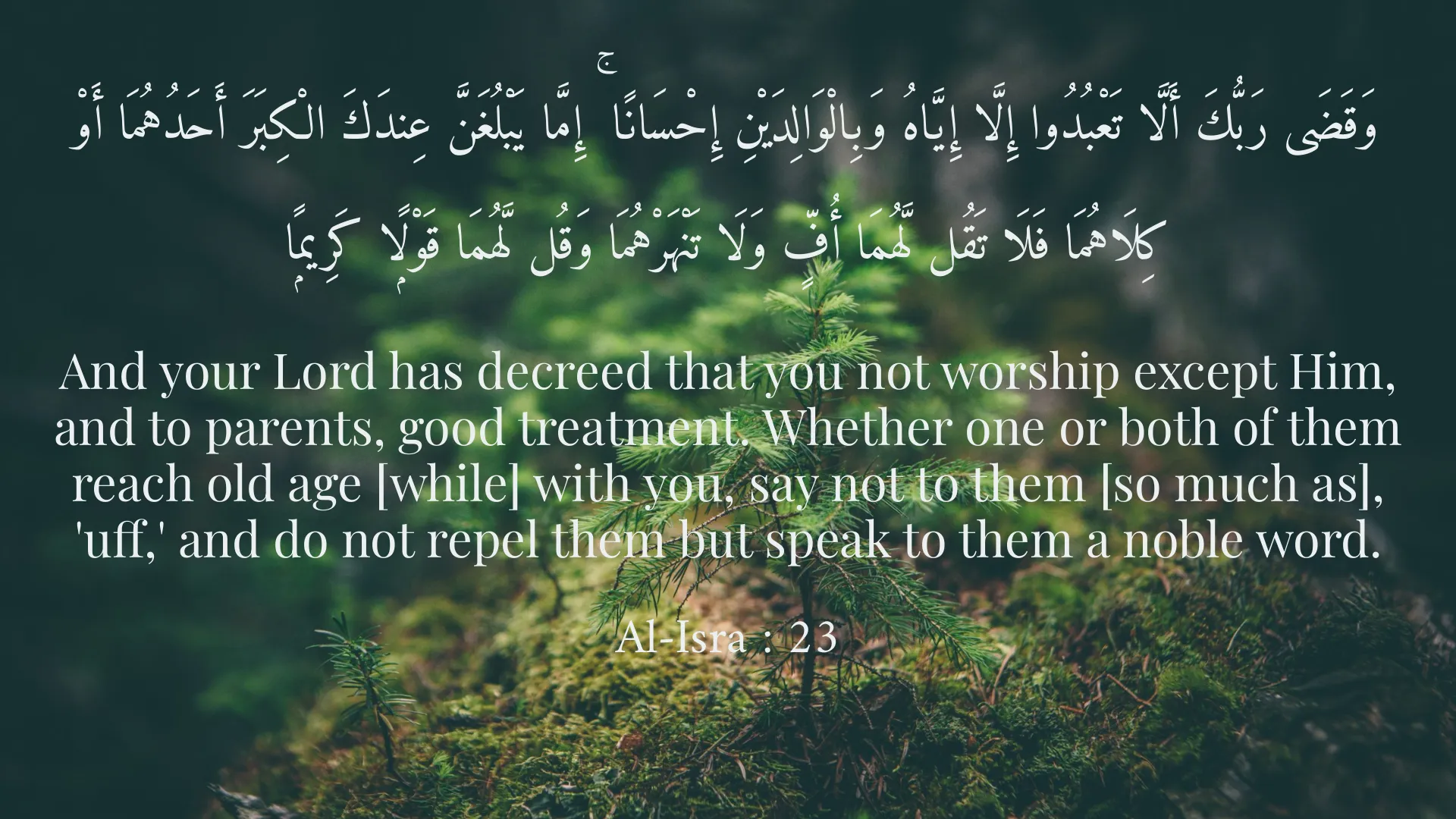
وَقَضَى رَبُّكَ أَلَّا تَعْبُدُوا إِلَّا إِيَّاهُ وَبِالْوَالِدَيْنِ إِحْسَانًا ۚ إِمَّا يَبْلُغَنَّ عِندَكَ الْكِبَرَ أَحَدُهُمَا أَوْ كِلَاهُمَا فَلَا تَقُل لَّهُمَا أُفٍّ وَلَا تَنْهَرْهُمَا وَقُل لَّهُمَا قَوْلًۭا كَرِيمًۭا
And your Lord has decreed that you not worship except Him, and to parents, good treatment. Whether one or both of them reach old age [while] with you, say not to them [so much as], 'uff,' and do not repel them but speak to them a noble word.
Al-Isra : 23
وَوَصَّيْنَا الْإِنسَانَ بِوَالِدَيْهِ ۚ أَنِ اشْكُرْ لِي وَلِوَالِدَيْكَ إِلَيَّ الْمَصِيرُ
And We have enjoined upon man [care] for his parents. But if they endeavor to make you associate with Me that of which you have no knowledge, do not obey them. To Me is your return, and I will inform you about what you used to do.
Luqman : 14
Short Story
Once upon a time, there was a man who was always preoccupied with his future. He neglected his parents until one day he noticed they had fallen seriously ill. He decided to spend more time with them and serve them with love and respect. By doing this, both his parents felt better, and he found greater peace within himself. The man realized that loving one’s parents is not only a good deed but can also enrich one’s life.