Quranic Answer
Hijab in Islam is far more than merely a piece of cloth; it embodies a profound and multifaceted concept of modesty, dignity, and respect that resonates deeply within the cultural and spiritual context of the Islamic faith. At its core, hijab refers to the covering of the body and the preservation of modesty, particularly among women, as mandated in the Holy Quran. However, the implications of hijab extend beyond gender, encapsulating the moral and ethical responsibilities of both men and women within the Islamic community. In this article, we will delve into the significance of hijab in Islam, exploring its origins, its implications for both genders, and its broader societal impacts. The roots of hijab can be traced back to the teachings found in the Quran, which serves as the primary source of guidance for Muslims around the world. One of the key verses addressing the issue of women's adornment is found in Surah An-Nur, verse 31, where Allah instructs women to draw their veils over their bosoms and not to exhibit their adornments except to their husbands and close relatives. This directive underlines the importance of protecting one's modesty and dignity. Women's hijab, therefore, should be perceived as a symbol of their self-respect and an expression of their religious devotion. It is a conscious choice made by many women to adhere to their faith, fostering a sense of identity and belonging within the Islamic community. Moreover, it is essential to recognize that the Quran does not solely focus on women regarding modesty. In Surah An-Nur, verse 30, Allah commands men to lower their gaze and guard their private parts, highlighting that the principle of hijab is equally applicable to men. This commonly overlooked aspect reinforces the notion that modesty is a holistic concept in Islam, encompassing behaviors and attitudes for both genders. Men are encouraged to maintain a dignified appearance and conduct themselves in a manner that reflects their moral values and respect for others, thereby affirming that modesty transcends physical covering and is deeply rooted in one’s character and actions. Thus, the concept of hijab emerges as a collective responsibility for the entire Islamic community. Both men and women must hold themselves accountable for their actions and strive to create an environment characterized by mutual respect. In a broader context, hijab can be recognized as not just a personal act of faith, but as part of a public culture within the Islamic community that promotes modesty, respect, and ethical behavior. This communal aspect of hijab fosters a sense of unity among Muslims, encouraging them to support one another in their spiritual and moral journeys. Furthermore, hijab has various interpretations and practices across the diverse cultural backgrounds within the Islamic world. While it typically involves the wearing of headscarves and loose-fitting clothing for women, the style and manner of hijab can substantially vary based on cultural customs, personal beliefs, and societal norms. Some women may choose to wear a hijab in a more traditional manner, while others may adopt a more modern approach, reflecting their unique identities and experiences. This variability enriches the cultural tapestry of the Muslim community, illustrating that hijab is not a monolithic practice, but rather a deeply personal expression of faith and modesty. In addition to the religious and cultural dimensions, the hijab has also attracted attention in contemporary society, raising discussions about women’s rights, personal choice, and the intersection of faith and feminism. Critics may argue that hijab symbolizes oppression, particularly in societies where women are compelled to wear it against their will. However, many Muslim women contest this narrative, asserting that hijab can represent empowerment and agency rather than subjugation. For these women, choosing to wear the hijab is an assertion of their identity, a rejection of societal pressures related to appearance, and a commitment to their faith. It is crucial to understand that the practice of hijab should be voluntary and rooted in an individual's spiritual convictions rather than enforced by external pressures. This principle of choice aligns with the broader Islamic ethos of free will and personal accountability in one’s relationship with Allah. Encouraging informed discussions about hijab can help dismantle stereotypes and promote a more nuanced understanding of its significance within the Muslim community. In the modern era, hijab continues to evolve as a topic of discussion and examination both within and outside the Muslim landscape. Social media has played a pivotal role in reshaping perceptions of hijab, allowing women to share their experiences, styles, and interpretations openly. This digital representation has contributed to a growing movement of hijab-wearing women who are redefining beauty standards and challenging societal norms. As a result, hijab is increasingly viewed as a dynamic and evolving expression of one's identity rather than a static tradition. In conclusion, hijab in Islam embodies an intricate blend of faith, culture, and personal choice that holds significance for both men and women. While traditionally linked to the concept of modesty for women, the principles of hijab are equally pertinent to men, establishing it as a shared responsibility within the Islamic community. Beyond its religious connotations, hijab invites broader discussions about empowerment, identity, and personal conviction. Through awareness and respectful dialogue, we can appreciate the richness of hijab as a cultural practice, fostering an environment where mutual respect and understanding thrive. Thus, the hijab stands not only as a symbol of modesty but as a testament to the diverse and complex realities of Muslim life in the modern world, bridging the gap between tradition and contemporary expression.
Related Verses
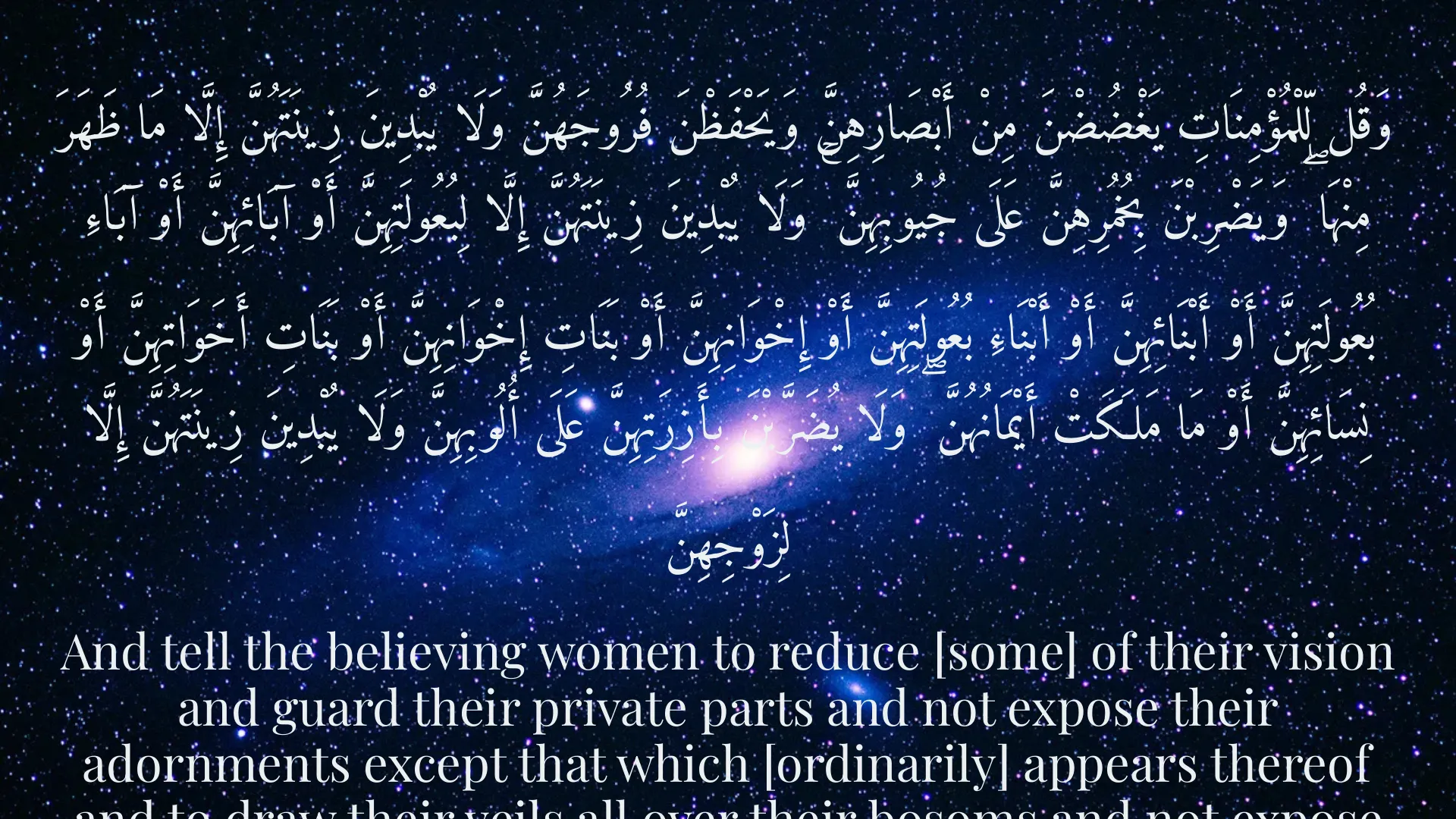
وَقُل لِّلْمُؤْمِنَاتِ يَغْضُضْنَ مِنْ أَبْصَارِهِنَّ وَيَحْفَظْنَ فُرُوجَهُنَّ وَلَا يُبْدِينَ زِينَتَهُنَّ إِلَّا مَا ظَهَرَ مِنْهَا ۖ وَيَضْرِبْنَ بِخُمُرِهِنَّ عَلَى جُيُوبِهِنَّ ۚ وَلَا يُبْدِينَ زِينَتَهُنَّ إِلَّا لِبُعُولَتِهِنَّ أَوْ آبَائِهِنَّ أَوْ آبَاءِ بُعُولَتِهِنَّ أَوْ أَبْنَائِهِنَّ أَوْ أَبْنَاءِ بُعُولَتِهِنَّ أَوْ إِخْوَانِهِنَّ أَوْ بَنَاتِ إِخْوَانِهِنَّ أَوْ بَنَاتِ أَخَوَاتِهِنَّ أَوْ نِسَائِهِنَّ أَوْ مَا مَلَكَتْ أَيْمَانُهُنَّ ۖ وَلَا يُضَرَّبْنَ بِأَزِرَتِهِنَّ عَلَى أُلُوبِهِنَّ وَلَا يُبْدِينَ زِينَتَهُنَّ إِلَّا لِزَوْجِهِنَّ
And tell the believing women to reduce [some] of their vision and guard their private parts and not expose their adornments except that which [ordinarily] appears thereof and to draw their veils all over their bosoms and not expose their adornments except to their husbands, fathers, fathers of their husbands, sons, the sons of their husbands, brothers, the sons of brothers, the daughters of brothers, the women, or those whom their right hands possess.
An-Nur : 31
قُلْ لِلْمُؤْمِنِينَ يَغْضُضُوا مِنْ أَبْصَارِهِمْ وَيَحْفَظُوا فُرُوجَهُمْ ۚ ذَٰلِكَ أَزْكَىٰ لَهُمْ ۗ إِنَّ اللَّهَ خَبِيرٌ مِّا يَصْنَعُونَ
And tell the believing men to lower [some] of their vision and guard their private parts. That is purer for them. Indeed, Allah is Acquainted with what they do.
An-Nur : 30
Short Story
One day, Aref encountered a woman fully veiled walking in the street. He thought to himself, this woman is a symbol of modesty and purity, respecting herself and others. Aref then decided to strive to maintain his true hijab, not just in attire but also in his heart and intentions.