Quranic Answer
In the sublime teachings of the Holy Quran, the relationship between intention (niyyah) and action (amal) is one of the most fundamental and profound topics concerning the destiny and value of human deeds in the sight of God. Intention and action cannot be considered as two completely separate categories; rather, they are intertwined and interdependent, much like the soul and body of a single reality. However, if an order of priority is to be considered, the Quran clearly emphasizes the paramount importance of intention and sincerity (ikhlas), to the extent that a correct intention imparts true spirit and value to an action, and without it, even the greatest deeds may remain worthless and fruitless. The Holy Quran repeatedly stresses the necessity of 'ikhlas' (sincerity) in worship and action. Ikhlas is that pure and unadulterated intention performed solely to gain God's pleasure, devoid of any hint of hypocrisy, show-off, or worldly motives. For instance, in Surah Al-Bayyinah, verse 5, Allah states: "And they were not commanded except to worship Allah, [being] sincerely obedient to Him, inclining to truth, and to establish prayer and to give zakah. And that is the correct religion." This verse clearly articulates that the essence and foundation of religion is the sincere worship of God, and actions like prayer and zakat are only valuable if they stem from a pure intention. It is this sincerity in intention that transforms an action from a mere physical or superficial movement into a true and divinely accepted act of worship. Intention, one could say, is the criterion by which the value of deeds is measured by God. A small act performed with a pure and divine intention can hold far greater value than a grand and ostentatious act performed with a non-divine intention. The Holy Quran in Surah Al-Kahf, verse 110, states: "So whoever would hope for the meeting with his Lord - let him do righteous work and not associate anyone with the worship of his Lord." This verse also emphasizes that righteous work (amal salih) is acceptable only when it is free from polytheism (shirk) and hypocrisy, and is done solely for God, which is precisely the sincerity in intention. This sincerity is crucial not only in acts of worship but in all aspects of human life, including social relations, business, and even inner thoughts. A financial aid to the poor, if given with the intention of showing off or gaining reputation, is worthless in God's sight, but if given with a sincere intention solely for God's pleasure, even if the amount is small, it will receive a great reward. Indeed, it is the intention that defines the primary direction and purpose of an action, elevating it from a material to a spiritual level. In other words, intention is like a compass that guides the path of action towards divine satisfaction. Without this compass, an action might get lost. On the other hand, the importance of action should not be overlooked. Intention alone, no matter how pure, cannot bear fruit if it does not lead to righteous action. The Holy Quran frequently mentions faith and righteous deeds together, indicating their inseparable connection. For example, in many verses, believers who have "believed and done righteous deeds" are promised paradise and immense rewards. This linkage demonstrates that faith (which originates from intention and inner belief) is incomplete without action, and action without pure intention is dull. Action is the manifestation and external expression of intention. If there is a good intention in the heart but no effort is made to realize it, that intention alone is not sufficient. For instance, a good intention to help others gains value when it manifests in practical assistance (whether financial, physical, or intellectual). So, in answer to the question of whether intention is more important than action, it can be said that intention gives intrinsic worth and value to the action, and without it, the action is worthless. However, this does not mean that action is unimportant. Action is the manifestation and fruit of intention, and it is necessary for pure intentions to come to fruition. In fact, intention and action are two wings for the human soul to fly towards perfection and divine satisfaction. Intention is the driving force and guide, and action is the means and path to reach the destination. Therefore, both are essential and complementary to each other, but sincere intention is the root and foundation of every acceptable and valuable deed in the sight of God. It is this sincerity in intention that determines the spiritual quality of the action and brings about the true reward. For this reason, in Islamic culture, great emphasis is placed on 'self-reckoning' and monitoring one's inner intentions to ensure that one always maintains purity and sincerity of intention, and performs deeds with the goal of divine pleasure. This comprehensive perspective fills the believer's life with spirituality and purpose, as even the smallest daily tasks can be transformed into acts of worship with a divine intention and earn eternal reward. Thus, we can conclude that intention is the principle and the root, while action is the fruit and result of that root; neither is complete without the other, but intention breathes life into the action and gives it a divine direction.
Related Verses
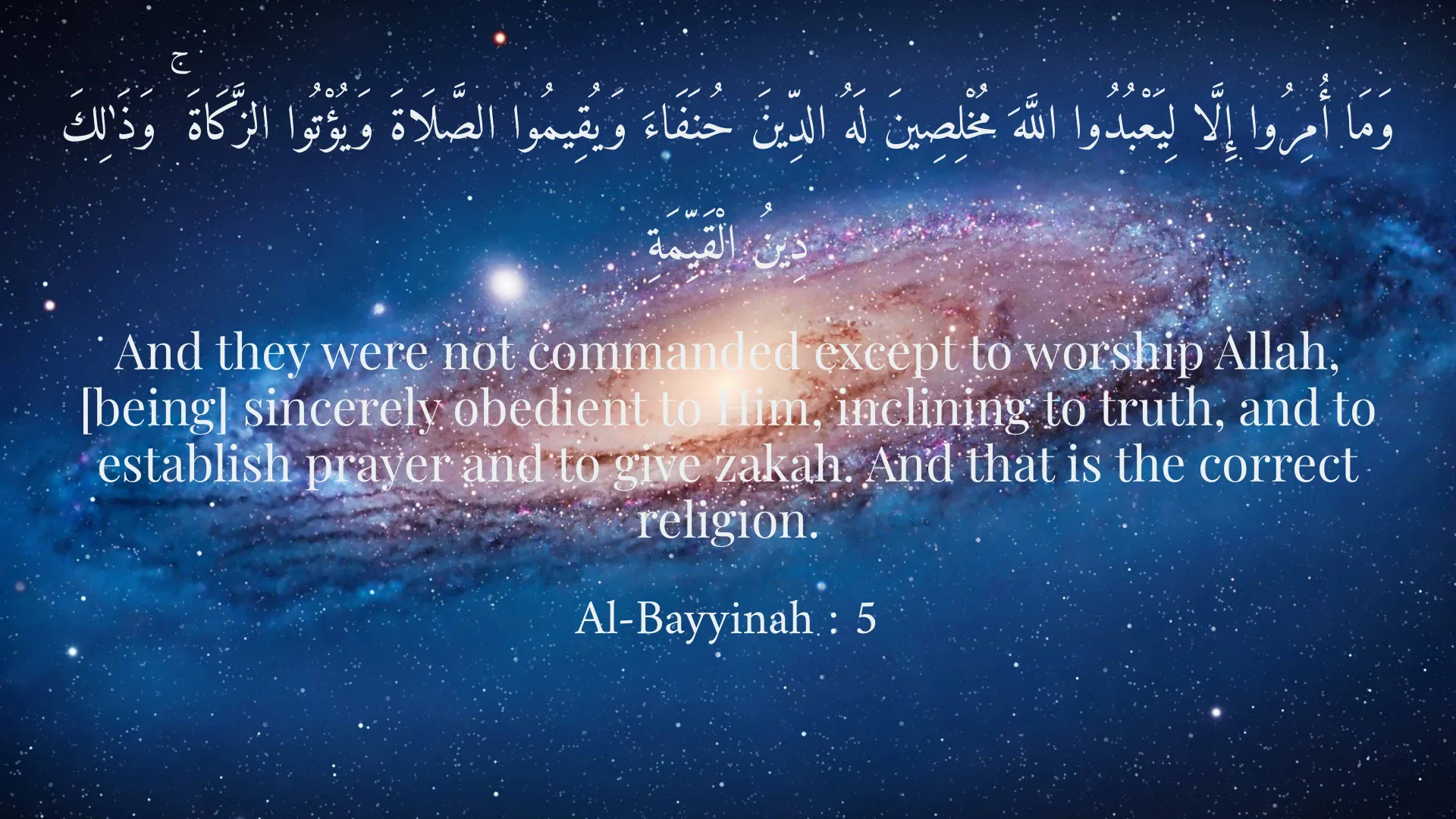
وَمَا أُمِرُوا إِلَّا لِيَعْبُدُوا اللَّهَ مُخْلِصِينَ لَهُ الدِّينَ حُنَفَاءَ وَيُقِيمُوا الصَّلَاةَ وَيُؤْتُوا الزَّكَاةَ ۚ وَذَٰلِكَ دِينُ الْقَيِّمَةِ
And they were not commanded except to worship Allah, [being] sincerely obedient to Him, inclining to truth, and to establish prayer and to give zakah. And that is the correct religion.
Al-Bayyinah : 5
قُلْ إِنَّمَا أَنَا بَشَرٌ مِّثْلُكُمْ يُوحَىٰ إِلَيَّ أَنَّمَا إِلَٰهُكُمْ إِلَٰهٌ وَاحِدٌ ۖ فَمَن كَانَ يَرْجُو لِقَاءَ رَبِّهِ فَلْيَعْمَلْ عَمَلًا صَالِحًا وَلَا يُشْرِكْ بِعِبَادَةِ رَبِّهِ أَحَدًا
Say, 'I am only a man like you, to whom has been revealed that your god is one God. So whoever would hope for the meeting with his Lord - let him do righteous work and not associate anyone with the worship of his Lord.'
Al-Kahf : 110
إِنَّا أَنزَلْنَا إِلَيْكَ الْكِتَابَ بِالْحَقِّ فَاعْبُدِ اللَّهَ مُخْلِصًا لَّهُ الدِّينَ
Indeed, We sent down to you the Book in truth, so worship Allah, [being] sincere to Him in religion.
Az-Zumar : 2
Short Story
Once upon a time, in a city lived a man named Zahed, renowned for his piety and devotion. Every morning and evening, he would stand for prayers in the city mosque, reciting the Quran with a melodious voice that captivated all who heard him, earning him a reputation for saintliness. People regarded him as virtuous and held him in high esteem. However, in the same city, there was a young man named Aref who paid less attention to his outward appearance and preferred to contemplate God in solitude. Aref would quietly and humbly visit the sick and help the needy day and night, without anyone ever knowing of his good deeds. One day, a friend of Zahed's, surprised, asked him, "How is it that with all your prayers and devotion, occasional temptations and self-admiration still creep into your heart?" Zahed sighed regretfully and said, "My friend, my outward appearance is more adorned than my inner self. Sometimes, while worshipping, I think about what people will say about me and how they will praise me. My intention becomes tainted with hypocrisy, and this is what kills the spirit of my action." Then Zahed's friend went to Aref and found him helping an infirm old woman. Aref was helping kindly and without expectation, without even a smile on his lips, as if he saw only God. Zahed's friend said to Aref, "I commend you for your sincere and humble deeds." Aref calmly replied, "I only look at my intention. If my intention is purely for God, even the smallest act becomes the greatest worship. If the intention is corrupted, the greatest worship becomes worthless. The essence is the intention, which directs the action and gives it value." From that day forward, the city's people understood that the true value of deeds lies not in their outward appearance or grandeur, but in the purity and sincerity of intention; an intention that, like the sun, shines upon the heart and gives life to the action.