Quranic Answer
The Quran, as the divine revelation, provides a comprehensive and profound definition of a righteous life, transcending mere worldly success or fleeting pleasures. It paints a picture of a life lived in harmony with the Creator's will, leading to true peace, fulfillment, and ultimate salvation in both this world and the Hereafter. A righteous life, as depicted in the Quran, is not a static state but a dynamic journey of continuous spiritual, ethical, and social development. It is fundamentally rooted in a pure and unwavering belief in God (Allah), followed by actions that reflect this belief in every aspect of an individual's existence. At its core, a righteous life begins with Tawhid, the absolute monotheism – the belief in the oneness of God and the rejection of all forms of polytheism or idolatry. This foundational principle dictates that all worship, devotion, and submission are due solely to Allah. This belief shapes an individual's worldview, making them realize that life's ultimate purpose is to recognize and worship their Creator. As stated in Surah Adh-Dhariyat (51:56), "And I did not create the jinn and mankind except to worship Me." This purpose of worship is not merely ritualistic but encompasses all actions performed with sincerity and in accordance with divine guidance. It means living with constant awareness of God's presence, striving to earn His pleasure, and fearing His displeasure. Beyond belief, the Quran meticulously details the actions and character traits that constitute a righteous life. Surah Al-Baqarah (2:177) offers a concise yet expansive definition of "Birr" (righteousness), often considered the cornerstone of ethical living in Islam. This verse states: "Righteousness is not that you turn your faces toward the east or the west, but [true] righteousness is [in] one who believes in Allah, the Last Day, the angels, the Book, and the prophets and gives wealth, in spite of love for it, to relatives, orphans, the needy, the traveler, those who ask [for help], and for freeing slaves; [and who] establishes prayer and gives zakah; [and who] fulfill their promise when they promise; and [who] are patient in poverty and hardship and during battle. Those are the ones who have been true, and it is those who are the righteous." This single verse encapsulates the essence of a righteous life: it is a holistic blend of profound faith (Iman), practical worship (Ibadah), social responsibility (Ihsaan), and unwavering patience (Sabr). Faith (Iman) forms the bedrock. Believing in Allah, His angels, His revealed books, His messengers, and the Last Day provides the spiritual compass for a righteous life. This faith is not a mere intellectual assent but a deep conviction that translates into action. It instills a sense of accountability, knowing that every action, no matter how small, will be weighed on the Day of Judgment. Following faith, the Quran emphasizes practical acts of worship (Ibadah), particularly establishing regular prayers (Salat) and giving obligatory charity (Zakat). Prayer serves as a direct link between the believer and their Creator, purifying the soul, restraining from indecency and evil, and providing spiritual strength. Zakat, on the other hand, cleanses wealth and fosters social solidarity by distributing resources to the less fortunate, preventing extreme wealth disparity and promoting economic justice. These pillars of Islam are fundamental to the daily rhythm of a righteous life. A significant component of a righteous life is social responsibility and ethical conduct (Akhlaq and Ihsaan). The Quran repeatedly stresses the importance of treating others with kindness, justice, and compassion. Giving wealth, even when one loves it, to relatives, orphans, the needy, and travelers highlights the communal aspect of righteousness. It is a call to actively address poverty and social inequality, reflecting a profound concern for the well-being of the wider community. Furthermore, fulfilling promises is paramount, emphasizing integrity and trustworthiness in all dealings. This aspect of righteousness extends to all human interactions, promoting harmonious relationships within families, neighborhoods, and society at large. The Quran also extensively details various virtues crucial for a righteous life. Justice (Adl) is a recurring theme, requiring individuals to uphold fairness even against themselves, their parents, or relatives, regardless of wealth or status. Surah An-Nisa (4:135) beautifully illustrates this: "O you who have believed, be persistently [upholders of] justice, witnesses for Allah, even if it be against yourselves or parents and relatives. Whether one is rich or poor, Allah is more worthy of both. So follow not [personal] inclination, lest you deviate. And if you distort [your testimony] or refuse [to give it], then indeed Allah is ever, with what you do, Acquainted." This commitment to justice ensures societal order and protects the rights of all individuals. Patience (Sabr) is another virtue highly extolled. Facing adversity, poverty, hardship, or even conflict with steadfastness and reliance on God is a hallmark of the righteous. It involves perseverance in performing good deeds, refraining from evil, and enduring trials with grace. This resilience is a key to spiritual growth and demonstrates profound trust in Allah's plan. Moreover, a righteous life involves self-purification and moral excellence. Avoiding sins, refraining from backbiting, slander, hypocrisy, arrogance, and greed are all part of this journey. The Quran encourages humility, forgiveness, truthfulness, and gentle speech. It also emphasizes the importance of moderation in all aspects of life, avoiding extravagance and miserliness, as well as fanaticism and negligence. The Quran also frames life itself as a test and a temporary abode, where the quality of one's deeds determines their ultimate destiny. Surah Al-Mulk (67:2) clearly states this purpose: "He who created death and life to test you [as to] which of you is best in deed - and He is the Exalted in Might, the Forgiving." This perspective encourages believers to constantly strive for excellence in their actions, knowing that every moment is an opportunity to earn divine reward. It fosters a proactive approach to doing good and avoiding harm, with an eye on the eternal consequences. In summary, the Quran defines a righteous life as a journey guided by sincere faith in God, manifested through consistent acts of worship, exemplary ethical conduct, profound social responsibility, and unwavering patience in the face of life's trials. It is a life lived with purpose, balance, and a continuous striving for moral excellence and spiritual closeness to Allah. It’s a life that brings peace to the individual, harmony to the family, justice to society, and ultimately, eternal felicity in the Hereafter. It is a holistic framework that integrates belief with action, individual virtue with collective well-being, and worldly pursuits with eternal aspirations, offering a clear path to true human flourishing.
Related Verses
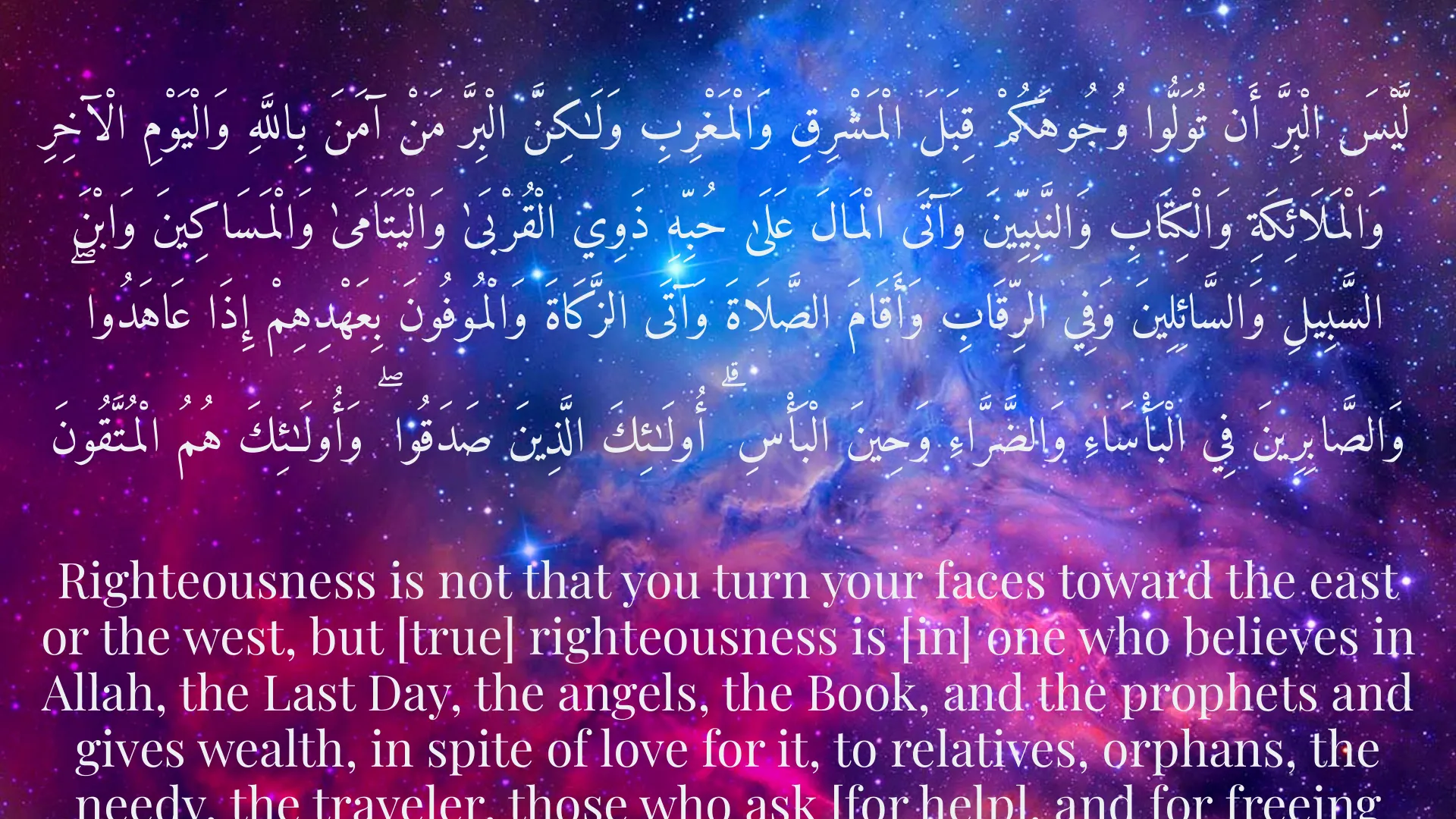
لَّيْسَ الْبِرَّ أَن تُوَلُّوا وُجُوهَكُمْ قِبَلَ الْمَشْرِقِ وَالْمَغْرِبِ وَلَٰكِنَّ الْبِرَّ مَنْ آمَنَ بِاللَّهِ وَالْيَوْمِ الْآخِرِ وَالْمَلَائِكَةِ وَالْكِتَابِ وَالنَّبِيِّينَ وَآتَى الْمَالَ عَلَىٰ حُبِّهِ ذَوِي الْقُرْبَىٰ وَالْيَتَامَىٰ وَالْمَسَاكِينَ وَابْنَ السَّبِيلِ وَالسَّائِلِينَ وَفِي الرِّقَابِ وَأَقَامَ الصَّلَاةَ وَآتَى الزَّكَاةَ وَالْمُوفُونَ بِعَهْدِهِمْ إِذَا عَاهَدُوا ۖ وَالصَّابِرِينَ فِي الْبَأْسَاءِ وَالضَّرَّاءِ وَحِينَ الْبَأْسِ ۗ أُولَٰئِكَ الَّذِينَ صَدَقُوا ۖ وَأُولَٰئِكَ هُمُ الْمُتَّقُونَ
Righteousness is not that you turn your faces toward the east or the west, but [true] righteousness is [in] one who believes in Allah, the Last Day, the angels, the Book, and the prophets and gives wealth, in spite of love for it, to relatives, orphans, the needy, the traveler, those who ask [for help], and for freeing slaves; [and who] establishes prayer and gives zakah; and [who] fulfill their promise when they promise; and [who] are patient in poverty and hardship and during battle. Those are the ones who have been true, and it is those who are the righteous.
Al-Baqarah : 177
الَّذِي خَلَقَ الْمَوْتَ وَالْحَيَاةَ لِيَبْلُوَكُمْ أَيُّكُمْ أَحْسَنُ عَمَلًا ۚ وَهُوَ الْعَزِيزُ الْغَفُورُ
He who created death and life to test you [as to] which of you is best in deed - and He is the Exalted in Might, the Forgiving.
Al-Mulk : 2
يَا أَيُّهَا الَّذِينَ آمَنُوا كُونُوا قَوَّامِينَ بِالْقِسْطِ شُهَدَاءَ لِلَّهِ وَلَوْ عَلَىٰ أَنفُسِكُمْ أَوِ الْوَالِدَيْنِ وَالْأَقْرَبِينَ ۚ إِن يَكُنْ غَنِيًّا أَوْ فَقِيرًا فَاللَّهُ أَوْلَىٰ بِهِمَا ۖ فَلَا تَتَّبِعُوا الْهَوَىٰ أَن تَعْدِلُوا ۚ وَإِن تَلْوُوا أَوْ تُعْرِضُوا فَإِنَّ اللَّهَ كَانَ بِمَا تَعْمَلُونَ خَبِيرًا
O you who have believed, be persistently [upholders of] justice, witnesses for Allah, even if it be against yourselves or parents and relatives. Whether one is rich or poor, Allah is more worthy of both. So follow not [personal] inclination, lest you deviate. And if you distort [your testimony] or refuse [to give it], then indeed Allah is ever, with what you do, Acquainted.
An-Nisa : 135
Short Story
In Saadi's Bustan, it is narrated that a just king, one night, observed his wise minister, who, instead of enjoying the palace's comforts, was engaged in worship in a corner, turning away from the transient world. The king asked, "O Minister, you who possess every blessing, why do you subject yourself to such austerity?" The minister replied with a smile, "O King, this fleeting life is but a bridge to the eternal abode. Just as a traveler gathers provisions for a long journey, so too must we prepare for the Hereafter. True kingship is not in worldly power and wealth, but in righteous deeds that bring forth divine pleasure and ensure eternal happiness." The king was deeply moved by these words, and from that day forward, he founded his life upon justice and benevolence, truly understanding that the essence of life lies in good conduct, not merely in fleeting pleasures. He realized that the true definition of a righteous life is in serving people, upholding rights and fairness, and walking on the path to earn divine pleasure, which brings lasting reward and deep tranquility. This story teaches us that the measure of a righteous life is not the glitter of the world, but the depth of faith and purity of deeds, which ultimately lead to true contentment and peace.