Quranic Answer
Honesty is widely recognized as one of the cornerstone virtues of human character and is regarded as a foundational trait in many religious teachings. In the context of Islam, honesty holds a particularly elevated status as emphasized in the Holy Quran. This sacred text not only advocates for honesty in human interactions but also underscores its importance across various dimensions of life. The ability to be honest is pivotal for establishing authentic relationships, fostering trust, and promoting a harmonious society. Drawing upon relevant verses from the Quran, we can discern the profound significance of honesty and its implications for both individual and collective wellbeing. The Quran clearly states that Allah promises good rewards for the believers who embody virtuous qualities, and among these, honesty is highlighted as a defining trait. In Surah Al-Baqarah, verse 177, Allah defines righteousness not merely in terms of rituals or outward acts but outlines it holistically, integrating honesty as a core element of good character. Righteousness, as portrayed in this verse, is a composite of faith, good deeds, and moral integrity, suggesting that without honesty, one cannot truly be considered righteous in the sight of Allah. In Surah At-Tawbah, verse 119, this emphasis on truthfulness is echoed, where Allah directly instructs the believers: 'O you who have believed, fear Allah and be with the truthful.' This directive serves to remind the believers that honesty is not merely an option but a requirement for a devout and righteous life. By aligning with those who are truthful, individuals are building a foundation of trust that extends into all their relationships—whether personal, professional, or communal. The directive to 'be with the truthful' reflects the Quran's understanding that integrity is not isolated; it thrives within a community of shared values and ideals. The importance of honesty in speech is further emphasized in Surah Al-Ahzab, verse 70, which states, 'O you who have believed, fear Allah and speak words of appropriate justice.' This verse speaks to the power of words and their impact on justice and equity within society. When individuals speak the truth, they uphold fairness and transparency, fostering a culture of accountability and responsibility. Speaking honestly is not just a reflection of internal character; it also shapes social dynamics and helps to create an environment where misunderstanding and conflict are less likely to occur. Moreover, honesty is not limited to trivial matters or personal interactions. In Surah Al-Imran, verse 61, the necessity of truthfulness is extended to the very core of one’s belief system and the religion one chooses to embrace. This verse signifies that honesty must permeate all spheres of life, including one's spiritual convictions. True adherence to faith necessitates an honest engagement with one's beliefs and practices. In this light, honesty transcends beyond individual character and becomes a collective responsibility among believers. The consequences of dishonesty can be severe, leading to disintegration in relationships, societal distrust, and a breakdown of the moral fabric of communities. The Quran serves as a guiding light, steering believers away from deceit and manipulation, which can create injustice and contagion in society. Conversely, the promotion of honesty encourages deeper bonds among individuals, instills mutual respect, and aligns community goals towards betterment and service. Honesty also plays a crucial role in personal success. In various life situations, whether in business dealings, friendships, or family dynamics, being honest enhances one’s reputation and integrity. The trust built through consistent honest behavior contributes to personal development and success, as others are more likely to support, collaborate, and invest in a person known for their honest character. Ultimately, honesty is not just a moral virtue as highlighted in the Quran, but also a practical approach to achieving peace, prosperity, and success in life. In conclusion, honesty is a multifaceted virtue that is deeply rooted in Islamic teachings as presented in the Quran. The texts emphasize that honesty must be upheld across all facets of life and act as a guiding principle for believers. From fostering trust in human relationships to establishing a sincere connection with one’s faith, honesty is pivotal for promoting justice, integrity, and harmony within communities. As we reflect on these teachings, it becomes evident that honesty is not merely about being truthful; it is about fostering a way of life that ultimately leads to collective tranquility and prosperity. Therefore, cultivating honesty should not just be seen as a personal endeavor but rather a responsibility that upholds the moral fabric of society, encouraging individuals to embody truthfulness and contribute to the greater good.
Related Verses
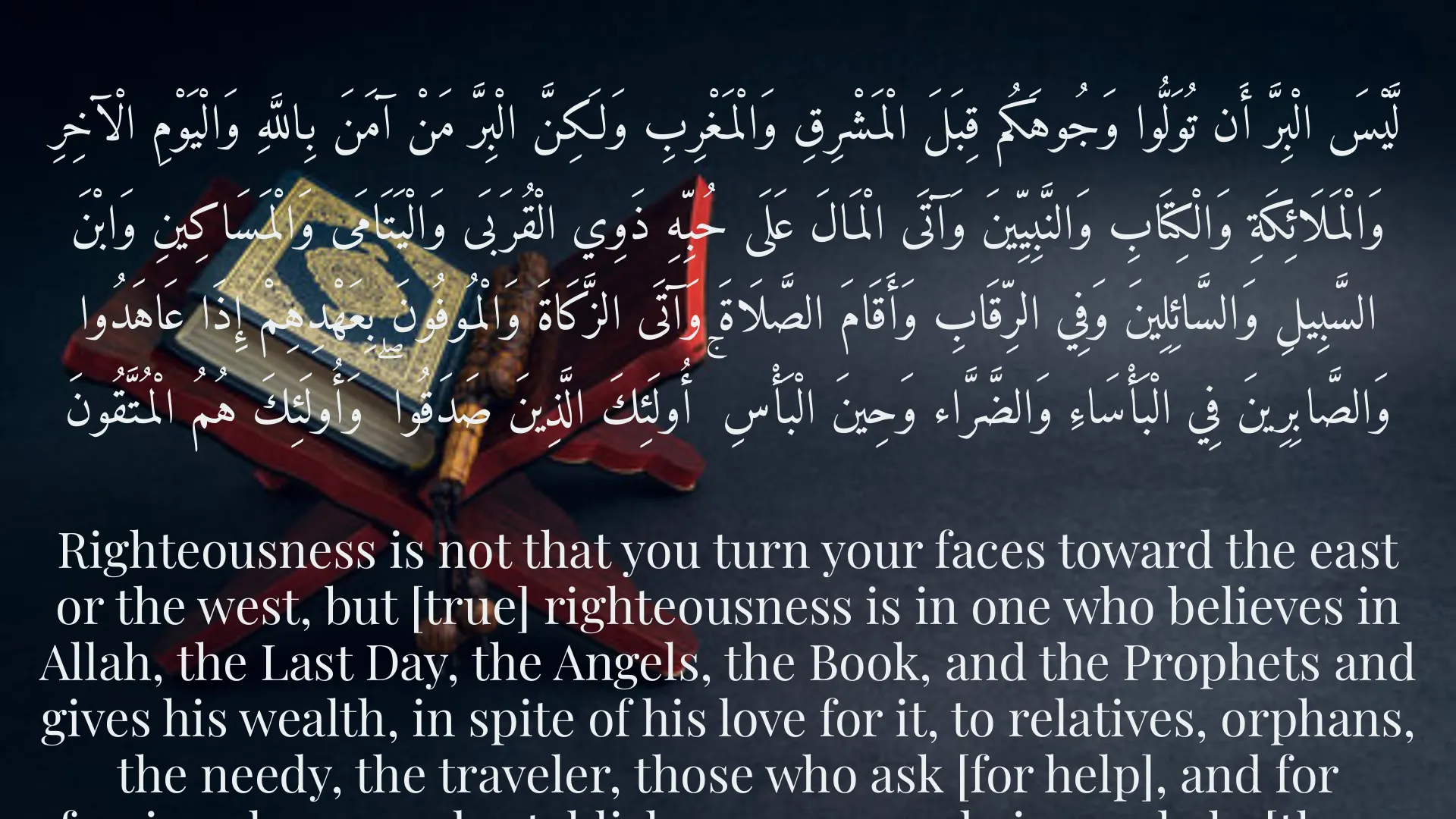
لَّيْسَ الْبِرَّ أَن تُوَلُّوا وَجُوهَكُم قِبَلَ الْمَشْرِقِ وَالْمَغْرِبِ وَلَكِنَّ الْبِرَّ مَنْ آمَنَ بِاللَّهِ وَالْيَوْمِ الْآخِرِ وَالْمَلَائِكَةِ وَالْكِتَابِ وَالنَّبِيِّينَ وَآتَى الْمَالَ عَلَى حُبِّهِ ذَوِي الْقُرَبَى وَالْيَتَامَى وَالْمَسَاكِينِ وَابْنَ السَّبِيلِ وَالسَّائِلِينَ وَفِي الرِّقَابِ وَأَقَامَ الصَّلَاةَ وَآتَى الزَّكَاةَ وَالْمُوفُونَ بِعَهْدِهِمْ إِذَا عَاهَدُوا وَالصَّابِرِينَ فِي الْبَأْسَاءِ وَالضَّرَّاء وَحِينَ الْبَأْسِ ۚ أُولَئِكَ الَّذِينَ صَدَقُوا ۖ وَأُولَئِكَ هُمُ الْمُتَّقُونَ
Righteousness is not that you turn your faces toward the east or the west, but [true] righteousness is in one who believes in Allah, the Last Day, the Angels, the Book, and the Prophets and gives his wealth, in spite of his love for it, to relatives, orphans, the needy, the traveler, those who ask [for help], and for freeing slaves; and establishes prayer and gives zakah; [those who fulfill their promise when they promise] and [those who are patient in hardship and during battle]. Those are the ones who have been true, and it is those who are the righteous.
Al-Baqarah : 177
يَا أَيُّهَا الَّذِينَ آمَنُوا اتَّقُوا اللَّهَ وَكُونُوا مَعَ الصَّادِقِينَ
O you who have believed, fear Allah and be with the truthful.
At-Tawbah : 119
يَا أَيُّهَا الَّذِينَ آمَنُوا اتَّقُوا اللَّهَ وَقُولُوا قَوْلًا سَدِيدًا
O you who have believed, fear Allah and say a word of appropriate justice.
Al-Ahzab : 70
Short Story
Once upon a time, there was a man named Hassan who encountered a fruit vendor in the market. Hassan told the vendor that the price of the pears was too high and that he would not buy them. The vendor, being a kind person, decided to give Hassan a discount. Just before they made a deal, Hassan suddenly remembered the verse from the Quran that stated: 'Deal with honesty and fairness'. He told the vendor that he was willing to pay the actual price, which helped Hassan establish a deeper friendship with the vendor and always practice honesty in his future dealings.