Quranic Answer
In the profound and rich teachings of the Holy Quran, the tongue is regarded as one of the most powerful tools bestowed upon humanity by God. This double-edged sword can either be a key to success and salvation or a source of perdition and grave sins. Therefore, the Quran meticulously addresses numerous instances of verbal missteps that are severely condemned. The purpose of these warnings is to guide humanity towards good, constructive, and pious speech, thereby fostering a healthy society and relationships built on respect and trust. One of the most prominent and severely condemned verbal missteps in the Quran is backbiting (Gheebah) and slander (Buhtan). Backbiting refers to speaking ill of someone in their absence in a way that, if they heard it, would displease them, even if what is said is true. Slander (Buhtan), however, is even more severe; it means speaking falsely and maliciously about someone, attributing to them something they are innocent of. The Quran, in Surah Al-Hujurat, verse 12, uses a shocking analogy to illustrate the ugliness of backbiting: "O you who have believed, avoid much [negative] assumption. Indeed, some assumption is sin. And do not spy or backbite each other. Would one of you like to eat the flesh of his brother when dead? You would detest it. And fear Allah; indeed, Allah is Accepting of repentance and Merciful." This analogy vividly portrays the repulsive nature of backbiting; just as eating the flesh of one's dead brother is a detestable and abhorrent act, backbiting is equally unpleasant and deserving of punishment. Backbiting erodes trust, plants seeds of resentment, and harms the unity of the Muslim community. Slander, being false accusation and fabrication, is an even greater injustice to the innocent individual and is considered a major sin. Another practice vehemently prohibited by the Quran is tale-bearing (Namimah) or malicious gossip. Namimah involves conveying information from one person to another with the intention of creating discord, conflict, and destroying friendly relations. Such an individual constantly engages in mischief and division. The Quran, in Surah Al-Qalam, verses 10 and 11, condemns such individuals, stating: "And do not obey every perjuror, contemptible, ˹10˺ a slanderer, a malicious gossip—˹11˺" (And do not obey every habitually swearing contemptible one, a slanderer going about with slander.) A tale-bearer, by relaying gossip and exaggerating facts, turns intimate relationships into animosity and disrupts the psychological peace of individuals and society. Lying (Kidhb) and false witness (Shahadat az-Zoor) are also among the verbal missteps strongly prohibited by the Quran. Truthfulness is the backbone of faith and integrity, while lying is the foundation of all corruption and depravity. In Surah An-Nahl, verse 105, it is stated: "Only those invent falsehood who do not believe in the verses of Allah, and it is those who are the liars." This verse associates lying with disbelief in Allah's revelations. Lying not only damages a person's character but also creates distrust and insecurity in society. False witness, a clear manifestation of lying, not only distorts justice by presenting falsehood as truth and truth as falsehood but also undermines the foundation of justice and disrupts social order. The Quran explicitly commands to avoid "Qawl az-Zoor" (false statement/false witness), as we read in Surah Al-Hajj, verse 30. Mockery (Sakhriyah), ridicule, and using offensive nicknames (Tanabuz bil Alqab) are also among the verbal vices explicitly forbidden in the Quran. In Surah Al-Hujurat, verse 11, we read: "O you who have believed, let not a people ridicule [another] people; perhaps they may be better than them; nor let women ridicule [other] women; perhaps they may be better than them. And do not insult one another and do not call each other by [offensive] nicknames. Wretched is the name of disobedience after [one's] faith. And whoever does not repent — then it is those who are the wrongdoers." Mocking others is a sign of arrogance and pride, and it instills feelings of inferiority and resentment in the victim. This act infringes upon the human dignity of individuals and contradicts the spirit of brotherhood and equality in Islam. Similarly, addressing others with offensive nicknames or finding fault with them are behaviors that lead to humiliation and annoyance, and instead of strengthening bonds of affection, they foster separation and animosity. Vain speech (Laghw) and speaking without knowledge are also condemned in the Quran. "Laghw" refers to any speech or action that is useless, aimless, false, or worthless. True believers are those who turn away from Laghw, as described in Surah Al-Furqan, verse 72, in the description of the servants of the Most Merciful: "And [they are] those who do not testify to falsehood, and when they pass by ill speech, they pass by it with dignity." This shows that a true believer avoids all false and worthless speech. Furthermore, speaking without knowledge, based on conjecture or fabrication, is another dangerous verbal misstep. In Surah Al-A'raf, verse 33, Allah forbids saying something about which we have no knowledge: "Say, 'My Lord has only forbidden immoralities - what is apparent of them and what is concealed - and sin, and oppression without right, and that you associate with Allah that for which He has not sent down authority, and that you say about Allah that which you do not know.'" This is especially crucial in religious and legal matters, as making statements without knowledge in these areas can lead to significant misguidance. Finally, harsh and vulgar speech (Fahish) is also implicitly condemned in the Quran. Although there might not be a direct verse explicitly naming "vulgar speech," the repeated emphasis in the Quran on "Qawlan Kareema" (noble word), "Qawlan Layyina" (gentle word), and "Qawlan Sadeeda" (straightforward and correct word) implicitly prohibits crude and inappropriate language. For instance, in Surah Al-Isra, verse 23, regarding speaking to parents, even saying "uff" (a word of annoyance) is forbidden, and instead, "Qawlan Kareema" is commanded. This illustrates that the tongue should always be used for respectful, polite, and pleasant speech. Controlling one's tongue from obscene language, insults, humiliation, and speech that causes harm or annoyance to others is a sign of true faith and piety, paving the way for individual and social prosperity.
Related Verses
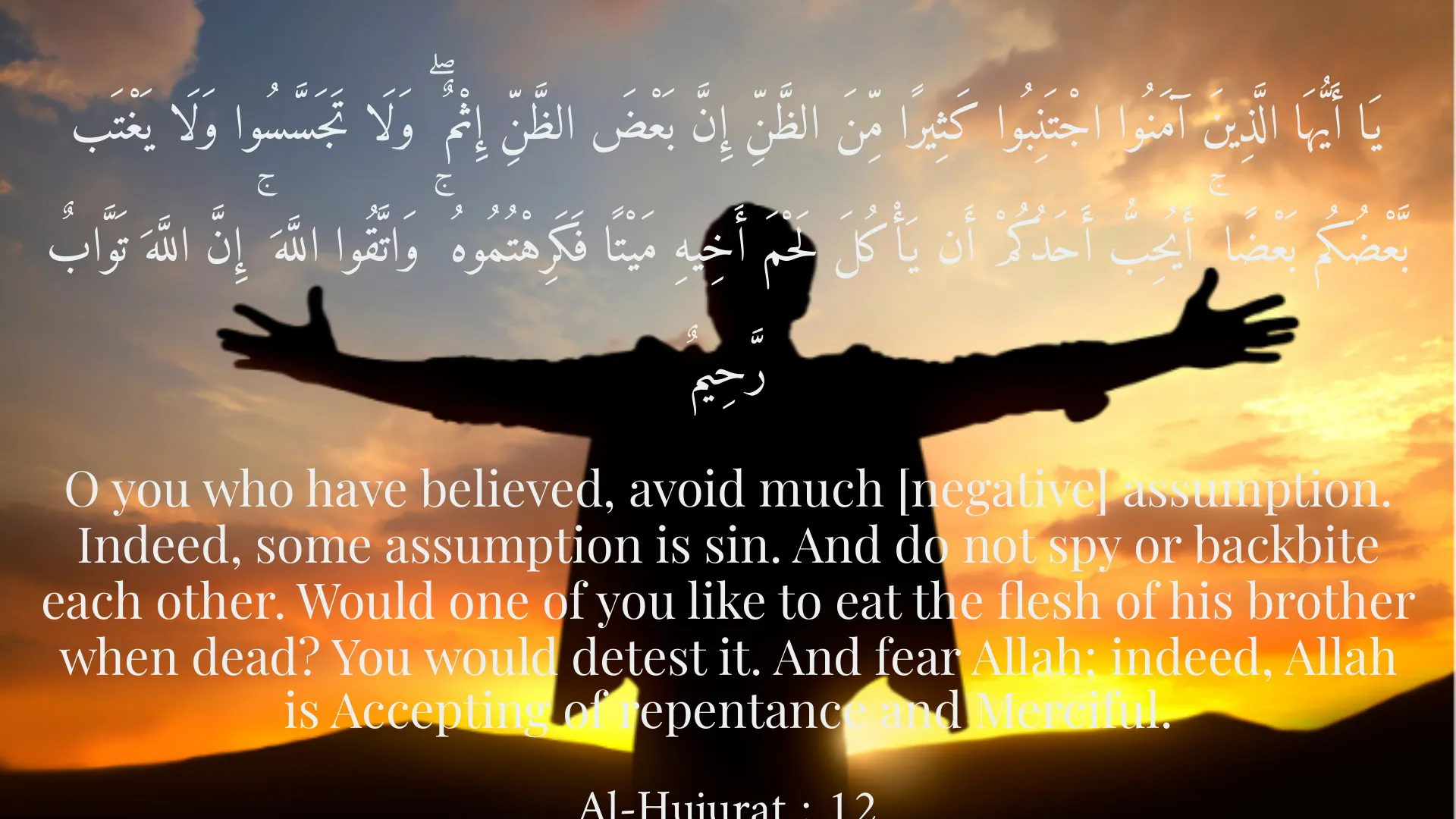
يَا أَيُّهَا الَّذِينَ آمَنُوا اجْتَنِبُوا كَثِيرًا مِّنَ الظَّنِّ إِنَّ بَعْضَ الظَّنِّ إِثْمٌ ۖ وَلَا تَجَسَّسُوا وَلَا يَغْتَب بَّعْضُكُم بَعْضًا ۚ أَيُحِبُّ أَحَدُكُمْ أَن يَأْكُلَ لَحْمَ أَخِيهِ مَيْتًا فَكَرِهْتُمُوهُ ۚ وَاتَّقُوا اللَّهَ ۚ إِنَّ اللَّهَ تَوَّابٌ رَّحِيمٌ
O you who have believed, avoid much [negative] assumption. Indeed, some assumption is sin. And do not spy or backbite each other. Would one of you like to eat the flesh of his brother when dead? You would detest it. And fear Allah; indeed, Allah is Accepting of repentance and Merciful.
Al-Hujurat : 12
يَا أَيُّهَا الَّذِينَ آمَنُوا لَا يَسْخَرْ قَوْمٌ مِّن قَوْمٍ عَسَىٰ أَن يَكُونُوا خَيْرًا مِّنْهُمْ وَلَا نِسَاءٌ مِّن نِّسَاءٍ عَسَىٰ أَن يَكُنَّ خَيْرًا مِّنْهُنَّ ۖ وَلَا تَلْمِزُوا أَنفُسَكُمْ وَلَا تَنَابَزُوا بِالْأَلْقَابِ ۖ بِئْسَ الِاسْمُ الْفُسُوقُ بَعْدَ الْإِيمَانِ ۚ وَمَن لَّمْ يَتُبْ فَأُولَٰئِكَ هُمُ الظَّالِمُونَ
O you who have believed, let not a people ridicule [another] people; perhaps they may be better than them; nor let women ridicule [other] women; perhaps they may be better than them. And do not insult one another and do not call each other by [offensive] nicknames. Wretched is the name of disobedience after [one's] faith. And whoever does not repent — then it is those who are the wrongdoers.
Al-Hujurat : 11
إِنَّمَا يَفْتَرِي الْكَذِبَ الَّذِينَ لَا يُؤْمِنُونَ بِآيَاتِ اللَّهِ ۖ وَأُولَٰئِكَ هُمُ الْكَاذِبُونَ
Only those invent falsehood who do not believe in the verses of Allah, and it is those who are the liars.
An-Nahl : 105
وَالَّذِينَ لَا يَشْهَدُونَ الزُّورَ وَإِذَا مَرُّوا بِاللَّغْوِ مَرُّوا كِرَامًا
And [they are] those who do not testify to falsehood, and when they pass by ill speech, they pass by it with dignity.
Al-Furqan : 72
Short Story
It is narrated that in ancient times, there were two neighbors, one eloquent and talkative, and the other quiet and dignified. One day, the talkative one said to the quiet one, 'My friend, how is it that I see you speak less and attend fewer gatherings of gossip and backbiting?' The quiet one smiled and said, 'My dear, the tongue has two edges; one edge holds the sweetness of speech and guidance, and the other, the bitterness of resentment and regret. Many a word that leaves the mouth costs years of regret and the loss of friends. Saadi, the eloquent, says: "What is the tongue in the mouth, O wise one? / It is the key to the treasure of the skilled." So, if you turn this key carelessly, you might squander a treasure you have strived for years to build. Instead of speaking ill of others in their absence, or hurting hearts with harsh words, let us accustom our tongues to good remembrance and kind speech, so that we may find peace ourselves and fill our surroundings with peace and friendship. For good words are like rain on a dry plain, giving life, while harsh words are like a sword to the heart, inflicting a deep wound.