Quranic Answer
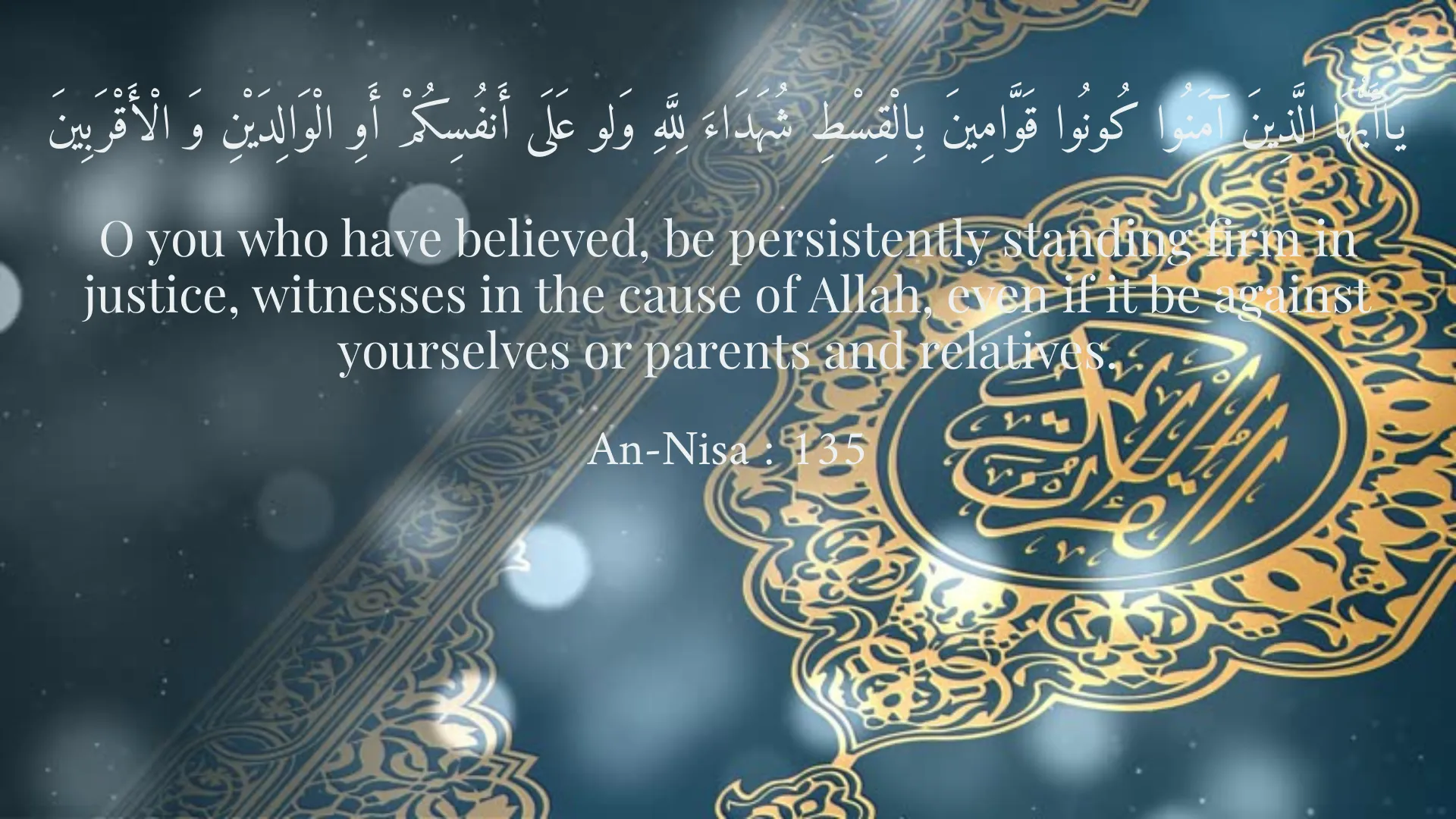
Justice in the Quran is a fundamental principle of Islam, underscored repeatedly throughout its verses. The concept of justice plays a vital role in Islamic teachings and establishes a moral compass for believers. A noteworthy verse that encapsulates the essence of justice can be found in Surah An-Nisa, verse 135, where Allah commands the believers to uphold justice in their judgments and behaviors and to never stray from fairness. This verse states, 'O you who have believed, be persistently standing firm in justice, witnesses in the cause of Allah, even if it be against yourselves or parents and relatives.' Here, Allah emphasizes the basic tenet that justice must be prioritized in every aspect of life, regardless of personal affections or relationships; this indicates that one's commitment to justice should supersede personal interests or familial bonds. The imperative to prioritize justice above personal biases teaches the individual to approach truth and fairness with unwavering integrity. The message conveyed in this verse is profound, urging Muslims to remain steadfast even in the face of adversity or the repercussions of their judgments. This illustrates a unique aspect of Islamic ethics, where justice is deemed non-negotiable, ensuring that truth prevails irrespective of the personal stakes involved. Such a commitment to justice cultivates a society rooted in fairness and equality, fundamentally opposing practices of favoritism or discrimination. Moreover, the Islamic perspective on justice encompasses a holistic approach to respect for every individual's rights while prohibiting discrimination. This essential viewpoint is reiterated in numerous chapters of the Quran, emphasizing that every individual deserves fair treatment. In Surah Al-Ma'idah, verse 8, we see a similar emphasis, where Allah states, 'O you who have believed, be persistently standing firm in justice, witnesses for Allah.' This verse reinforces the notion that Muslims are obligated to be honest and just not only in public platforms but also in their daily interactions and relationships. It serves as a reminder that the integrity of one’s judgments extends beyond personal matters to societal obligations as well. In a broader context, these verses illustrate the importance of a justice-oriented mindset for the Muslim community, advocating for an environment where societal interactions are characterized by equality and fairness. Islam encourages its followers to foster relationships built on principles of justice, which serves to strengthen communal bonds. The Quran speaks to the need to be aware of the particular circumstances faced by individuals in society, which is crucial in establishing a just order in communal affairs. By considering the specific situations and challenges faced by different individuals, a more nuanced and compassionate approach to justice can be adopted. This sensitivity is vital in promoting an inclusive society where every voice is heard, and justice manifests itself beyond mere legalistic definitions. Justice in Islam also encompasses a strong ethical dimension, distinguishing it from punitive interpretations of justice often found in contemporary discussions. It espouses forgiveness, repentance, and the potential for rehabilitation, thereby promoting restorative justice rather than merely punitive measures. The concept of justice transcends merely rectifying injustices; it seeks to restore harmony within the community. It implies a duty not only to avoid wrongdoing but also to actively contribute to the welfare of others. Furthermore, justice acts as a benchmark against which all actions, both personal and social, can be measured. The Quran extensively discusses the need for maintaining a balance in all affairs and upholding the values of justice. It encourages individuals to engage with others in a manner that is respectful and fair, which can be translated into ethical business practices, equitable treatment in politics, and just legal proceedings. This exemplary standard further contributes to the establishment of a society that values integrity and fairness in human interactions, thereby enhancing overall social cohesion. The principle of justice in the Quran has profound implications for governance systems as well. It necessitates fair laws and equitable governance practices, advocating for transparency and accountability from those in power. Leaders are requested to be just, as their actions significantly influence the lives of individuals. In Islamic teachings, leaders are stewards of the community and are thus held to high moral standards. By ensuring justice is foundational in governance, it accentuates the importance of civil rights and the rule of law, which are crucial for social stability and harmony. As Muslims, adhering to the principles of justice fosters a spirit of responsibility that extends beyond personal conduct. It compels individuals to advocate for justice within their communities, engage in social activism, and raise awareness about injustices faced by marginalized populations. This duty is part of the collective responsibility of the Muslim community, to promote a societal framework where justice prevails. By doing so, they reflect the teachings of the Quran which remains relevant and necessary across various contexts and societies. Finally, the essence of justice must always occur within the realms of piety and divine guidance. The Quran contextualizes justice not simply as a social contract but as a moral imperative wedged in spirituality, highlighting that true justice emerges from a heart aligned with God’s commandments. This duality of justice as both a societal obligation and a spiritual tenet signifies its significance in the life of every believer. In conclusion, justice in the Quran serves not only as a guiding principle but likewise as a vital component for fostering a harmonious society. Its emphasis on fairness, equality, and individual rights offers a robust framework for personal conduct and societal organization. Thus, justice stands as one of the most crucial ethical principles within Islam, shaping individual behaviors and guiding the collective moral compass of the community. As Muslims strive to embody these teachings, they contribute to the creation of a just, equitable society that adheres to the divine prerogatives laid out in the Quran.
Related Verses
يَاأَيُّهَا الَّذِينَ آمَنُوا كُونُوا قَوَّامِينَ بِالْقِسْطِ شُهَدَاءَ لِلَّهِ وَلو عَلَى أَنفُسِكُمْ أَوِ الْوَالِدَيْنِ وَ الْأَقْرَبِينَ
O you who have believed, be persistently standing firm in justice, witnesses in the cause of Allah, even if it be against yourselves or parents and relatives.
An-Nisa : 135
يَا أَيُّهَا الَّذِينَ آمَنُوا كُونُوا قَوَّامِينَ لِلَّهِ شُهَدَاءَ بِالْقِسْطِ
O you who have believed, be persistently standing firm in justice, witnesses for Allah.
Al-Ma'idah : 8
Short Story
Once upon a time, a man lived in a city known for its justice. He always endeavored to uphold fairness in his actions and judgments. One day, his brother complained to him, but he, recalling the teachings of the Quran, acted justly and provided a fair response. This led to his brother respecting him more, and in the end, he too embraced the path of brotherhood and fairness.