Quranic Answer
The concept of the 'butterfly effect,' which suggests that the smallest change in one place can lead to large and unpredictable consequences elsewhere, although not explicitly mentioned by this specific name in the verses of the Quran, finds profound resonance and deep connection with fundamental principles and concepts within Islamic teachings. The Holy Quran emphasizes the truth that no action, whether small or large, goes unaccounted for, and every deed, whether on an individual or societal level, will entail its specific results and consequences. This comprehensive perspective is rooted in the Quran's monotheistic worldview, which considers the universe to be governed by a precise and calculated order, connecting everything to the eternal will and knowledge of Allah. One of the most central Quranic concepts directly related to the butterfly effect is the principle of 'Jazaa al-A’maal' or the recompense of deeds. The Quran clearly states that even actions weighing as little as an atom (dharrah) or a mustard seed (khardal), which might seem insignificant from our superficial perspective, are recorded by Allah and will be accounted for on the Day of Judgment. In Surah Az-Zalzalah, verses 7 and 8, we read: 'So whoever does an atom's weight of good will see it, And whoever does an atom's weight of evil will see it.' These verses explicitly demonstrate that even the smallest intentions, words, and actions, no matter how insignificant they may seem at the moment of their execution, possess weight and impact within the divine system and can lead to immense changes in an individual's destiny or even society. This is precisely the essence of the butterfly effect: a small action can be the starting point of a chain of reactions and consequences that lead to large and sometimes unpredictable outcomes. Furthermore, the concept of 'Sunan Allah' or the divine laws governing existence also reinforces this idea. The Quran portrays the universe as an intelligent and law-abiding system, administered according to divine laws, where every action and reaction has its own logic and rule. These laws, sometimes manifest and sometimes hidden, ensure that nothing in this world is unaccounted for or without effect. Surah Yunus, verse 61, states: 'And you are not [engaged] in any matter, nor do you recite any portion of the Quran, nor do you do any deed except that We are witnesses over you when you are involved in it. And not absent from your Lord is any [atom's] weight on the earth or in the heaven or anything smaller than that or greater but that it is in a clear register.' This verse not only emphasizes the comprehensiveness of divine knowledge but also highlights the reality that no action or phenomenon, however minute and trivial, is outside the divine reckoning cycle. This implies that whatever we do, even a glance, a thought, or a word, can be a seed that bears great fruits or immense calamities in the future. The Quran also stresses individual and collective responsibility for actions. Every individual is accountable for their deeds, and the results of those deeds not only affect them personally but can also cast a shadow over their surroundings, family, community, and even future generations. A small personal decision, such as choosing the right path or straying, can alter the destiny of a family; a small act of charity can be the beginning of a significant social movement; and a minor injustice can destabilize the foundations of a society. Quranic narratives, such as the stories of the people of Lut or the people of 'Aad and Thamud, illustrate how the wrongful actions of a few, even if initially appearing insignificant, could lead to widespread punishment and destruction, which is the manifestation of the butterfly effect on a collective scale. In the spiritual dimension, the butterfly effect is clearly manifested in the Quran through concepts such as repentance (tawbah), seeking forgiveness (istighfar), and righteous deeds (amal salih). A sincere regret for a minor sin can open a gateway to divine mercy and a complete change in one's life path; similarly, a pure act of kindness, however small, can lead to a chain of blessings. For instance, the Prophet Muhammad (PBUH) is reported to have said: 'Shame over a bad deed sometimes leads a person to good deeds and compensates for the past.' This demonstrates that even a seemingly small feeling of remorse can lead to significant spiritual and practical transformations. Ultimately, while the Quran does not explicitly use the term 'butterfly effect,' its foundational intellectual and spiritual principles, particularly in emphasizing the interconnectedness of actions and consequences, human accountability, the precision and comprehensiveness of divine knowledge, and the systematic nature of existence, clearly reflect this concept. The Quran warns humanity that no action, however small, is insignificant, and every atom's weight of good or evil will have a lasting impact in this world and the hereafter. This insight not only motivates humans to be meticulous and precise in their smallest actions but also calls them to contemplate the complexities and subtleties of the creation system and the infinite power of the Creator, who manages everything with the utmost precision. This emphasis on the impact of minute and grand actions calls humanity to greater awareness and responsibility, reminding them that their life and the world they inhabit are an interconnected whole, where every part can influence the whole.
Related Verses
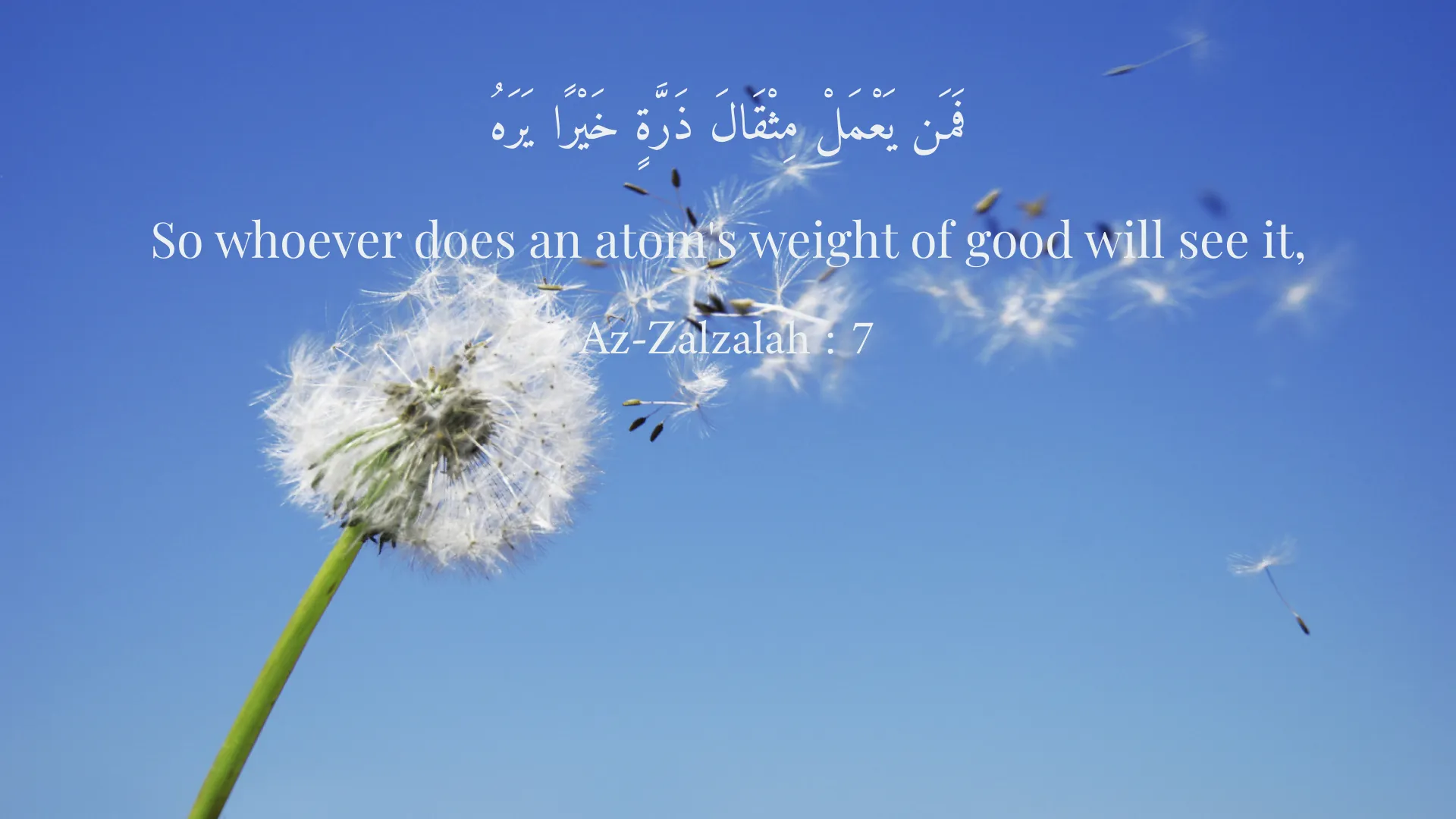
فَمَن يَعْمَلْ مِثْقَالَ ذَرَّةٍ خَيْرًا يَرَهُ
So whoever does an atom's weight of good will see it,
Az-Zalzalah : 7
وَمَن يَعْمَلْ مِثْقَالَ ذَرَّةٍ شَرًّا يَرَهُ
And whoever does an atom's weight of evil will see it.
Az-Zalzalah : 8
وَمَا تَكُونُ فِی شَأْنٍ وَمَا تَتْلُو مِنْهُ مِن قُرْآنٍ وَلَا تَعْمَلُونَ مِنْ عَمَلٍ إِلَّا كُنَّا عَلَیْكُمْ شُهُودًا إِذْ تُفِیضُونَ فِیهِ ۚ وَمَا یَعْزُبُ عَن رَّبِّكَ مِن مِّثْقَالِ ذَرَّةٍ فِی الْأَرْضِ وَلَا فِی السَّمَاءِ وَلَا أَصْغَرَ مِن ذَٰلِكَ وَلَا أَكْبَرَ إِلَّا فِی كِتَابٍ مُّبِینٍ
And you are not [engaged] in any matter, nor do you recite any portion of the Quran, nor do you do any deed except that We are witnesses over you when you are involved in it. And not absent from your Lord is any [atom's] weight on the earth or in the heaven or anything smaller than that or greater but that it is in a clear register.
Yunus : 61
یَا بُنَیَّ إِنَّهَا إِن تَكُ مِثْقَالَ حَبَّةٍ مِّنْ خَرْدَلٍ فَتَكُن فِی صَخْرَةٍ أَوْ فِی السَّمَاوَاتِ أَوْ فِی الْأَرْضِ یَأْتِ بِهَا اللَّهُ ۚ إِنَّ اللَّهَ لَطِیفٌ خَبِیرٌ
O my son, indeed if there is [even] the weight of a mustard seed of it and it is in a rock or in the heavens or in the earth, Allah will bring it forth. Indeed, Allah is Subtle and Acquainted.
Luqman : 16
Short Story
It is narrated in Saadi's Gulistan that Nushirvan, the just king, was hunting a sparrow. At that moment, one of his companions, without permission, picked an apple from a garden. Nushirvan, surprised, asked: 'Why did you do that?' The man replied: 'It was a small apple, and it harmed no one.' Nushirvan, with a kind and wise tone, said: 'This is the beginning of corruption. If a king eats one apple without permission, his soldiers will uproot all the trees in the garden. From us it is that upon us it is.' This beautiful story illustrates how a small, seemingly insignificant act, if overlooked, can lead to a chain of greater corruption and destruction; every action of ours, even the smallest, is the seed of a greater future.