Quranic Answer
The concept of the 'butterfly effect,' originating from chaos theory, suggests that small changes in a system can lead to vastly significant and unpredictable outcomes in the future. This term, commonly illustrated by the example of a butterfly flapping its wings in Brazil potentially causing a hurricane in Texas, is a subject of modern scientific and philosophical discourse. It is important to note that the Holy Quran, as a divine book of guidance, does not directly address modern scientific concepts such as the 'butterfly effect' nor does it use such terminology. The language of the Quran is metaphorical, allegorical, and primarily focused on guiding humanity towards fundamental principles of ethics, actions, and the relationship between humans, God, and the universe. However, one can find principles and concepts within the Quranic verses that bear a profound resonance and alignment with the core idea of the 'butterfly effect' – namely, the significance and widespread impact of small and seemingly insignificant actions. One of the most prominent of these principles in the Quran is the principle of 'Jaza'' (recompense) and the accountability for one's deeds. The Quran explicitly emphasizes that no action, whether good or bad, no matter how small, goes unaccounted for, and its consequences will ultimately become manifest. In Surah Az-Zalzalah (The Earthquake), verses 7 and 8, Allah states: "Faman ya’mal mithqala dharratin khayran yarah; wa man ya’mal mithqala dharratin sharran yarah." This translates to: "So whoever does an atom's weight of good will see it, And whoever does an atom's weight of evil will see it." The word 'dharrah' (ذرة) here refers to the smallest and most insignificant quantity, which can denote a tiny particle or even dust. These verses articulate the Quranic truth that even the most minute actions, words, intentions, or choices of a human being possess a true weight and a real impact within the universal system. These impacts may not be immediately discernible or may not yield their major consequences at once, but ultimately, within the intricate cycle of causes and effects, their results will unfold. This is precisely the essence of the butterfly effect, which emphasizes the non-linear and unforeseen consequences of small actions. For example, a tiny kind word can initiate a chain of friendship and intimacy, whereas a small lie or a minor gossip can lead to major divisions and conflicts within society. The Quran also highlights the power and influence of seemingly simple and small actions. A trifling act of charity, if done with sincere intention, can hold immeasurable value in the sight of Allah and bring abundant blessings to an individual's life and to society. Conversely, a small injustice or a minor inequity, if overlooked and allowed to spread, can lead to systemic corruption and societal decay. This demonstrates that the Quranic perspective on actions extends beyond their initial appearance and size; it considers their hidden, sequential, and cumulative impacts. This concept aligns well with the idea of the butterfly effect, where a minor alteration can affect a large system. Furthermore, the Holy Quran insists that Allah Almighty is fully aware of and encompasses everything, even the smallest particles and the most hidden intentions and actions. In Surah Luqman, verse 16, we read: "Ya bunayya innaha in taku mithqala habbatin min khardalin fatakun fi sakhratin aw fi as-samawati aw fi al-ardi ya’ti biha Allah; inna Allaha Latifun Khabir." This means: "O my son, indeed if there is [even] the weight of a mustard seed and it is [hidden] in a rock or in the heavens or in the earth, Allah will bring it forth. Indeed, Allah is Subtle and Acquainted." This verse illustrates that nothing is hidden from Allah's knowledge and awareness, and even the smallest actions and particles in the universe are part of His divine plan and wisdom. This comprehensiveness of divine knowledge does not contradict the 'unpredictability' aspect of the butterfly effect from a human perspective; rather, it complements it. From a human viewpoint, the outcomes of a small action may seem complex and unpredictable, but from Allah's perspective, all these paths and consequences have been known and decreed from eternity. This signifies that there is no true 'chaos' in the universe; instead, what we perceive as chaos is the complexity of divine order and planning that lies beyond our limited comprehension. Moreover, the concept of change and transformation in individuals and societies can also align with this view. In Surah Ar-Ra'd (The Thunder), verse 11 states: "Inna Allaha la yughayyiru ma bi qawmin hatta yughayyiru ma bi anfusihim." This means: "Indeed, Allah will not change the condition of a people until they change what is in themselves." This verse indicates that major social and historical transformations originate from internal and individual changes. A small decision to repent, a tiny step towards self-improvement, or a seemingly insignificant initiative to better society, can gradually lead to much larger transformations. This idea that significant changes are rooted in small ones is entirely consistent with the concept of the butterfly effect, even if the Quran does not articulate it in scientific terms. In conclusion, while the Quran does not directly use the term 'butterfly effect,' it strongly emphasizes the significance of small actions and their far-reaching consequences. This emphasis encompasses not only ethical and spiritual repercussions in the afterlife but also worldly and social impacts of deeds. This Quranic perspective invites humanity to be vigilant and responsible for every thought, word, and action that emanates from them; for even our smallest deeds can, in the long run, generate significant waves of good or evil in the universe. This itself is a form of 'butterfly effect' defined within the broader scope of ethics, spirituality, and the divine system of cause and effect, reminding humanity that no action, however trivial, is lost in Allah's reckoning, and its consequences will manifest sooner or later.
Related Verses
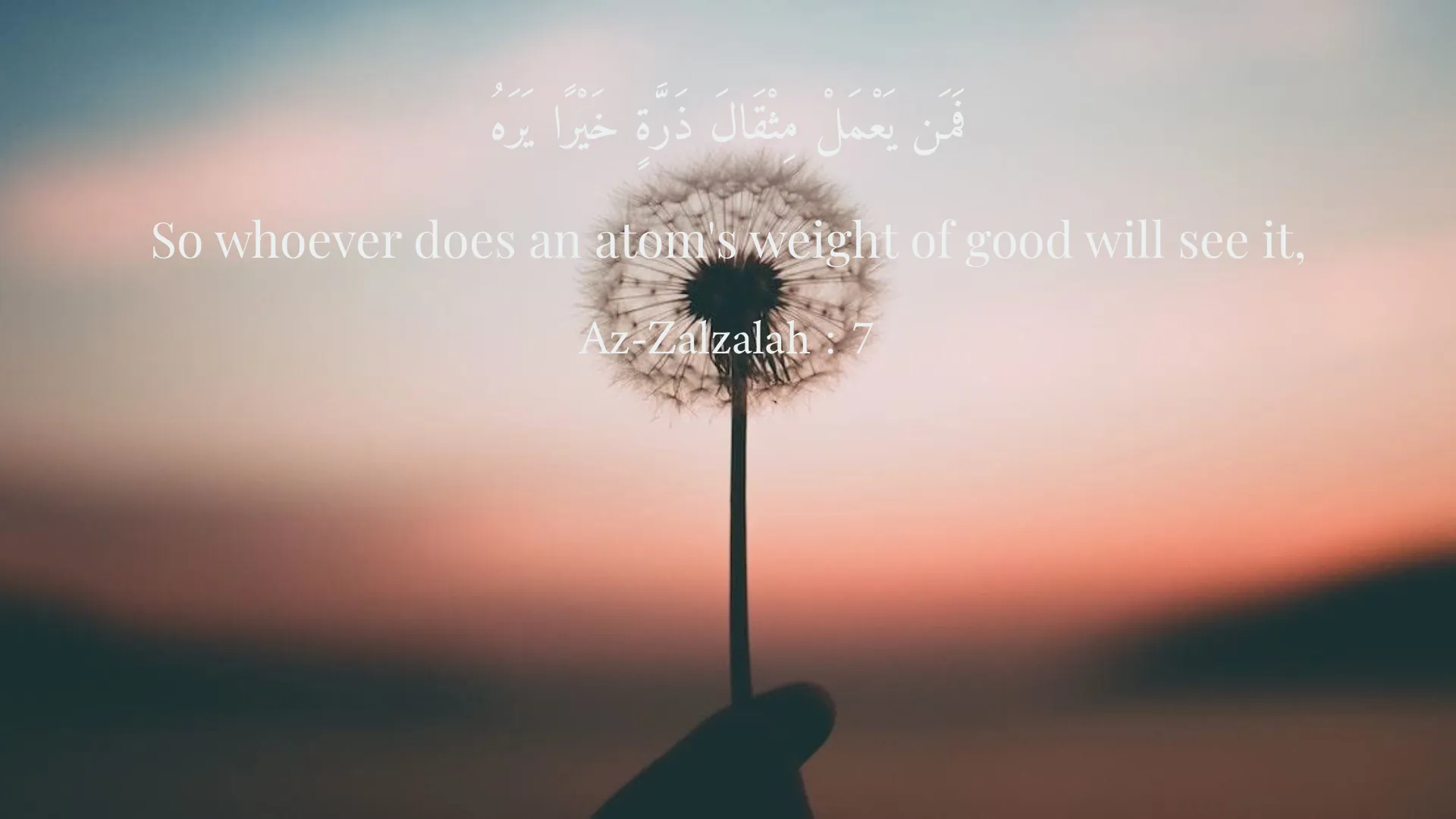
فَمَن يَعْمَلْ مِثْقَالَ ذَرَّةٍ خَيْرًا يَرَهُ
So whoever does an atom's weight of good will see it,
Az-Zalzalah : 7
وَمَن يَعْمَلْ مِثْقَالَ ذَرَّةٍ شَرًّا يَرَهُ
And whoever does an atom's weight of evil will see it.
Az-Zalzalah : 8
يَا بُنَيَّ إِنَّهَا إِن تَكُ مِثْقَالَ حَبَّةٍ مِّنْ خَرْدَلٍ فَتَكُن فِي صَخْرَةٍ أَوْ فِي السَّمَاوَاتِ أَوْ فِي الْأَرْضِ يَأْتِ بِهَا اللَّهُ ۚ إِنَّ اللَّهَ لَطِيفٌ خَبِيرٌ
O my son, indeed if there is [even] the weight of a mustard seed and it is [hidden] in a rock or in the heavens or in the earth, Allah will bring it forth. Indeed, Allah is Subtle and Acquainted.
Luqman : 16
إِنَّ اللَّهَ لَا يُغَيِّرُ مَا بِقَوْمٍ حَتَّىٰ يُغَيِّرُوا مَا بِأَنفُسِهِمْ ۗ
Indeed, Allah will not change the condition of a people until they change what is in themselves.
Ar-Ra'd : 11
Short Story
It is narrated that a benevolent man was passing through a parched plain when he saw a withered tree. He thought to himself, 'Perhaps a bird or a passerby might need water in its shade.' With a small effort, he fetched water from a distant well and, with a small cup, poured it at the roots of that dry tree. This small act, in the eyes of others, might have seemed insignificant, and no one would have imagined what could come of it. But time passed, and by the grace of divine providence and the effort of that kind man, the tree miraculously turned green again, sprouted leaves and branches, and grew mighty. That robust tree became a widespread shade for weary travelers and a safe haven for migrating birds, and its fruits nourished passersby. Many benefited from it, and that benevolent man, years later when he himself had reached old age, as he passed by that tree and saw how life had returned to it and how many were benefiting from it, perceived the immense reward of his small act in the unseen realm. Indeed, though the seed of goodness may be tiny, its fruit is boundless, and its blessings extend beyond our imagination, just as a butterfly's flap can stir up storms and a single drop of water can nourish a sea.