Quranic Answer
In the realm of spirituality and moral philosophy, the relationship between human actions and their consequences is a profound topic that has been examined extensively in religious texts, including the Holy Quran. The Quran, as a divine revelation, outlines not only the actions that humans should undertake but also delves deep into the intentions driving these actions. The significance of intent is stressfully emphasized in Surah Al-Baqarah, verse 225, where Allah notes, 'Allah is All-Aware of what is in your hearts.' This simple yet profound statement captures the essence of ethical conduct within Islam. It suggests that the mere act of doing good is not sufficient; the underlying intention behind these actions plays a crucial role in determining their ultimate effects. Thus, the exploration of how intentions influence the outcomes of human actions is vital for understanding the moral framework within the Quran. Analyzing this topic necessitates a multi-layered approach, as it involves psychological, spiritual, and social dimensions. Practitioners of Islam are often reminded to purify their intentions before embarking on any good deed. This call to self-reflection encourages individuals to evaluate why they are engaging in particular actions. Is it purely for the sake of Allah, or is there an ulterior motive, such as seeking praise and recognition from others? This introspection is key, for actions performed with an honest intention are more likely to yield the positive outcomes that one seeks. Conversely, actions laced with insincerity often lead to unforeseen negative consequences, even if those actions appear beneficial on the surface. For instance, a charity may be given not out of selflessness, but to bolster a person’s image within their community. In such cases, while the act of giving remains, the lack of pure intention can taint the act itself. The law of karma, while present in various religious philosophies, resonates in the Quranic narrative as well—acknowledging that the intention behind an action can drastically influence its fruit. Thus, what may appear as a good deed could have adverse repercussions if it is not rooted in genuine effort and piety. Is this concept too strictly regional or culturally specific? Not at all; such repercussions can be seen universally—but they are explicitly articulated within the Quranic framework. Moving forward, it is also essential to consider the various obstacles and complications that might arise even from deeds that seem inherently good. In Surah At-Talaq, verse 3, the concept of divine mercy and support is expressed: 'And whoever fears Allah, He will make for him a way out.' This suggests a reciprocal relationship between intentionality, piety, and divine intervention. The verse implies that those who remain conscious of Allah in their actions—those who hold sincere intentions—will be guided through difficulties. The divine promise for such individuals is not only solace but also pathways to solutions that may have been obscured by worldly complications. Thus, one must not foolishly assume that all actions deemed positive will naturally lead to favorable results, without regard for the mindset enveloping these actions. Even well-intentioned actions can become muddled with complexities due to external factors that cause them to have unintended consequences. Here, the teachings of the Quran reveal a nuanced understanding of morality that transcends the simplistic binary of good versus evil. Moreover, this complexity necessitates constant self-reflection and a strong connection with God. The interplay of intention and action is not merely an illustration of ethical behavior; it is a call for individuals to engage in ongoing personal growth and evaluation. The emphasis placed on sincerity in actions not only enhances individual spiritual awareness but also impacts communal harmony. When individuals in a community act with pure intentions, it fosters a climate of trust, as the outcomes of good deeds become vehicle for positive societal change. Furthermore, when the collective heart of a community beats in unison—with everyone purposing towards sincere actions aligned with divine guidance—the entire environment cultivates positivity, empowerment, and resilience. In conclusion, the Quranic perspective on the outcomes of human actions intricately binds intentions with their resultant effects. The profound messages within Surah Al-Baqarah and Surah At-Talaq emphasize that intentions serve as the bedrock of ethical actions, which carry significant spiritual and practical implications. Therefore, it is vitally important for practitioners to engage in continual self-assessment, cultivating awareness of their motivations and desires. This journey toward intention purity shapes not only individual destinies but collectively influences the cosmic balance of actions and outcomes within the universe. The essence of sincerity in one’s actions, accompanied by a steadfastness in faith, holds the potential to transform lives and communities, guidance affording a way out in times of struggle and hardship. Ultimately, through aligning our intentions with divine principles, we embark on a path towards a more fulfilling spiritual life, enriched by genuine connections to both God and fellow human beings.
Related Verses
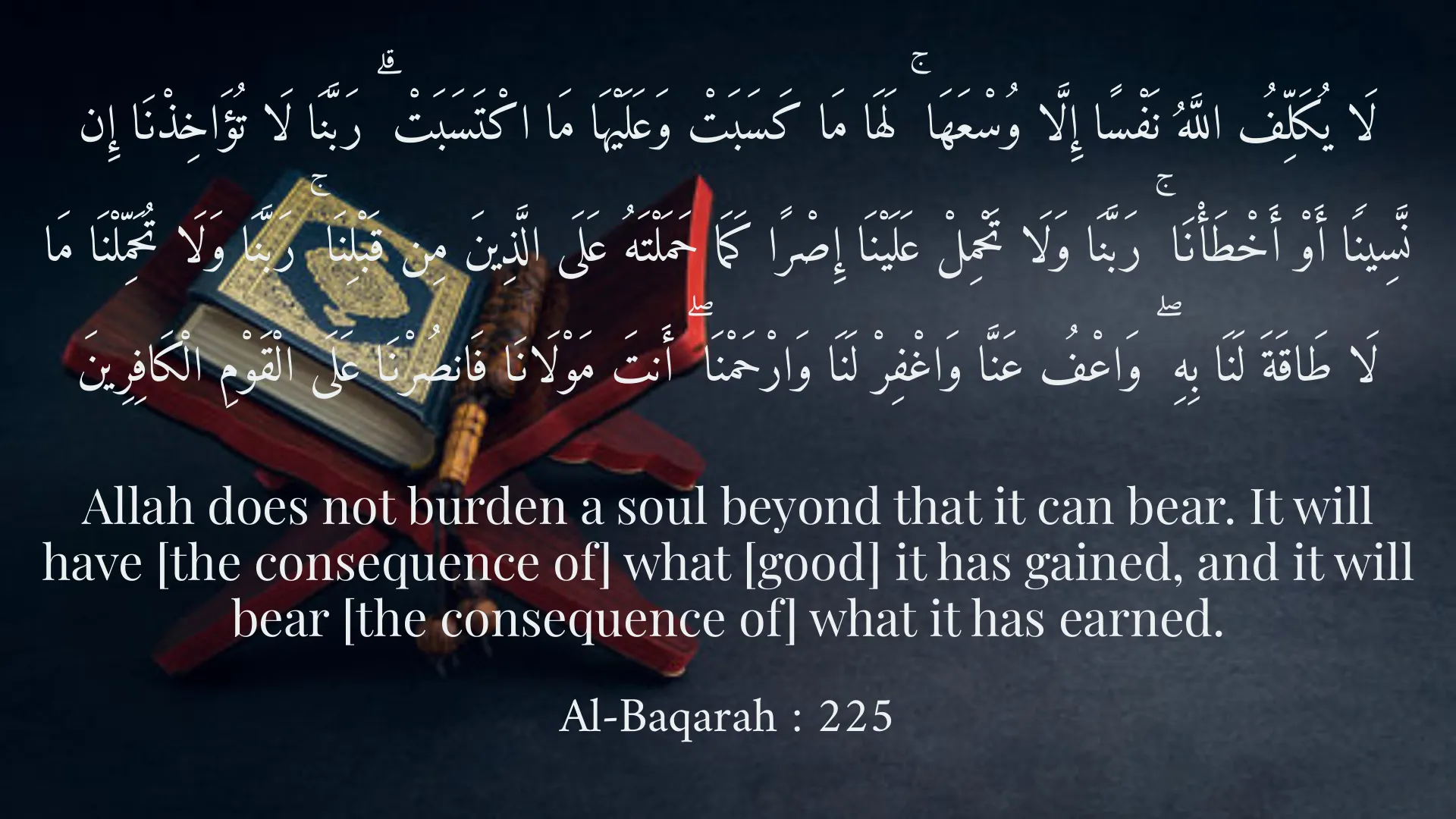
لَا يُكَلِّفُ اللَّهُ نَفْسًا إِلَّا وُسْعَهَا ۚ لَهَا مَا كَسَبَتْ وَعَلَيْهَا مَا اكْتَسَبَتْ ۗ رَبَّنَا لَا تُؤَاخِذْنَا إِن نَّسِينََا أَوْ أَخْطَأْنَا ۚ رَبَّنَا وَلَا تَحْمِلْ عَلَيْنَا إِصْرًا كَمَا حَمَلْتَهُ عَلَى الَّذِينَ مِن قَبْلِنَا ۚ رَبَّنَا وَلَا تُحَمِّلْنَا مَا لَا طَاقَةَ لَنَا بِهِ ۖ وَاعْفُ عَنَّا وَاغْفِرْ لَنَا وَارْحَمْنَا ۖ أَنتَ مَوْلَانَا فَانصُرْنَا عَلَى الْقَوْمِ الْكَافِرِينَ
Allah does not burden a soul beyond that it can bear. It will have [the consequence of] what [good] it has gained, and it will bear [the consequence of] what it has earned.
Al-Baqarah : 225
وَمَن يَتَّقِ اللَّهَ يَجْعَل لَّهُ مَخْرَجًا
And whoever fears Allah – He will make for him a way out.
At-Talaq : 3
Short Story
One day, a man named Amir decided to do a good deed and help a charity. However, his intention was merely to be seen, not from a place of love. When news of his good deed reached him and people praised him, he felt an emptiness inside. At that moment, a verse from the Quran flashed in his mind: 'Allah is with the truthful.' He realized he had found no real joy in his act of charity. Eventually, he decided to purify his intention and continue to do good deeds for the sake of God and humanity and truly thrived and felt happy in that path.