Quranic Answer
In the divine discourse of the Holy Quran, various rhetorical and literary techniques are employed to convey the divine message in the most effective and profound manner, allowing it to penetrate human hearts. One of these highly powerful and meaningful techniques is the initiation of certain verses with an oath (Qasam). These oaths are not merely literary expressions; rather, they carry deep meanings, lofty objectives, and hidden wisdom. Reflecting upon them unravels many existential truths and secrets. The initiation of verses with oaths in the Quran has multiple, deeply rooted reasons, each contributing to the semantic richness and impact of the divine word. The first and perhaps most crucial reason is to emphasize and confirm the truth. In Arab culture, and indeed in many other cultures, an oath serves as a tool to unequivocally affirm a statement, prove the speaker's sincerity, and dispel any doubt. When Allah Almighty swears by something, it signifies that what follows the oath (the 'Muqsam 'alayh' - the object of the oath) is an undeniable, indubitable truth of such significance and certainty that it necessitates a divine oath for emphasis. This method makes the listener realize that they are not dealing with an ordinary or trivial matter, but rather with a subject of such high standing that the Creator of the universe has sworn by it. This emphasis was particularly effective when addressing audiences who harbored doubts about divine truths or outright denied them. The second objective of oaths is to capture the audience's attention and stimulate their capacity for contemplation and reflection. What Allah swears by is typically from among the magnificent creations and astonishing phenomena of existence, including the sun, moon, stars, night, day, dawn, afternoon, fig, olive, the pen, Mount Tur, and even the human soul. These oaths are not solely for emphasizing a point; they are, in themselves, an invitation to ponder the grandeur and order of these phenomena. It is as if Allah, by swearing by these cosmic and internal signs, calls upon humanity to observe them and deduce the boundless existence, power, wisdom, and knowledge of the Creator. Each of these phenomena is a clear sign of God's oneness, the purposeful nature of creation, and the truth of the Hereafter. When a verse begins with "Wa ash-Shamsi wa duhâha" (By the sun and its brightness), the listener instinctively grasps the sun's majesty and its vital role in life, preparing their mind to receive the main message of the verse, which is often about the purification or corruption of the soul. This method serves as a spiritual and psychological prelude, preparing the mind to accept the truth. A third wisdom behind oaths is to bestow honor upon what is sworn by. When Allah swears by one of His creations, it confers upon that phenomenon a high status and dignity. This oath signifies the grandeur, importance, and special role that the phenomenon plays in the cosmic order and in divine wisdom. For instance, the oath "Wa al-Qalami wa mā yasturūn" (By the pen and what they inscribe) in Surah Al-Qalam signifies the immense importance of knowledge, writing, and the transmission of wisdom in the Quranic worldview. This oath illustrates the exalted position of knowledge and its tools in the sight of Allah Almighty and makes humanity aware of their significance on the path of guidance and perfection. Similarly, the oath "Wa at-Tīni wa az-Zaytūn" (By the fig and the olive) not only refers to valuable fruits but also alludes to sacred regions where revelation descended, demonstrating the depth of meaning and breadth of Quranic allusions. Fourthly, oaths create eagerness and encourage the listener to hear the rest of the discourse. Especially at the beginning of short Meccan surahs, which often have a powerful and admonitory tone, oaths act like a hook, capturing the audience's attention and encouraging them to listen and understand what follows. This method was particularly effective in an environment where people resisted or mocked the divine message. With an engaging and powerful opening, the Quran paved the way for the truth to penetrate hearts. Finally, it can be said that oaths in the Quran are not merely rhetorical tools for emphasizing truth and attracting attention. They are bridges between the world of creation and the world of command, between outward signs and inner realities, and between material existence and spiritual messages. Every Quranic oath is a window to a deeper understanding of the Creator, creation, and the purpose of life. These oaths teach us how to contemplate the world around us, how to pay attention to divine signs, and how to use them to strengthen faith and attain knowledge. They serve as a reminder that everything in this universe has been created with precise wisdom, and every phenomenon is a testament to God's infinite greatness and power. The divine message that follows these oaths is rooted in this very greatness and truth.
Related Verses
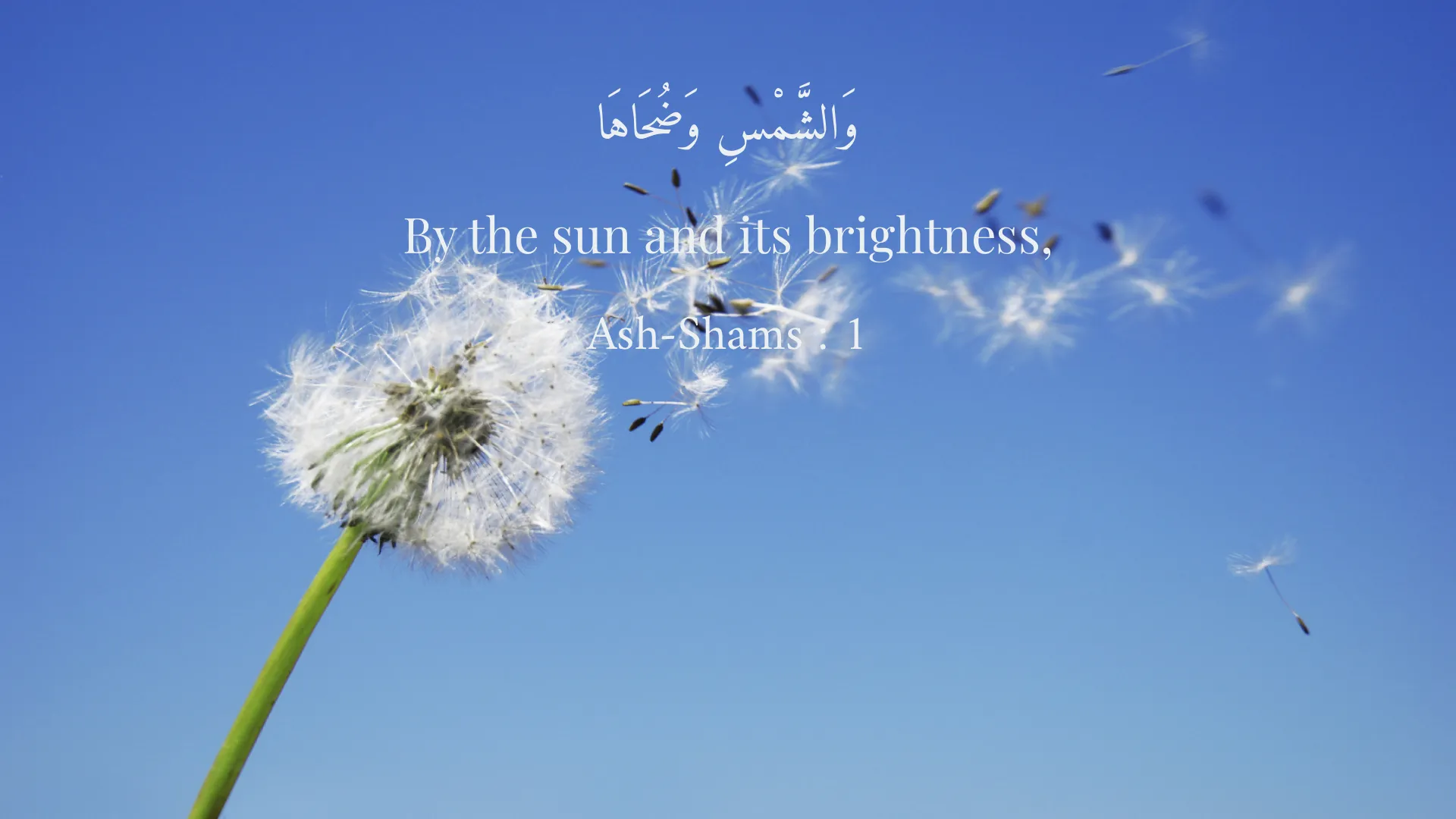
وَالشَّمْسِ وَضُحَاهَا
By the sun and its brightness,
Ash-Shams : 1
وَالْعَصْرِ
By time,
Al-'Asr : 1
وَالتِّينِ وَالزَّيْتُونِ
By the fig and the olive,
At-Tin : 1
ن ۚ وَالْقَلَمِ وَمَا يَسْطُرُونَ
Nun. By the pen and what they inscribe,
Al-Qalam : 1
Short Story
Once upon a time, a wise man was speaking to a gathering, advocating for sincerity and truthfulness in words. One listener, full of doubt, asked, "How can we be sure that your words are the absolute truth?" The wise man smiled and said, "Saadi says: 'Truthfulness is the perfection of a man; crookedness is a sign of baseness.' But in the divine word, sometimes, to provide a firm and conclusive proof of a truth, God Himself swears by the grandeur of His creations. It is as if God, by swearing by the shining sun or the tranquil night, wishes to remind mankind that whatever follows is a truth as clear as day and as firm as night. These oaths are not to prove God's power, for His power needs no oath, but to strengthen your hearts so that you may know how deeply every divine word is rooted in a great truth. They are an invitation to contemplate the very signs you see every day and often pass by. So, instead of doubt, look at the signs and find the truth within them.