Quranic Answer
The Quran, as the foundational text of Islam, serves as a comprehensive guide for all aspects of human life, extending far beyond mere rituals and spiritual devotion. This holistic approach inherently includes detailed guidance on economic ethics, a domain that significantly impacts individual well-being and societal harmony. The profound presence of numerous verses addressing economic principles is not coincidental; rather, it reflects Islam's fundamental commitment to establishing a just, equitable, and morally sound society. This divine emphasis transforms everyday financial transactions and wealth management into acts imbued with spiritual significance, demonstrating that true faith permeates every facet of existence, including the marketplace. One primary reason for the extensive coverage of economic ethics in the Quran is the paramount importance of establishing justice and equity (Adl wa Ihsan). The Quran consistently condemns all forms of oppression, exploitation, and unfair practices. Economic interactions, given their inherent potential for power imbalances and the temptation of greed, are particularly susceptible to injustice. Without clear divine parameters, human avarice can lead to systems where wealth concentrates in the hands of a few, where the vulnerable are exploited, and where deceit becomes a norm. The Quran intervenes precisely to counteract these tendencies, providing a framework that ensures fairness for all participants in economic activities. A prime example is the absolute prohibition of Riba (usury or interest). In Surah Al-Baqarah (2:275), Allah explicitly declares: “Those who consume interest will not stand [on the Day of Resurrection] except as one stands who is being beaten by Satan into insanity. That is because they say, 'Trade is only like interest.' But Allah has permitted trade and forbidden interest. So whoever has received an admonition from his Lord and desists may have what has passed, and his affair rests with Allah. But whoever returns [to dealing in interest] - those are the companions of the Fire; they will abide eternally therein.” This powerful verse not only forbids Riba but articulates the inherent ethical distinction between it and legitimate trade. Riba, by generating wealth without shared risk or productive effort, can perpetuate cycles of debt and exploitation, contrasting sharply with trade that involves effort, risk, and mutual benefit. The Quran seeks to cultivate an economic environment where wealth is earned through honest labor and fair exchange, fostering a system that prioritizes community well-being over individual accumulation through predatory practices. Secondly, the Quran emphasizes social responsibility and welfare (Mas'uliyah Ijtima'iyah wa Rafah). It instills the understanding that wealth is not merely an individual's personal possession but a trust (Amanah) from God, to be managed responsibly for the benefit of the broader community. This principle mandates that wealth must circulate and support the less fortunate, preventing extreme disparities and fostering collective prosperity. This is primarily actualized through the institutions of Zakat (obligatory charity) and Sadaqah (voluntary charity). Zakat, a mandatory annual purification of wealth, is systematically redistributed to specific categories of the needy, while Sadaqah encourages spontaneous acts of generosity. The Quran repeatedly commends those who spend their wealth in the path of Allah, particularly on the poor, orphans, and the destitute. This robust system aims to alleviate poverty, bridge economic gaps, and strengthen social bonds, ensuring that basic needs are met and that no one is left marginalized. The spirit behind these regulations is to build a compassionate society where mutual support flourishes, leading to greater social cohesion and stability. This emphasis on giving extends beyond mere financial transactions; it is a profound spiritual discipline that purifies wealth and cultivates empathy and altruism in the giver, transforming material interactions into opportunities for spiritual growth. Thirdly, the Quran addresses economic ethics as a means for moral purification and spiritual development (Tazkiyah an-Nafs wa Numuw Ruhani). Human beings are often susceptible to the allure of material possessions, leading to vices such as greed, envy, stinginess, and deceit. Economic interactions, more than almost any other sphere, test human character. By providing clear ethical guidelines, the Quran aims to elevate economic activity from a purely materialistic pursuit to a spiritual endeavor. It promotes virtues like honesty, trustworthiness, integrity, generosity, and contentment, while vehemently discouraging fraud, hoarding, extravagance, and waste. Surah An-Nisa (4:29) explicitly cautions: “O you who have believed, do not consume one another's wealth unjustly but only [in lawful] business by mutual consent.” This verse underscores the fundamental principle of consent and legality in all transactions, ensuring that wealth is acquired and utilized through legitimate and mutually agreed-upon means. Furthermore, the strong condemnation of fraudsters, as seen in Surah Al-Mutafeffifin (83:1-3): “Woe to those who give less [than due], Who, when they take a measure from people, take in full. But if they give by measure or by weight to them, they cause loss,” demonstrates the meticulous attention to fairness even in the minutest daily dealings. These injunctions aim to cultivate a deep moral consciousness within individuals, reminding them that every economic act is observed by God and carries significant ethical weight, contributing to the purification of the self and the betterment of society. Fourthly, the integration of economic ethics is crucial for building a stable and righteous society (Bina' Mujtama' Salih wa Mustaqirr). A society rife with economic injustice, corruption, and pervasive poverty cannot achieve genuine peace, stability, or prosperity. The Quran provides a comprehensive framework for an economic system that promotes sustainable growth, encourages productive labor, protects property rights, and ensures the just distribution of resources. When economic principles are firmly rooted in divine morality, they foster an environment of trust, transparency, and accountability, thereby minimizing exploitation and conflict. Such a stable economic foundation enables individuals to pursue their spiritual development and contribute constructively to the community. Conversely, an economically fragmented or unjust society often descends into chaos and instability, impeding the ability of its members to practice their faith and lead fulfilling lives. The Quranic economic model is designed to avert such societal decay by establishing principles that balance material advancement with moral integrity, ensuring that economic development serves humanity's higher purpose. Finally, the Quran imbues economic activity with a profound sense of accountability in the hereafter (Muhasabah fil-Akhirah). Believers are constantly reminded that their wealth – its acquisition, management, and expenditure – will be meticulously accounted for on the Day of Judgment. This eschatological dimension adds an immense layer of meaning and seriousness to all economic behavior. It serves as a powerful deterrent against illicit gains, dishonesty, and excessive greed, while simultaneously acting as a strong incentive for generosity, fair dealing, and responsible stewardship of resources. The Quran establishes that life on earth, including one's economic endeavors, is a comprehensive test where one's true character and devotion to God are fully revealed. This holistic perspective underscores that Islam does not separate the sacred from the secular but integrates economic life as an inseparable part of one's spiritual journey towards God. In summary, the Quran dedicates substantial attention to economic ethics because it perceives economic life as a fundamental and integral aspect of human existence, a critical arena for the manifestation of justice, the exercise of social responsibility, the pursuit of moral integrity, and ultimately, accountability before God. By providing detailed and prescriptive guidance on economic matters, the Quran ensures that human societies are not only materially prosperous but also spiritually enriched and morally upright, perfectly aligning with the comprehensive and all-encompassing nature of the Islamic message. This divine wisdom offers a pathway to safeguard humanity from the perils of unchecked materialism and guides them toward a balanced, harmonious, and divinely sanctioned life, both individually and collectively.
Related Verses
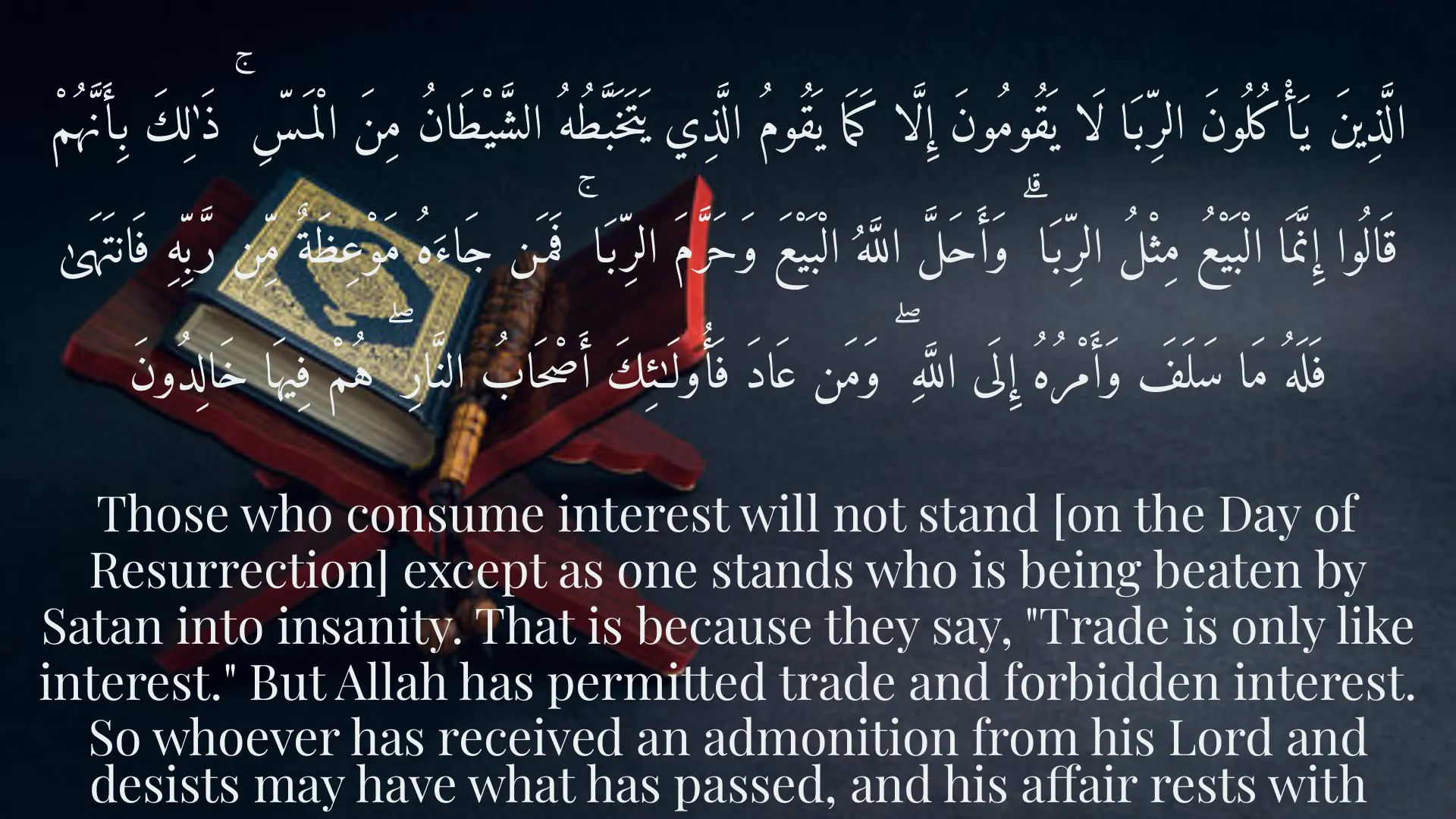
الَّذِينَ يَأْكُلُونَ الرِّبَا لَا يَقُومُونَ إِلَّا كَمَا يَقُومُ الَّذِي يَتَخَبَّطُهُ الشَّيْطَانُ مِنَ الْمَسِّ ۚ ذَٰلِكَ بِأَنَّهُمْ قَالُوا إِنَّمَا الْبَيْعُ مِثْلُ الرِّبَا ۗ وَأَحَلَّ اللَّهُ الْبَيْعَ وَحَرَّمَ الرِّبَا ۚ فَمَن جَاءَهُ مَوْعِظَةٌ مِّن رَّبِّهِ فَانتَهَىٰ فَلَهُ مَا سَلَفَ وَأَمْرُهُ إِلَى اللَّهِ ۖ وَمَن عَادَ فَأُولَٰئِكَ أَصْحَابُ النَّارِ ۖ هُمْ فِيهَا خَالِدُونَ
Those who consume interest will not stand [on the Day of Resurrection] except as one stands who is being beaten by Satan into insanity. That is because they say, "Trade is only like interest." But Allah has permitted trade and forbidden interest. So whoever has received an admonition from his Lord and desists may have what has passed, and his affair rests with Allah. But whoever returns [to dealing in interest] - those are the companions of the Fire; they will abide eternally therein.
Al-Baqarah : 275
يَا أَيُّهَا الَّذِينَ آمَنُوا لَا تَأْكُلُوا أَمْوَالَكُم بَيْنَكُم بِالْبَاطِلِ إِلَّا أَن تَكُونَ تِجَارَةً عَن تَرَاضٍ مِّنكُمْ ۚ وَلَا تَقْتُلُوا أَنفُسَكُمْ ۚ إِنَّ اللَّهَ كَانَ بِكُمْ رَحِيمًا
O you who have believed, do not consume one another's wealth unjustly but only [in lawful] business by mutual consent. And do not kill yourselves [or one another]. Indeed, Allah is to you ever Merciful.
An-Nisa : 29
وَيْلٌ لِّلْمُطَفِّفِينَ
Woe to those who give less [than due],
Al-Mutaffifin : 1
الَّذِينَ إِذَا اكْتَالُوا عَلَى النَّاسِ يَسْتَوْفُونَ
Who, when they take a measure from people, take in full.
Al-Mutaffifin : 2
وَإِذَا كَالُوهُمْ أَو وَّزَنُوهُمْ يُخْسِرُونَ
But if they give by measure or by weight to them, they cause loss.
Al-Mutaffifin : 3
Short Story
It is told that in a bustling city market, there was a merchant renowned for his integrity and honesty. Whenever a customer approached him, he would weigh his goods with accurate and fair scales, never diminishing the weight or quality of his merchandise. People placed complete trust in him, and his business flourished day by day. In the same market, there was another merchant, driven by greed, who constantly tampered with his scales, shortchanging customers to gain more profit. He thought he was clever, but it wasn't long before his dishonesty became known throughout the city, and people turned away from him, causing his business to dwindle. The first merchant, though perhaps not gaining wealth as quickly initially, found that his trustworthiness brought not only blessings to his fortune but also lasting good repute and the perpetual respect of the people. This tale illustrates that the lesson the Quran teaches us—justice and fairness in dealings—not only brings reward in the afterlife but also brings peace and prosperity in this world.