Quranic Answer
The Holy Quran, regarded as the divine scripture of Muslims, extends beyond mere textual recitation; it invites believers and scholars alike to engage in contemplation and deep thought regarding its verses. This divine call towards reflection holds substantial significance, as it serves as a gateway for individuals to uncover deeper meanings and greater truths that are not immediately apparent on the surface. The Quran is not merely a book to be read; it is a profound source of wisdom meant to guide Muslims in their daily lives and spiritual journeys. One of the most compelling invitations to contemplation is encapsulated in Surah Al-Imran, verse 191, where Allah states, 'Do they not reflect upon the creation of the heavens and the earth and the alternation of night and day?' This particular verse emphasizes the importance of observation and inquiry into the natural world around us. It serves as a reminder for human beings to be mindful of the signs presented in creation, urging them to derive knowledge and understanding from their surroundings. Through thoughtful examination, individuals are encouraged to recognize patterns, explore interconnectedness, and gain insights that extend beyond the physical world. Moreover, in another verse from Surah Muhammad, verse 26, God poses a poignant question: 'Do they not reflect on the Quran?' This inquiry is more than rhetorical; it is a clear affirmation of the Quran's inherent call for contemplation. It compels readers to acknowledge the depth of the messages conveyed within its pages and pushes them towards deeper engagement with the text. This emphasis on reflection indicates a profound understanding of the Quran's role in human life—it serves as a conduit for individuals to seek truth, comprehend the divine workings of God, and ultimately, to navigate their existence with wisdom and clarity. The act of reflection, as encouraged by the Quran, does not simply end at gaining intellectual insights. It propels individuals on a transformative journey that can lead to a more profound understanding of themselves, their purpose in life, and their relationship with the Creator. In a world that often prioritizes distraction and superficial understanding, the Quran's call for contemplation acts as a guide, steering individuals back towards introspection and spiritual awakening. It challenges them to ponder the layers of existence, cultivating a richer appreciation for the complexities of life. Contemplation, as emphasized by the Quran, also nurtures spiritual growth. When individuals engage earnestly with the Quranic text and its implications, they unlock a path toward self-improvement and enlightenment. The Quran frequently illustrates that many signs of God's presence exist not only in the broader world but also within human beings themselves. This dual aspect of creation suggests that understanding and recognizing these signs require wisdom—a quality that is often cultivated through contemplation. The Quran’s consistent reminder of reflection encourages people to approach their daily experiences from a fresh perspective. It prompts them to explore the reasons behind events in their lives, the beauty of creation, and the intricate relationships that bind humanity. Each moment and experience becomes an opportunity for learning, leading individuals to embrace both the highs and lows of life. This enriched understanding fosters resilience and wisdom, allowing individuals to face challenges with a sense of purpose. Furthermore, the encouragement of contemplation serves to deepen the relationship between the believer and the Quran. As individuals seek to understand the text's meanings, they become more attuned to its teachings and applications in their daily lives. The Quran transforms from a static scripture into a living guide—a companion that provides insight and guidance through various life circumstances. In addition to fostering spiritual growth and personal development, contemplation of the Quran also enhances social consciousness. It invites individuals to reflect on their responsibilities toward others and the community. The Quran promotes values of compassion, justice, and equality, urging believers to embody these principles in their interactions with others. By contemplating these teachings, individuals can become catalysts for positive change in society, working towards a world that reflects the divine attributes of mercy and justice put forth in the Quran. In the broader context of Islamic theology, the role of contemplation cannot be overstated. The Quran establishes a framework for understanding the nature of God, creation, and human existence. Those who approach the Quran with an open heart and a reflective mind are more likely to gain insights that resonate with their personal experiences and the world around them. The Quran’s multifaceted teachings offer layers of meaning that can be peeled back through contemplation, revealing truths that were previously concealed. In conclusion, the Quran stands as a profound invitation to contemplation and thoughtfulness, urging individuals to engage deeply with its verses. It prompts humanity to observe the intricate details of creation, question the nature of existence, and explore their own inner landscapes. This process of reflection is not merely an intellectual exercise; it is a journey towards spiritual awakening and personal transformation. As Allah’s messages unfold, individuals come to appreciate the signs of God both within and outside themselves. The Quran thus emerges as a timeless source of wisdom, guiding believers in their quest for meaning, truth, and fulfillment in life. Therefore, embracing the call to reflect upon the Quran is paramount for anyone seeking to navigate their life purposefully and spiritually.
Related Verses
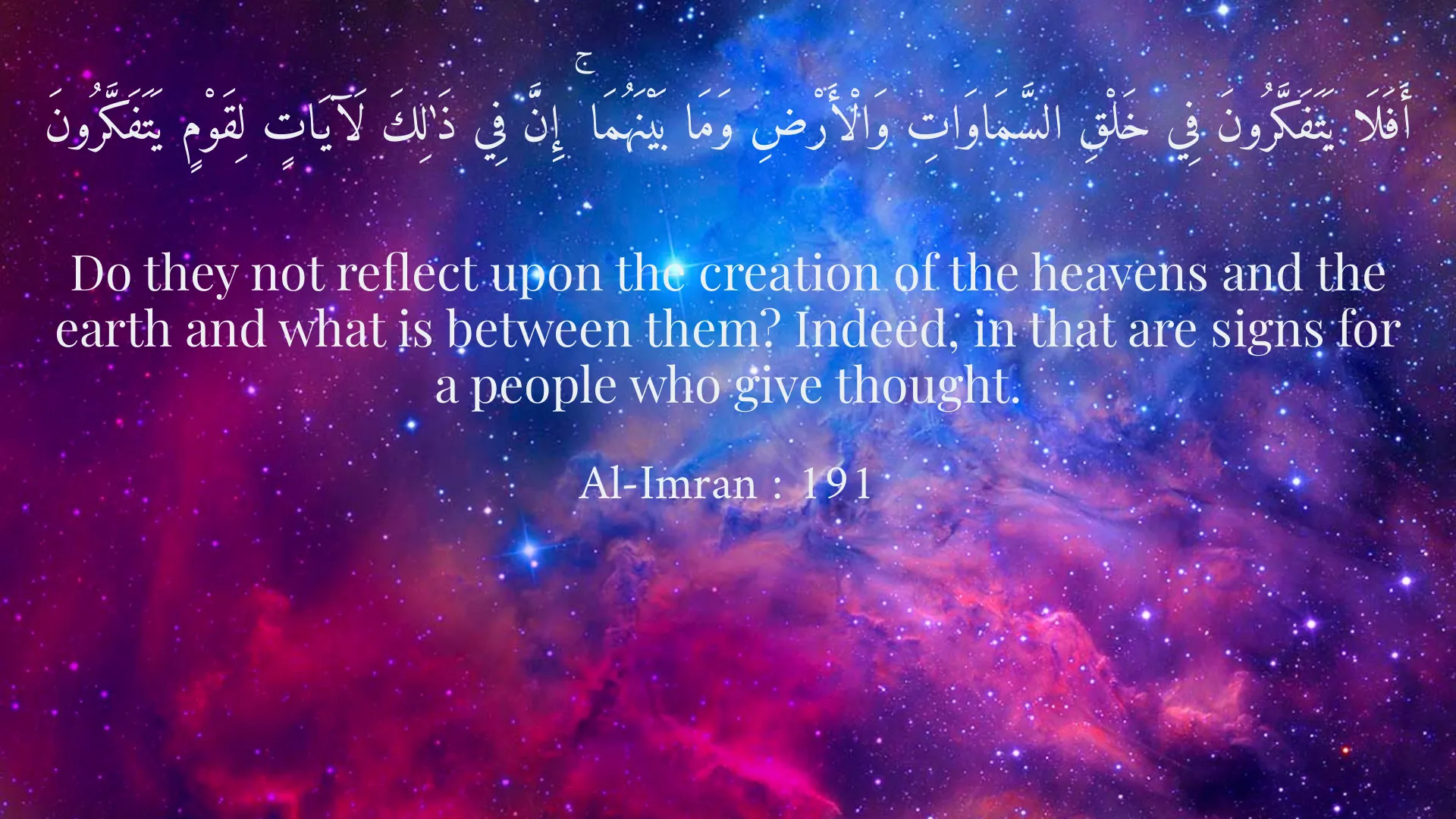
أَفَلَا يَتَفَكَّرُونَ فِي خَلْقِ السَّمَاوَاتِ وَالْأَرْضِ وَمَا بَيْنَهُمَا ۚ إِنَّ فِي ذَٰلِكَ لَآيَاتٍ لِقَوْمٍ يَتَفَكَّرُونَ
Do they not reflect upon the creation of the heavens and the earth and what is between them? Indeed, in that are signs for a people who give thought.
Al-Imran : 191
أَلَمْ يَتَدَبَّرُوا الْقُرْآنَ أَمْ عَلَى قُلُوبٍ أَقْفَالُهَا
Do they not reflect upon the Quran, or are there locks upon their hearts?
Muhammad : 26
Short Story
On a delightful day, a young man named Ali decided to reflect more on the Quran. While walking in the park, he looked up at the sky and suddenly recalled a verse that stated, 'Do they not reflect upon the creation of the heavens and the earth?' He felt as if God was calling him to contemplation, and this feeling deepened his understanding. After that, Ali resolved to allocate time every day for thinking about the verses of the Quran, filling his life with peace and hope as a result.