Quranic Answer
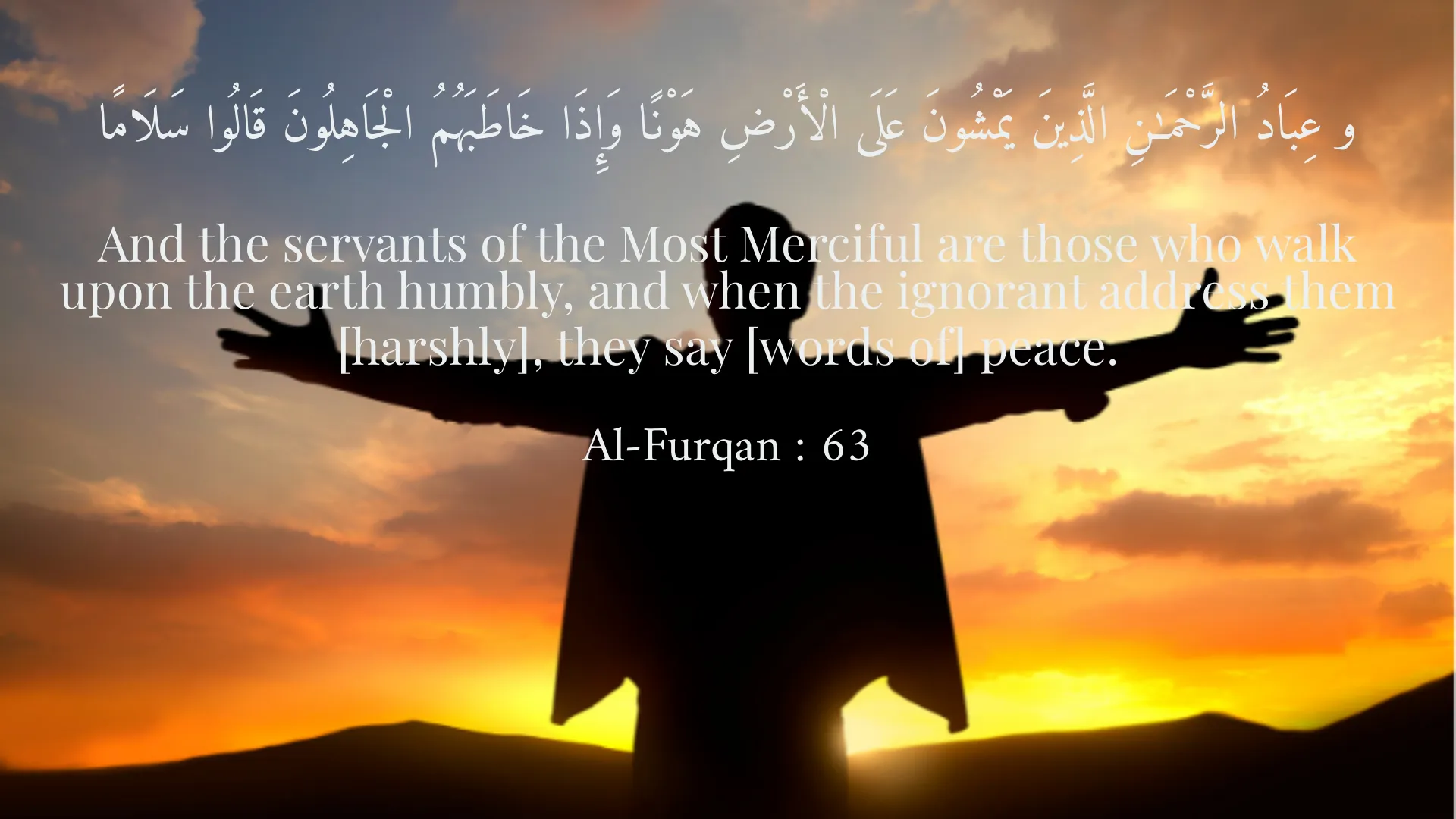
The Holy Quran, revered by Muslims as the divine revelation from Allah, emphasizes various moral and ethical characteristics that form the foundation of a righteous life. Among these characteristics, humility stands out as a vital quality essential for individual development and societal harmony. The Quran presents humility not just as a mere act of modesty but as a comprehensive approach that leads to personal integrity, social betterment, and spiritual elevation. In Surah Al-Furqan, verse 63, we find a profound message encapsulated in a succinct yet powerful statement: "And the servants of the Most Merciful are those who walk upon the earth humbly, and when the ignorant address them [harshly], they say [words of] peace." This verse lays the groundwork for understanding the essence of humility in the Islamic context. It delineates the behavior of those who are true servants of Allah—they walk humbly on the earth, indicating a lifestyle steeped in modesty and respect toward others. The imagery of walking "humbly" suggests that true humility is an active choice, rather than a passive state of being. It implies that individuals should consciously choose to adopt a demeanor characterized by modesty while navigating through life. The Quran illustrates that the sincere servants of Allah treat everyone—with no exceptions—with kindness and grace, irrespective of the treatment they receive in return. When faced with ignorance or hostility, they respond with words of peace, demonstrating a profound level of emotional intelligence and restraint. This reaction not only showcases their character but importantly serves as a model for others, promoting a culture of calmness and appropriate responses even in confrontational situations. In this regard, humility serves to cleanse the heart and soul from the detrimental effects of pride and vanity. In a world that often glorifies success, wealth, and power, the notion of humility can appear counterintuitive. However, the Quran urges humanity to recognize that the trappings of pride only lead to a fortified sense of isolation from others and from the divine. Through humility, individuals can relate better to one another, breaking down barriers that often arise from egotism. Additionally, in Surah An-Nisa, verse 36, the Quran further emphasizes the importance of humility in interpersonal relationships. The verse stipulates, "Worship Allah and associate nothing with Him, and to parents, do good." Here, the instruction to treat parents and others well inherently encompasses the principle of humble behavior. The act of caring for one’s parents with reverence, love, and humility exemplifies a fundamental duty enshrined in Islamic teachings. By encouraging respectful treatment of parents and others, the Quran not only fosters family values but also establishes a ripple effect, promoting societal harmony rooted in mutual respect and understanding. Humility plays an essential role in nurturing social relationships. When individuals embody this quality, it paves the way for deeper connections and more fulfilling relationships. People are naturally drawn to those who demonstrate humility because such individuals exude warmth, compassion, and approachability. This mutual respect fosters a sense of belonging and community, which is fundamental for social cohesion. Moreover, the act of being humble can enhance one’s own sense of happiness and fulfillment. In a society that often equates worth with status and achievements, humility acts as a refreshing alternative, reminding individuals that true value lies beyond superficial markers of success. The internal peace achieved through faith combined with humble actions can lead to a contentment that transcends material gains. In essence, the Quran advocates for a life led by humility for both individual and collective wellbeing. Recognizing oneself in relation to others and acknowledging one’s limitations contribute to personal growth. This acknowledgment does not diminish one's spirit or worth, rather it enriches the individual’s perspective and encourages a life dedicated to serving not only God but also humanity. Furthermore, considering humility from a spiritual perspective can create an understanding that humans are mere servants of a greater power—the Most Merciful. Recognizing one’s smallness in comparison to the divine fosters a sense of gratitude and entitlementlessness. Such awareness can cultivate a profound respect for others, recognizing their worth as fellow creations of Allah. However, the journey towards humility can often be challenging in societies that promote competitiveness and individualism. It requires conscious effort to deconstruct inherent biases that exalt personal achievements while undermining the contributions of collective humanity. Through education, reflection, and practice, believers are encouraged to foster lives imbued with humility, which can profoundly transform social norms. In conclusion, the Holy Quran emphasizes humility as an essential characteristic for spiritual and moral growth. By modeling humble behavior, believers can navigate their lives with grace, foster positive relationships, and ultimately find inner peace. The teachings in the Quran offer timeless wisdom that remains relevant in contemporary society, encouraging individuals to embrace humility as a path toward not only personal contentment but also societal harmony. In this manner, the tenet of humility becomes a guiding principle, promoting not just individual betterment but a more compassionate and understanding world.
Related Verses
و عِبَادُ الرَّحْمَـٰنِ الَّذِينَ يَمْشُونَ عَلَى الْأَرْضِ هَوْنًا وَإِذَا خَاطَبَهُمُ الْجَاهِلُونَ قَالُوا سَلَامًا
And the servants of the Most Merciful are those who walk upon the earth humbly, and when the ignorant address them [harshly], they say [words of] peace.
Al-Furqan : 63
وَاعْبُدُوا اللَّهَ وَلَا تُشْرِكُوا بِهِ شَيْئًا وَبِالْوَالِدَيْنِ إِحْسَانًا
And worship Allah and associate nothing with Him, and to parents, do good.
An-Nisa : 36
Short Story
Once in a village, there was a man named Hossein who always behaved with humility and modesty. One day, one of his neighbors, who was an arrogant person, spoke to him, and Hossein responded gently. This behavior of Hossein impacted the neighbor, leading him to decide to set aside some of his arrogance. Hossein showed him that humility can strengthen friendships and beautify life.