Quranic Answer
Lying is a disapproved behavior in Islam, and the Holy Quran emphasizes this point extensively. From its teachings and principles, Islam promotes a society built on trust, honesty, and integrity. It recognizes that even small lies can lead to harmful consequences that jeopardize interpersonal relationships and societal harmony. In exploring the significance of truthfulness, the consequences of lies, and the teachings from the Quran regarding this matter, we understand why honesty is intrinsically valued in Islam and how it can help shape a moral community. One of the most direct admonitions against lying in the Quran can be found in Surah Al-Baqarah, verse 42, where Allah admonishes the believers: "And do not mix the truth with falsehood or conceal the truth while you know [it]." This verse powerfully illustrates how lying is not merely a verbal misrepresentation but an act of concealment that corrupts the very essence of truth. Mixing truth with falsehood not only deceives others but also leads the individual away from the straight path laid out by Allah. In Islam, truth is seen as a divine quality, and deviating from this quality by lying is a serious misstep. Moreover, lying has dire repercussions on an individual’s faith and relationship with Allah. For instance, Surah Az-Zumar, verse 3 states: "Beware! The religion is for Allah alone. And those who take protectors besides Him [say], 'We only worship them so that they may bring us closer to Allah.'" This verse emphasizes the importance of sincerity in worship and actions. It warns against the deceptive practice of seeking intermediaries in faith and reaffirms that lying, even as a means to achieve a perceived beneficial end, could lead one astray. The practice of lying can create intricate webs of deceit that distance the individual from Allah, who values transparency and honesty over falsehood. In a broader context, the implications of lying extend beyond individual accountability. Societal trust hinges significantly on the honesty of its members. A lie, regardless of its magnitude, has the potential to erode trust within social relationships and even within a community at large. Communities reliant on mutual trust and honesty thrive, while those where deceit becomes commonplace fracture and become plagued by suspicion and uncertainty. When individuals witness lies, even minor ones, they become more inclined to question the integrity of social interactions, leading to a culture of distrust. The Holy Prophet Muhammad (peace be upon him) profoundly articulated this in his teachings about honesty. He stated, "Truth leads to righteousness, and righteousness leads to Paradise. A man will continue to tell the truth until he is recorded with Allah as a truthful person. And beware of lying, for verily, lying leads to wickedness, and wickedness leads to Hellfire. A man will continue to lie until he is recorded with Allah as a liar." This hadith starkly outlines the spiritual trajectory from honesty to virtue and from lies to vice, indicating that the quality of truthfulness is essential for one’s spiritual well-being and moral standing. From a psychological and social perspective, the consistency of honesty cultivates mental well-being. Living a life anchored in honesty facilitates mental peace and reduces the cognitive dissonance that often accompanies deceit. When individuals tell the truth, it liberates them from the burdens of maintaining falsehoods. Furthermore, honest behavior fosters open communication, nurturing healthy relationships that are critical for emotional support and community cohesion. Conversely, dishonesty breeds anxiety and stress. The expendable energy required to remember lies and maintain a facade takes a toll on one’s mental health. The underlying fear of being exposed can lead to pervasive anxiety and paranoia. The Islamic perspective, emphasizing transparency, actively promotes mental stability and tranquil living. By steering clear of lies and deceitful acts, one aligns with the ethical teachings of Islam, fostering not only personal integrity but also contributing to social stability and harmony. Moreover, the emphasis on truth in Islam serves to empower individuals against manipulation and exploitation by others. In a world rife with misinformation and opportunistic behavior, the principles laid out in Islamic teachings encourage believers to uphold truth as a shield against deceit. By cultivating an inner commitment to honesty, individuals are not easily swayed by external influences that leverage deceitful strategies to exploit or mislead. In conclusion, the disapproval of lying in Islam is multifaceted, extending from spiritual implications to societal consequences. The Holy Quran clearly articulates the importance of truthfulness, emphasizing that even small lies can lead to significant harm, both to individuals and society. The call to avoid mixing truth with falsehood is a cornerstone of moral behavior and communal living. Therefore, fostering an environment of honesty is not merely a personal virtue but a path toward building a cohesive and thriving society. By reinforcing a culture rooted in truth, we not only adhere to the teachings of Islam but also promote the mental and social health of our communities. It is imperative for believers to internalize these principles of honesty and recognize their profound implications on both personal conduct and collective societal norms.
Related Verses
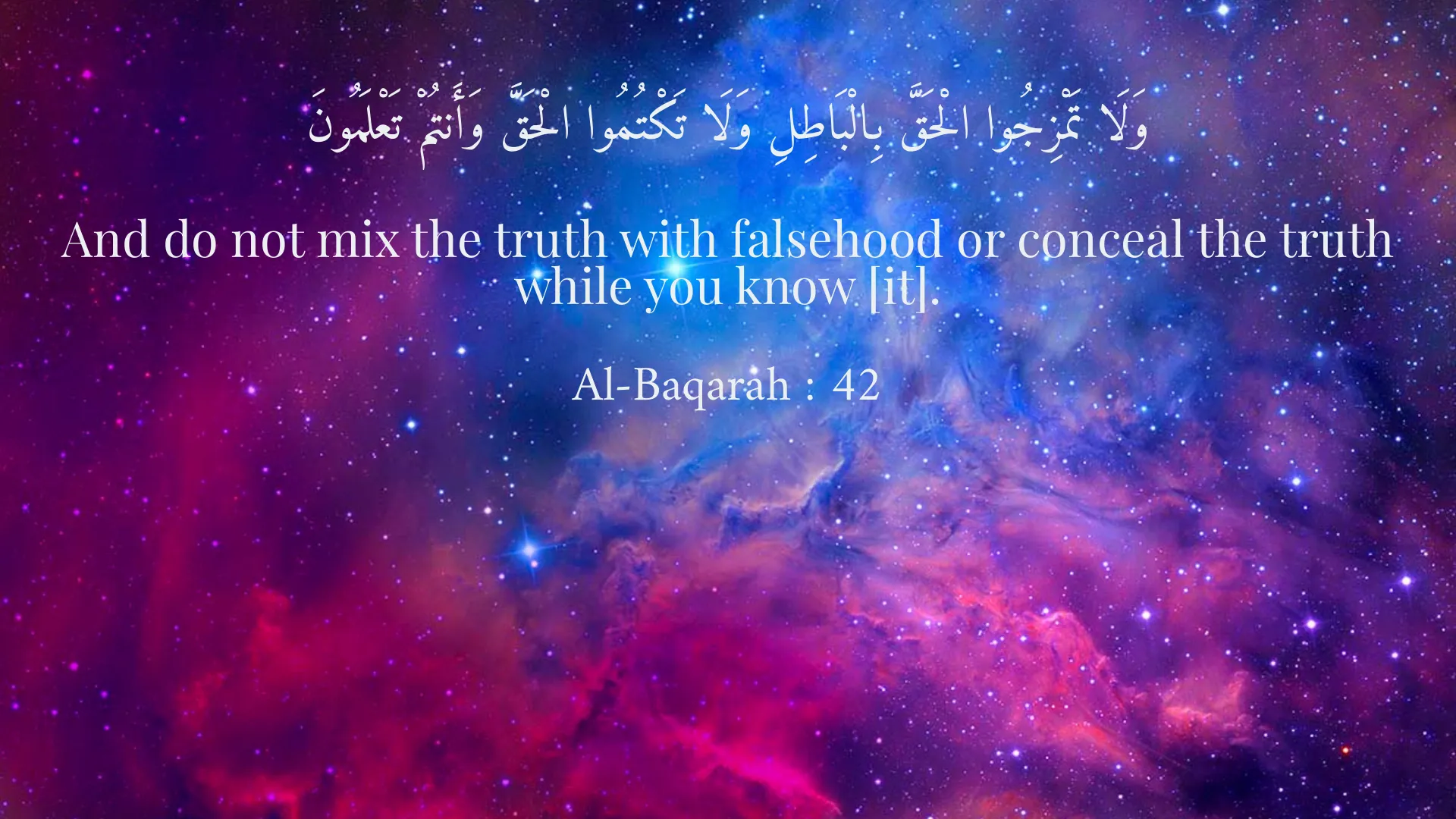
وَلَا تَمْزِجُوا الْحَقَّ بِالْبَاطِلِ وَلَا تَكْتُمُوا الْحَقَّ وَأَنتُمْ تَعْلَمُونَ
And do not mix the truth with falsehood or conceal the truth while you know [it].
Al-Baqarah : 42
أَلْمَغَصْدُ الأَوْلَى لِلَّهِ ووَظَائِفَ الألَهَ عَلَى الَغَيْرِ
Beware! The religion is for Allah alone.
Az-Zumar : 3
Short Story
In a distant time, two friends named Ali and Hassan were always close to each other. One day Hassan told Ali, 'I told a small lie to a friend to make him feel better.' Ali, with concern, replied, 'Every lie, no matter how small, has its consequences. He may feel happy at first, but when he discovers the truth, he will become distrustful of you.' Reflecting on this, Hassan decided to avoid lying, even in minor details, and build his relationships with others on honesty.