Quranic Answer
In the profound and comprehensive teachings of the Holy Quran, silence in the face of evil and wrongdoing is not merely passive indifference; rather, it is a clear violation of a divine and social duty. The glorious Quran calls upon believers to play an active role in reforming society and establishing justice. This vital duty, known in Islamic terminology as "Amr bil Ma'ruf wa Nahi anil Munkar" (enjoining good and forbidding evil), is the cornerstone of a virtuous and faithful society. The imperative to not remain silent in the face of evil stems from several Quranic principles and divine wisdom, which not only ensure individual salvation but also guarantee the survival of the community. Firstly, a Clear Divine Command and Social Responsibility: The Quran explicitly commands believers to actively stand against evil. In Surah Al-Imran, verse 104, Allah states: "And let there be [arising] from you a nation inviting to [all that is] good, enjoining what is right and forbidding what is wrong, and those will be the successful." This verse is not merely advice but a definitive command, asserting that the existence of a group dedicated to enjoining good and forbidding evil is essential for the community's success. Silence, in this context, means ignoring this divine command and steering the community away from the path of salvation. This responsibility is not solely individual; it is a collective duty placed upon the entire Muslim Ummah. If individuals or the community as a whole shirk this responsibility, the fabric of society will unravel, and corruption will become pervasive. A society that remains silent in the face of wrongdoing effectively permits its growth and proliferation, which amounts to passive participation in corruption. The silence of activists and righteous individuals opens the door for abusers and corrupt individuals, as they face no obstacles to their whims and greed. This negative dynamic gradually weakens moral and human values, pushing society toward decline. A true believer is not only righteous themselves but also strives to create a societal environment conducive to the growth of good and to prevent the spread of evil. This duty signifies the religious zeal and social responsibility of a Muslim individual. Secondly, Learning from Previous Nations and Preventing Divine Punishment: The Quran repeatedly refers to the fate of nations that incurred divine punishment because they abandoned this crucial duty. Surah Al-Ma'idah, verses 78 and 79, provides clear evidence for this claim: "Those who disbelieved among the Children of Israel were cursed by the tongue of David and of Jesus, the son of Mary. That was because they disobeyed and used to transgress. They did not forbid one another from Munkar (wrongdoing) that they did. How wretched was that which they were doing." These verses clearly indicate that silence in the face of sins and evil leads to divine wrath and curse, driving society towards destruction. Silence is not just an individual sin, but a societal one that can have severe consequences for the entire community. The Quranic narratives are replete with lessons demonstrating that societies which remained silent in the face of oppression and corruption experienced tragic fates. This silence lights the path of deviation for future generations. Indeed, this silence is a form of tacit approval of sin, and those who approve of sin are considered partners with the sinners. This Quranic warning is a strong motivation for believers not to neglect this vital duty for their own salvation and that of their community, and instead of hiding behind silence, to wisely and insightfully confront wrongdoings. Thirdly, Preserving Societal Health and Preventing the Spread of Corruption: Evil and wrongdoing are like an infectious disease. If not confronted at the outset, they rapidly spread and contaminate all aspects of society. Silence is tantamount to overlooking this disease and allowing it to consume the health of the community. When righteous and truth-seeking individuals remain silent, wrongdoers become bolder and find more space for their activities. The Quran believes that a healthy society is one where enjoining good and forbidding evil is active, as this prevents corruption and wrongdoing from dominating goodness and righteousness. This confrontation means creating an environment where justice and morality prevail over injustice and immorality, and the public conscience remains awake. Failure to confront evil gradually diminishes its reprehensibility, turning it into something ordinary and even acceptable. This phenomenon, known in social psychology as "normalization," is the greatest danger to the spiritual health of a society. The duty of enjoining good and forbidding evil acts like the body's immune system, resisting pathogens and maintaining the health of the entire system. With every word of truth and every correct action, a part of this defense system is activated, saving society from collapse. Fourthly, A Test of Faith and a Sign of the Believer's Living Heart: True faith is not confined to individual acts of worship; it also manifests in action and social responsibility. Silence in the face of evil can be a sign of weak faith or even its absence. How can a believer who is indifferent to deviations and injustices claim to follow divine commands? Surah Hud, verse 113, states: "And do not incline toward those who do wrong, lest you be touched by the Fire. And you have not besides Allah any protectors; then you would not be helped." This verse warns that even an inclination of the heart and silence in the face of oppressors can lead to shared divine punishment. This duty requires courage and patience, as stated in Surah Luqman, verse 17: "O my son, establish prayer, enjoin what is right, forbid what is wrong, and be patient over what befalls you. Indeed, that is [part of] the matters [requiring] determination." This indicates that confronting evil is a challenging path that requires determination and perseverance, and silence is choosing the easier path, which often leads to nothing but ruin. This path, namely the path of "enjoining good and forbidding evil," is a test of faith and a test of will. Those who pass this test with flying colors will not only attain a high status with Allah but will also serve as role models for others and play an effective role in awakening dormant consciences. Fifthly, Distinguishing Right from Wrong and Accountability on the Day of Judgment: On the Day of Judgment, every individual will be held accountable for their deeds. Silence in the face of oppression and wrongdoing may be one of the acts for which one is questioned. The Quran consistently distinguishes between those who support truth and those who abandon it. In the story of the Sabbath-breakers (Surah Al-A'raf, verses 163-166), those among the Children of Israel who remained silent and those who actually fished on the Sabbath were all among the perished, while only the group that actively "forbade evil" was saved from divine punishment. Verse 165 of this Surah explicitly states: "So when they forgot that by which they had been reminded, We saved those who forbade evil and seized those who wronged with a wretched punishment because they were defiantly disobedient." This story is a very powerful Quranic example demonstrating that silence and inaction have similar consequences to committing wrongdoing, and the saved group consisted only of those who fulfilled the duty of enjoining good and forbidding evil. This further emphasizes that indifference to corruption cannot serve as an excuse or escape from divine responsibility. On the scene of Judgment Day, there will be no room for excuses for remaining silent in the face of oppression and corruption. Everyone, in their own capacity, will be questioned as to whether they fulfilled their duty regarding what they saw and heard. This reminder serves as a strong motivation for constant vigilance and not neglecting divine and human duty. Conclusion: Therefore, silence in the face of evil, according to the Holy Quran, is not a neutral act. Rather, it is a deviation from the path of truth, a shortcoming in fulfilling a divine duty, and a facilitator of corruption and decay in society. Every believer has a duty to stand against wrongdoing with kind words, righteous deeds, and, if necessary, effective measures. This responsibility is a sign of living faith and concern for the well-being of the individual and society. Ignoring evil empowers it and ultimately entraps both the oppressor and the silent bystander in a cycle of ruin. Standing against wrongdoing, though sometimes difficult and costly, is the path to salvation, the preservation of human dignity, and the attainment of divine pleasure. This duty is not only to protect others but also essential for the protection of our own souls and faith. So never shy away from speaking the truth and standing against falsehood, for silence will lead to a heavy price for yourself and society, extinguishing the light that Allah has placed within you for guidance.
Related Verses
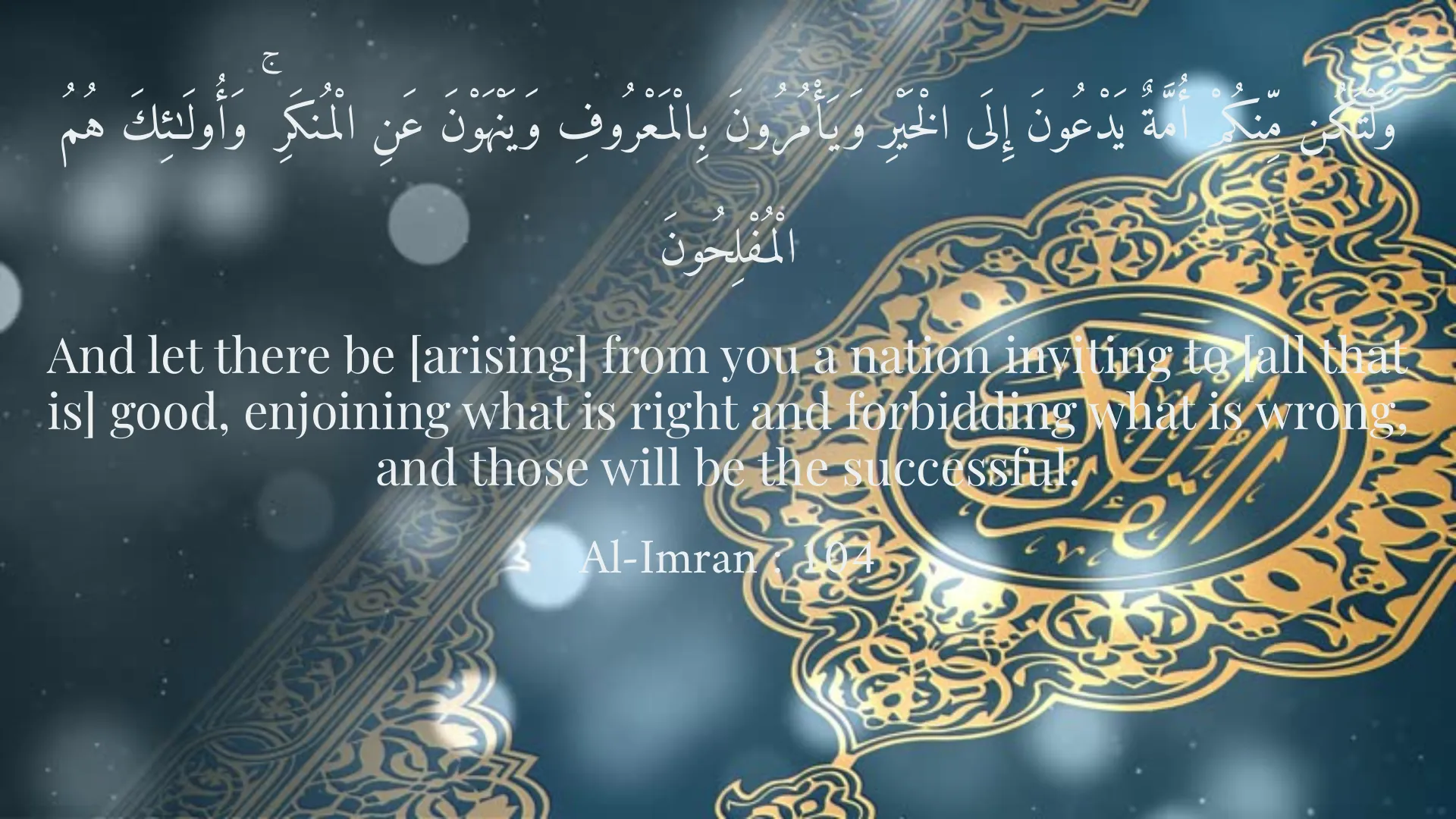
وَلْتَكُن مِّنكُمْ أُمَّةٌ يَدْعُونَ إِلَى الْخَيْرِ وَيَأْمُرُونَ بِالْمَعْرُوفِ وَيَنْهَوْنَ عَنِ الْمُنكَرِ ۚ وَأُولَٰئِكَ هُمُ الْمُفْلِحُونَ
And let there be [arising] from you a nation inviting to [all that is] good, enjoining what is right and forbidding what is wrong, and those will be the successful.
Al-Imran : 104
كَانُوا لَا يَتَنَاهَوْنَ عَن مُّنكَرٍ فَعَلُوهُ ۚ لَبِئْسَ مَا كَانُوا يَصْنَعُونَ
They did not forbid one another from Munkar (wrongdoing) that they did. How wretched was that which they were doing.
Al-Ma'idah : 79
وَلَا تَرْكَنُوا إِلَى الَّذِينَ ظَلَمُوا فَتَمَسَّكُمُ النَّارُ وَمَا لَكُم مِّن دُونِ اللَّهِ مِنْ أَوْلِيَاءَ ثُمَّ لَا تُنصَرُونَ
And do not incline toward those who do wrong, lest you be touched by the Fire. And you have not besides Allah any protectors; then you would not be helped.
Hud : 113
يَا بُنَيَّ أَقِمِ الصَّلَاةَ وَأْمُرْ بِالْمَعْرُوفِ وَانْهَ عَنِ الْمُنكَرِ وَاصْبِرْ عَلَىٰ مَا أَصَابَكَ ۖ إِنَّ ذَٰلِكَ مِنْ عَزْمِ الْأُمُورِ
O my son, establish prayer, enjoin what is right, forbid what is wrong, and be patient over what befalls you. Indeed, that is [part of] the matters [requiring] determination.
Luqman : 17
فَلَمَّا نَسُوا مَا ذُكِّرُوا بِهِ أَنجَيْنَا الَّذِينَ يَنْهَوْنَ عَنِ السُّوءِ وَأَخَذْنَا الَّذِينَ ظَلَمُوا بِعَذَابٍ بَئِيسٍ بِمَا كَانُوا يَفْسُقُونَ
So when they forgot that by which they had been reminded, We saved those who forbade evil and seized those who wronged with a wretched punishment because they were defiantly disobedient.
Al-A'raf : 165
Short Story
Once, a king sat in an assembly surrounded by nobles and ministers. One of the ministers spoke an unjust word and committed an act of oppression against an innocent person. Everyone present was there, but out of fear and caution, no one dared to object. A heavy silence prevailed in the assembly, as if everyone had sealed their lips and closed their eyes to the truth. However, in a corner of that gathering sat a pure-hearted and enlightened man, one of Saadi's students. Unable to bear the sight of injustice and the silence over truth, even though he knew his words might displease the king, he rose with a pleasant calm and an open countenance, saying: "O virtuous King! The greatness and splendor of your reign lie in ensuring that no truthful tongue remains silent out of fear, and no heart is hidden out of awe of injustice. Silence in the face of this sin is like a seed sown in the soil of goodness, yielding nothing but poisonous thorns." The king initially frowned, but this sincere and plainspoken advice made him ponder. The wise man continued: "If a disease appears in the body and the physician, fearing blame, conceals the ailment, will the patient recover? How, then, can we conceal the pain of society?" This heartfelt speech resonated deeply. The king came to his senses, ordered the wronged person's situation to be addressed, and asked the erring minister to repent and make amends. On that day, silence was broken, and light prevailed over darkness, thanks to a word spoken with sincerity and courage. So know, my friend, that silence in the face of evil is a path to darkness, and the word of truth is a light that illuminates the way.