Quranic Answer
Justice is one of the fundamental principles in human life that is greatly emphasized in the Holy Quran. As a deeply rooted value, justice serves not only as a moral compass for individuals but also as a vital element in the formation and sustenance of society. One of the most powerful assertions regarding justice is found in verse 135 of Surah An-Nisa, where Allah commands believers to "be persistently standing firm in justice, witnesses for Allah." This imperative serves as a reminder that justice must permeate our daily lives, urging us to uphold this ideal even in the face of social and individual challenges. In an era marked by division and discord, the need for justice has never been more pressing. Establishing justice is not merely a societal obligation; it contributes significantly to our inner peace, tranquility, and mental well-being. The importance of justice is reiterated in another central verse from the Quran, Surah Al-Ma'idah, verse 8, which similarly instructs, "O you who have believed, be persistently standing firm in justice, witnesses for Allah." This steadfast commitment to justice amid difficulty and adversity emphasizes the Quran’s profound understanding of the challenges faced by individuals in their pursuit of truth. Upholding justice is more than mere compliance with societal norms; it becomes a divine obligation, an act that aligns with the fundamental teachings of Islam. Justice is presented in the Quran not just as an abstract concept but as an essential attribute of Allah Himself. For instance, in Surah Al-An'am, verse 152, Allah advises believers by stating, "And do not approach the orphan's property except in a way that is best." This verse poignantly illustrates the delicate balance of justice, particularly in situations that involve the vulnerable and marginalized members of society. It is here that we can draw parallels to contemporary injustices that often occur when individuals neglect their responsibility to protect those unable to protect themselves. The call to establish justice transcends the mere absence of injustice; it requires proactive measures that work towards protecting the disenfranchised and ensuring equity in how individuals are treated. In contemporary society, the fight for justice manifests in various forms, including civil rights movements, advocacy for social change, and efforts to address systemic inequalities. But the Quranic perspective teaches that true justice necessitates unwavering endurance and courage, often requiring individuals to confront difficult truths and societal norms that may inherently resist those very principles. Therefore, justice must permeate every aspect of our lives, from our personal interactions to the broader community and legal systems. The Quran not only encourages believers to be witnesses to justice on behalf of Allah but challenges them to reflect this attribute in every stride they take. This perspective elevates justice to a fundamental duty, necessitating that individuals engage with the issues that prick at the conscience rather than standing by as passive observers. One might wonder how such high spiritual teachings can bridge the gap between individual beliefs and the collective societal responsibility. The answer lies in recognizing that belief in justice is not merely theoretical; it requires tangible actions. For example, engaging in dialogues that promote understanding, challenging discriminatory practices, or standing up for those who cannot stand for themselves are all expressions of this divine obligation. Additionally, the framework provided by the Quran offers a holistic understanding of justice, encompassing not just punitive measures but restorative practices that seek to rebuild relationships and communities torn apart by conflict or injustice. It encourages compassion and empathy, recognizing that understanding the human condition is vital to administering true justice. Alongside the pursuit of justice, the Quran emphasizes the importance of humility, urging believers to maintain a spirit of self-reflection. This humility fosters an environment where individuals can confront their own biases and strive to improve their understanding and practice of justice. It reminds us that the fight for justice is not merely a battle against external forces but also an internal struggle to align our actions with our values. To illustrate, when we objectify justice solely as a framework for condemnation, we overlook its potential for healing and reconciliation. Ultimately, fighting for justice is both a human duty and a divine mandate. The Quran’s constant reminders encourage us to delve deeper, reinforcing our collective responsibility to advocate for the oppressed and rectify injustices that persist in our societies. This profound engagement with justice is a call for action that resonates deeply within the ethical fabric of our communities. In conclusion, as we navigate the complexities of modern life, we must remain steadfast in fulfilling our obligation to establish justice. By embracing the teachings of the Quran regarding justice, we can initiate a ripple effect that extends beyond individual actions to influence societal change. Justice is not just a goal to be achieved; it is a journey we embark upon together as individuals committed to ensuring that fairness, equity, and compassion govern our interactions with one another. Ultimately, if necessary, we must be willing to fight for justice, for it is our duty—not just as individuals but as a united collective—to uphold this sacred principle in every corner of the world. In doing so, we align ourselves with divine will, ensuring that justice prevails in both our personal lives and the broader society we inhabit.
Related Verses
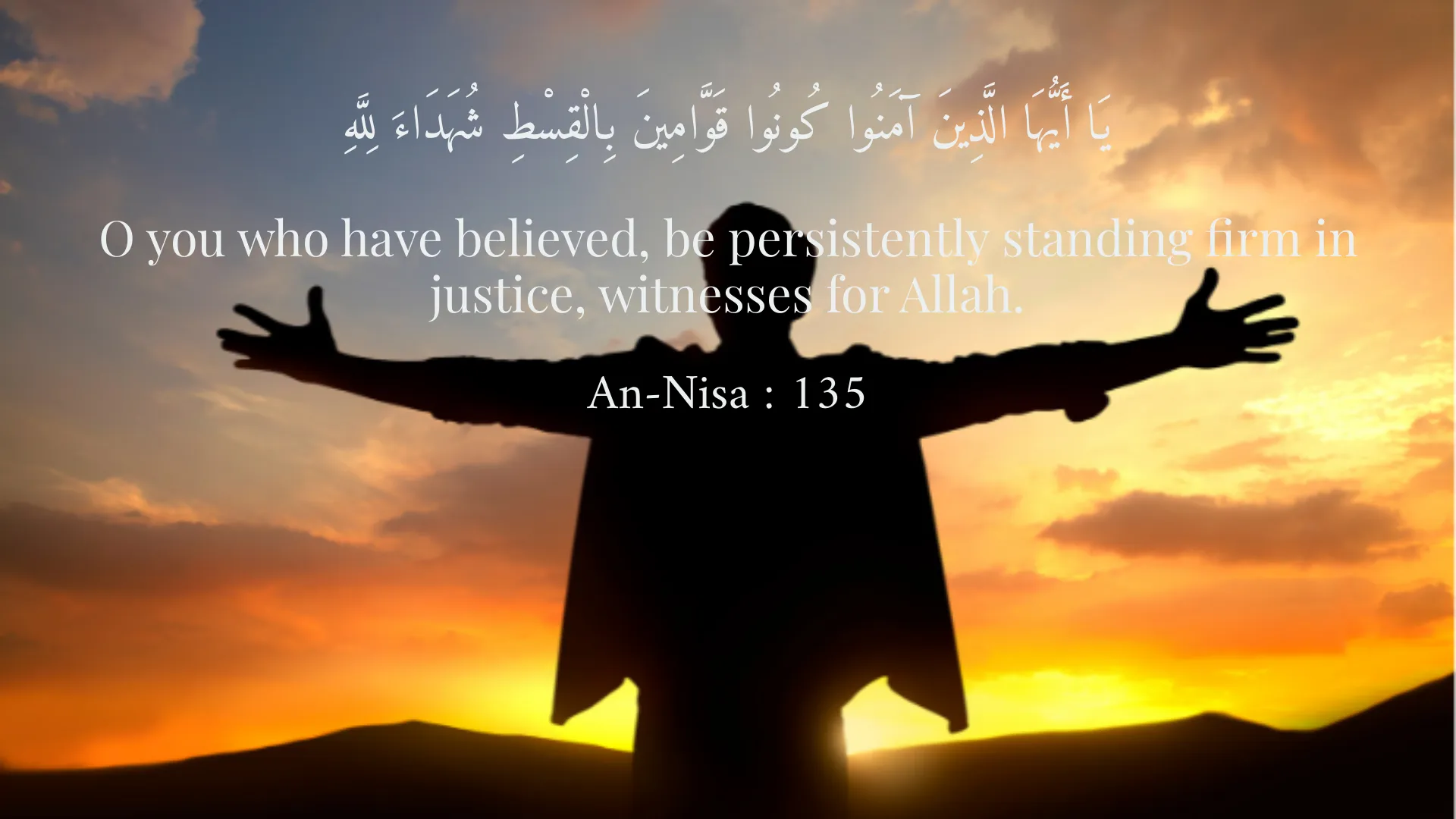
يَا أَيُّهَا الَّذِينَ آمَنُوا كُونُوا قَوَّامِينَ بِالْقِسْطِ شُهَدَاءَ لِلَّهِ
O you who have believed, be persistently standing firm in justice, witnesses for Allah.
An-Nisa : 135
يَا أَيُّهَا الَّذِينَ آمَنُوا كُونُوا قَوَّامِينَ لِلَّهِ شُهَدَاءَ بِالْقِسْطِ
O you who have believed, be persistently standing firm in justice, witnesses for Allah.
Al-Ma'idah : 8
وَلَا تَقْرَبُوا مَالَ الْيَتِيمِ إِلَّا بِالَّتِي هِيَ أَحْسَنُ
And do not approach the orphan's property except in a way that is best.
Al-An'am : 152
Short Story
One day, a man named Hassan decided to stand against oppression and injustice. While studying the verses of the Quran, he realized that Allah always invites us to uphold justice. Hassan encountered a woman suffering due to injustice and was determined to support her at all costs. Considering the situation, he began to gather people and together they stood against the injustice. Gradually, he became not only a hero for that woman but for all those who needed support for justice.