Quranic Answer
The Holy Quran is a profound guide that emphasizes personal responsibility and the significance of individual choices in the life of every believer. These teachings reinforce the notion that individuals must take ownership of their decisions and actions, as ultimately, each person is accountable for their own deeds. Throughout the Quran, there are many verses that illustrate this essential theme, urging communities and individuals alike to reflect upon their behavior and the consequences that arise from their choices. One of the clearest expressions of this principle can be found in Surah Al-Baqarah, verse 134, where Allah states: "Those are a community that has passed away. For them is what they earned, and for you is what you earn. And you will not be asked about what they used to do." This verse serves as a powerful reminder that past generations are accountable for their actions, and we, too, must focus on our own behaviors. The emphasis on personal accountability is evident; we can neither blame our predecessors for our shortcomings nor should we seek justification in their actions when making choices in our lives. The message in Surah Al-Baqarah extends further, encouraging believers to avoid imitating the sins of others. Imitation can be a double-edged sword. While it can foster unity and shared identity, it can also lead us astray if we blindly follow the negative behavior of our communities. By reminding us that we will not be questioned about the misdeeds of others, this verse urges us to harness our ability to think critically and make choices that align with divine guidance and righteousness. In Surah Yunus, verse 9, we again find the theme of personal responsibility echoed in Allah's words: "Whoever holds on to misguidance will suffer, but whoever turns to the guidance of Allah will tread the right path." This verse further clarifies the consequences of our choices. Holding on to misguidance can result in a lifetime of hardship and suffering, steering us away from the grace and mercy of The Almighty. In contrast, turning to Allah's guidance signifies seeking enlightenment and maintaining a conscious awareness of our intentions and actions. Through this understanding, we comprehend that our individual decisions shape our journey towards righteousness and our relationship with Allah. The Quran's emphasis on personal accountability continues in Surah Al-An’am, verse 164, where it is stated: "And no bearer of burdens will bear the burden of another." This verse succinctly encapsulates the essence of individual responsibility. Each person must be vigilant in their choices, understanding that the consequences of wrongdoings can only be shouldered by the doers themselves. This scripture illustrates that even amidst communal acting or collective behaviors, each individual's essence remains intact and personal accountability is non-negotiable. Together, these verses compel us to remain vigilant against the temptations of following the path of others, particularly when it leads to sinful behavior. We are reminded to keep our own motives and actions in check, as straying from the path of righteousness due to the influence of those around us could distance us from Allah's mercy. The Quran encourages critical analysis of our environment and the behaviors that we encounter within communities, underlining the importance of self-awareness and active engagement in the moral landscape. In a world that often glorifies superficiality and imitation, the teachings of the Quran are significant. They inspire individuals to strive for authenticity in character and behavior. Imitating the sins of others can create patterns of degradation instead of growth, distancing oneself from divine mercy and compassion. To combat this, one must cultivate a deep understanding of the Quran’s teachings and integrate its messages into daily life. By consistently engaging with divine guidance, individuals can nurture virtuous qualities and eschew sin, thus fostering an environment for personal and collective improvement. The act of distilling these lessons into our lives reinforces both our spiritual and ethical frameworks. Engaging in self-reflection, seeking knowledge, and possessing an unwavering commitment to integrity strengthens the bond that we share with Allah. Maintaining this connection sheds light on the path of righteousness and bestows upon us the wisdom necessary to navigate the complexities of life. Moreover, personal responsibility transcends mere adherence to lawful practices; it encapsulates the spirit of empathy and compassion towards others. When we recognize that our actions can influence those around us, we become more mindful of our choices. When individuals harness their potential to shape their lives positively, they pave the way for others to do the same. Thus, personal responsibility, as laid out in the Holy Quran, is an essential component of a flourishing society. Encouraging individuals to take ownership of their choices creates a ripple effect that can inspire positive change and uplift communities. Cultivating this awareness fosters an environment steeped in accountability and growth. In conclusion, the Holy Quran serves as a timeless source of wisdom that implores individuals to prioritize personal responsibility and moral integrity in their lives. By understanding the weight of our choices, we can strive for progress while steering clear of the pitfalls of imitation and wrongful acts. Each verse reiterates the importance of self-reflection, determination, and adherence to divine guidance, reminding us that while we are all part of a larger collective, our accountability lies solely within ourselves. This powerful message from the Quran remains profoundly relevant and essential in guiding us toward a virtuous life in accordance with Allah's will.
Related Verses
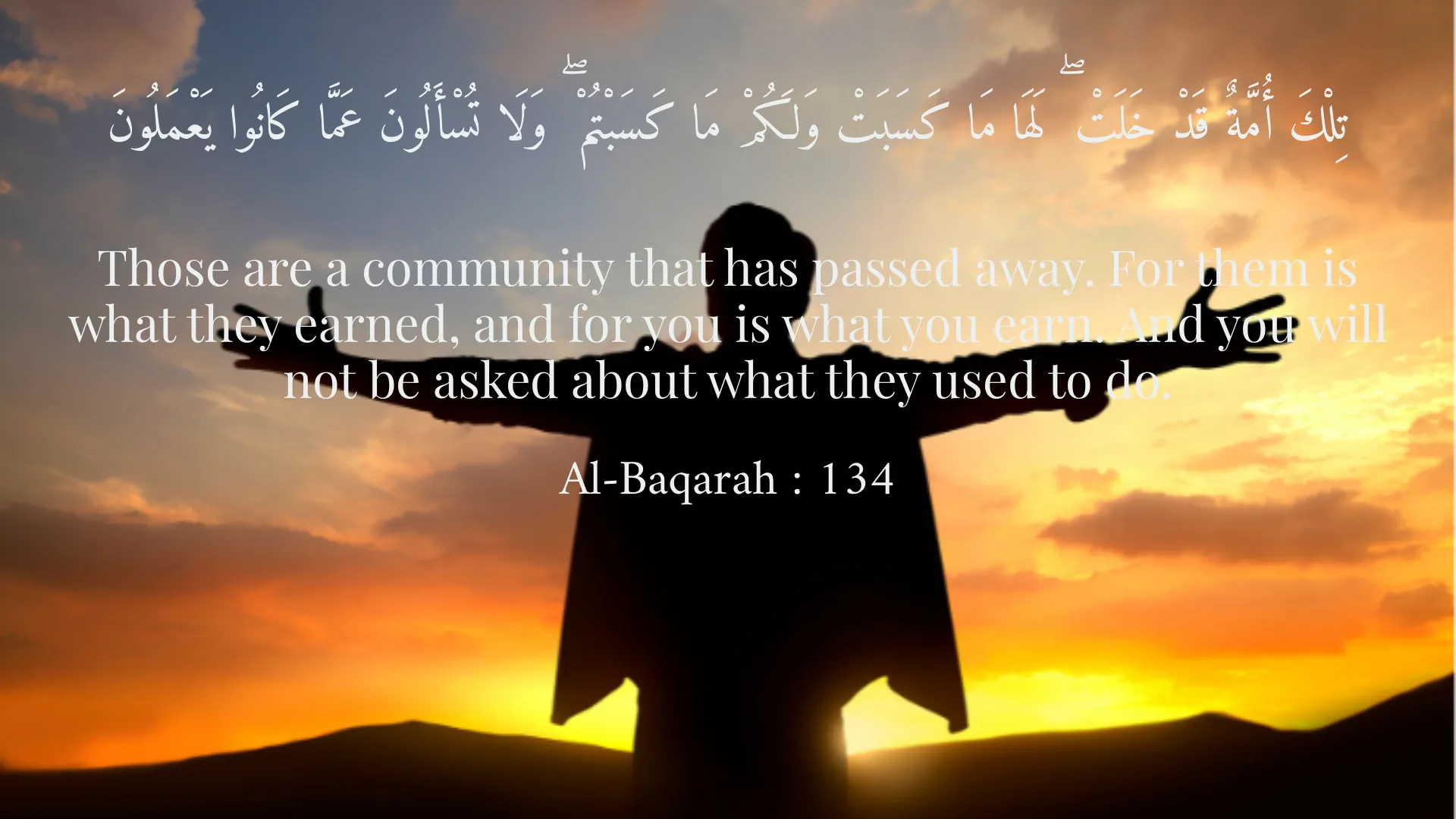
تِلْكَ أُمَّةٌ قَدْ خَلَتْ ۖ لَهَا مَا كَسَبَتْ وَلَكُمْ مَا كَسَبْتُمْ ۖ وَلَا تُسْأَلُونَ عَمَّا كَانُوا يَعْمَلُونَ
Those are a community that has passed away. For them is what they earned, and for you is what you earn. And you will not be asked about what they used to do.
Al-Baqarah : 134
إِنَّ الَّذِينَ آمَنُوا وَعَمِلُوا الصَّالِحَاتِ سَيَهْدِيهِمْ رَبُّهُمْ بِإِيمَانِهِمْ ۖ تَجْرِي مِن تَحْتِهِمُ الْأَنْهَارُ فِي جَنَّاتِ النَّعِيمِ
Indeed, those who have believed and done righteous deeds, their Lord will guide them by their faith. Rivers will flow beneath them in gardens of pleasure.
Yunus : 9
وَلَا تَزِرُ وَازِرَةٌ وِزْرَ أُخْرَىٰ ۚ وَإِن تَدْعُ مُثْقَلَةٌ إِلَىٰ حِمْلِهَا لَا يُحْمَلْ مِنهُ شَيْءٌ وَمَا أَنتَ بِمُسْمِعٍ مَنْ فِي الْقُبُورِ
And no bearer of burdens will bear the burden of another. And if one heavily laden calls another to [bear] his load, nothing of it will be lifted for him.
Al-An’am : 164
Short Story
Once upon a time, there was a young man named Hasan who pondered over his life's challenges. He often heard about the wrongdoings of his friends and realized that imitating them only led him into deeper troubles. One day in his neighborhood, he saw someone making a wrongful action, and everyone distanced themselves from him. This scene inspired Hasan to understand that every individual should focus on their actions and instead of imitating, draw inspiration from the positive lives of others.