Quranic Answer
In the Holy Quran, the themes of pride and arrogance are dealt with in profound depth, underscoring the importance of humility and the adverse effects of haughtiness on the human spirit and relationships. The Quran serves not merely as a religious document but as an ethical guide that highlights values essential for social harmony and spiritual wellbeing. In this article, we will explore the Quranic injunctions against pride and arrogance, their implications for personal development, and the benefits of embracing humility as a core tenet of character. One of the most poignant verses that capture the essence of this message is found in Surah Luqman, verse 18, which clearly states, 'And do not turn your cheek [in contempt] toward people and do not walk through the earth exultantly. Indeed, Allah does not like everyone self-deluded and boastful.' This command does not merely serve as an admonition against negative behavior; rather, it elucidates the fundamental qualities that Allah appreciates in believers. The Arabic term used here for 'pride' can imply a sense of superiority, a sense of entitlement, and a belief that one is above others. When Allah calls upon His believers to avoid such attitudes, it reflects a universal principle: that true strength lies in humility and not in arrogance. The significance of this passage is multi-faceted. On a personal level, pride can disconnect individuals from their true identity and self-awareness. When one believes they are superior to others, they risk losing the understanding that every person has intrinsic worth and unique contributions to offer. Arrogance fosters a culture of division and can lead to social isolation, as proud individuals often find it challenging to form meaningful connections with others. In contrast, humility fosters empathy, allowing for deeper understanding and connection with fellow human beings. Furthermore, Surah Al-A'raf, verse 146, offers a compelling illustration of the repercussions of arrogance. The verse recounts an incident with Prophet Moses (Musa) and his people when Allah instructed them to enter the holy land. Instead of embracing the opportunity, they hesitated out of fear, stating, 'Indeed, in it are a people of great strength. We will never enter it until they leave it.' This refusal, born from arrogance and a distorted perception of their capabilities, led to a significant loss—both spiritually and materially. Here, we witness how pride can prevent individuals from seizing divine blessings and hinders their relationship with Allah. The message of humility extends beyond personal interactions. It is foundational for broader social interactions and can play an essential role in establishing communities grounded in mutual respect, empathy, and understanding. Humility encourages open-mindedness, allowing individuals to listen to diverse perspectives and adapt their views accordingly. In today’s world, where polarization and division are prevalent, embracing humility as a social principle could be transformative. Moreover, humility is often linked to spiritual elevation. When one humbles oneself before Allah, acknowledging their limitations and dependence on Him, it cultivates a deeper bond rooted in trust and faith. This idea resonates throughout the Quran where believers are continually encouraged to turn towards Allah with humility, seeking guidance and mercy. Such a stance not only enriches one's spiritual life but also invites Allah's grace and compassion. The Quran teaches that true greatness lies in service to others, in acknowledging that we are not above anyone else in worth or dignity. This is encapsulated in the teachings of the Prophet Muhammad (PBUH), who often emphasized caring for the less fortunate and treating all individuals with respect, regardless of their status. In terms of practical application, distancing oneself from pride does not mean erasing one's achievements or hiding one's talents. Rather, it means acknowledging one's abilities while remaining grounded and connected to the larger community. A humble person recognizes their gifts as blessings to be used for the betterment of others, not merely for personal glorification. This approach fosters an atmosphere of cooperation and support, which ultimately benefits everyone involved. Furthermore, in various religions, and particularly in Islam, teachings about pride also emphasize the importance of sincerity in actions. A humble disposition inspires believers to act without seeking accolades or recognition. This inner sincerity aligns closely with the Islamic belief that the quality of one’s intentions determines the value of one’s deeds. In the absence of pride, one's actions can be more genuine, fostering an environment where individuals work together towards mutual growth and enlightenment. In conclusion, the Holy Quran unequivocally speaks against arrogance and pride, advocating instead for humility as a path to fruitful living and a deeper connection with the divine. The insights drawn from Surah Luqman and Surah Al-A'raf remind us of the pitfalls of haughtiness, illustrating how pride not only distances us from Allah's mercy but also from each other. The guidance provided encourages believers to cultivate humility as a way of life, centered on being of service to others, building harmonious relationships, and fostering a society anchored in respect and understanding. Indeed, the call to humility resonates profoundly in every aspect of life, leading to personal growth and spiritual elevation. By embodying these principles, individuals can not only draw closer to Allah but also contribute to a world marked by compassion, unity, and love.
Related Verses
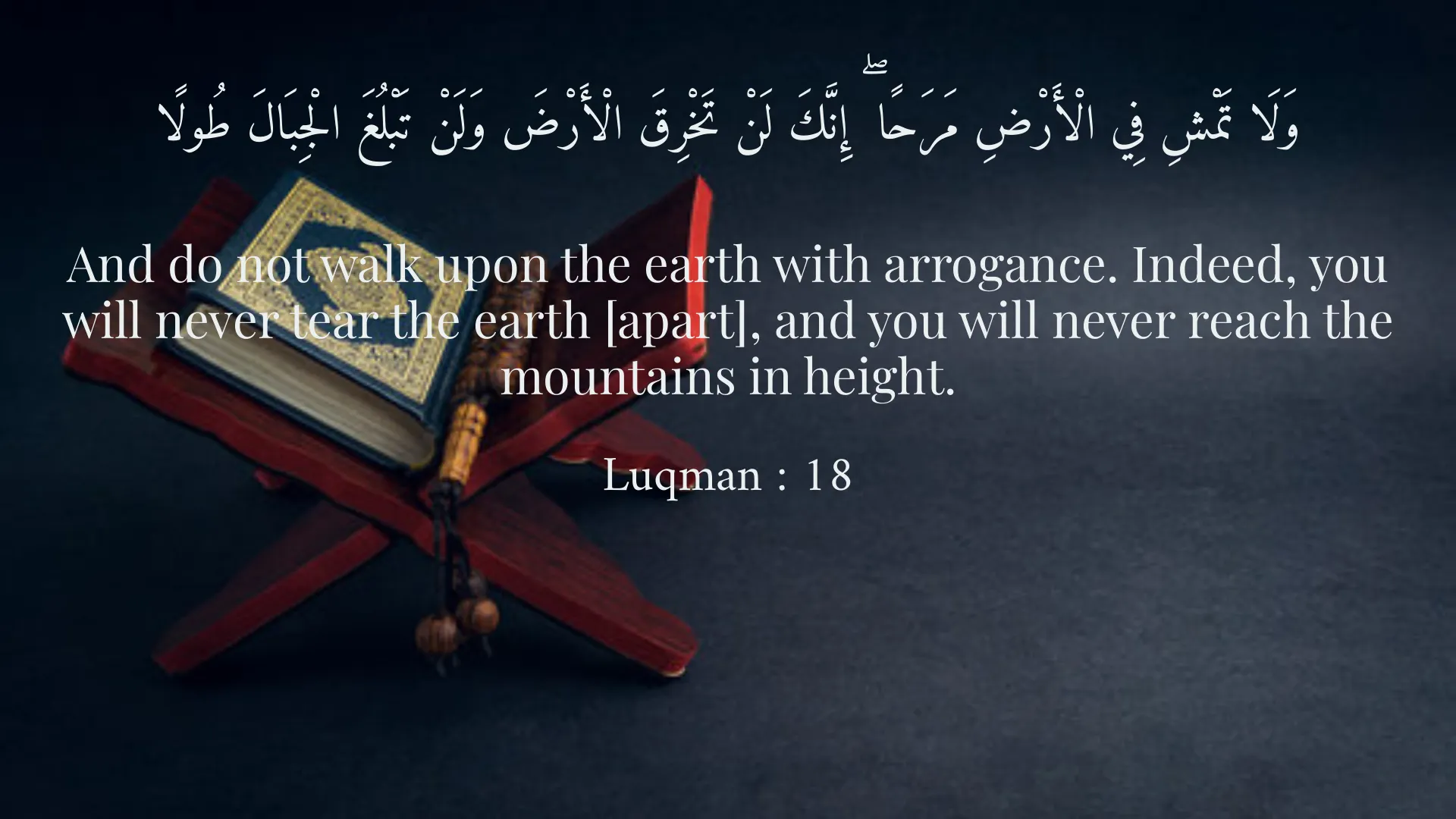
وَلَا تَمْشِ فِي الْأَرْضِ مَرَحًا ۖ إِنَّكَ لَنْ تَخْرِقَ الْأَرْضَ وَلَنْ تَبْلُغَ الْجِبَالَ طُولًا
And do not walk upon the earth with arrogance. Indeed, you will never tear the earth [apart], and you will never reach the mountains in height.
Luqman : 18
وَأَمَّا الَّذِينَ فِي قُلُوبِهِمْ مَرَضٌ فَإِنَّهُمْ لَن يُؤْمِنُوا إِلَّا أَنْ يَكُونُوا مَعَ أَصْحَابِهِمْ.
And as for those in whose hearts is a disease, they will not believe except that they are with their companions.
Al-A'raf : 146
Short Story
One day, a man named Ali, in his middle age, asked himself, "Why do some people always consider themselves superior to others?" After studying the Quran, he concluded that pride and arrogance are the main factors behind the separation of hearts. He decided to prioritize humility in his life. Gradually, he interacted with others with more kindness and humility, and he noticed a significant improvement in his relationships.