Quranic Answer
The concept of justice has been a cornerstone of ethical and moral philosophy throughout human history. Within the context of the Islamic faith, the significance of justice serves not only as a spiritual mandate but also as a fundamental principle for maintaining social order and promoting human dignity. This essay seeks to analyze the critical role of justice as depicted in the Holy Quran, specifically in Surah An-Nisa and Surah Al-Ma'idah, and to explore how these teachings can guide individuals and societies toward a more equitable existence. In Surah An-Nisa, verse 135, Allah commands believers to maintain a firm stance in justice, even if it requires speaking out against themselves or their loved ones: "O you who have believed! Be persistently standing firm in justice, witnesses in justice, even if it be against yourselves or your parents and relatives." This call to action underscores the profound importance of impartiality and integrity when it comes to establishing what is right and fair. The Quran emphasizes that justice remains paramount, regardless of personal stakes or familial ties. This radical notion challenges individuals to transcend their emotional biases and societal pressures and to commit themselves fully to the truth. The divine guidance in this verse serves as a reminder that a commitment to justice can lead to inevitable challenges. Speaking up for fairness, particularly in situations involving one's own family or friends, often generates conflict and discomfort. However, the moral imperative ignites a sense of empathy and responsible citizenship, encouraging believers to consider the larger ramifications of their actions. Ultimately, the individual who commits to the promise of justice can expect to find personal respect within their community, as well as a greater connection to their sense of self-worth. Justice in Islam is not confined to the realm of personal conduct or private conscience; it extends deeply into societal structures and institutions. One fundamental reason that Allah emphasizes justice is its collective benefit to society. When individuals uphold the earlier mentioned principles, they contribute to a culture of accountability and trust, resulting in stronger relationships and community cohesion. Societies flourishing under these auspices of justice are often marked by enhanced cooperation, reduced conflicts, and greater stability, resulting in an environment where all individuals can thrive. In reinforcing the notion of justice, Surah Al-Ma'idah, verse 8 further encourages believers to remain steadfast and act as witnesses for Allah: "O you who have believed, be persistently standing firm in justice, witnesses for Allah, even if it be against yourselves, or your parents or your relatives." The reiteration of the necessity to stand firm in truth signals an essential facet of Islamic ethos—having an unwavering commitment to justice despite potential backlash, disagreements, or personal risk. To truly embody justice is to recognize its vital nature in sustaining one's integrity and moral compass. By bringing forth the truth, even when it is uncomfortable or unfavored, individuals remain in alignment with divine expectations, cultivating a deeper relationship with Allah. True justice thus arguably becomes a path toward spiritual enlightenment and moral development. Moreover, justice is tied to the social fabric of any community; unfairness and inequity can lead to unrest, division, and conflict among the populace. When injustices are allowed to proliferate unchecked, they bring about social decay, paralyzing the aspirations and rights of various social groups. Through a profound belief in the importance of justice, people can cultivate a stronger sense of collective purpose. This united priority promotes social interactions that are based on fairness—crucial for the establishment of peace and security within a community. Upholding justice essentially creates a system in which everyone can contribute to society, fostering not only individual dignity but also promoting the welfare of all individuals without discrimination. When citizens evince a collective commitment to both uphold justice and rectify inequalities, communities become agents for positive change. From a psychological perspective, individuals who embrace justice often partake in activities that generate social responsibility awareness and engagement. This, in turn, leads to greater satisfaction in their lives. Ultimately, when a society collectively prioritizes justice, the repercussions can manifest in improved mental health on a population level as individuals feel valued and included within their community. The connection between justice and tranquility is deeply embedded in the Quranic promise that those who commit to fairness and truth will find serenity. By upholding justice, individuals not only honor their relationship with Allah, but they also contribute positively to the world around them, thus fostering harmony among their fellow beings. In conclusion, the importance of justice is a prominent theme articulated in the Holy Quran as illustrated in Surah An-Nisa and Surah Al-Ma'idah. The teachings emphasize the necessity for individuals to be unwavering in their pursuit of justice, even amidst adversity. In doing so, not only do they align themselves with divine principles, but they also cultivate respect and credibility within their communities, leading to a profound sense of inner peace. The promise that arises from adhering to justice is not merely an ethic of personal integrity, but a foundation for establishing a cohesive and thriving society. By promoting justice, we enrich both the individual spirit and the collective well-being, paving the way for security and tranquility in a world yearning for harmony.
Related Verses
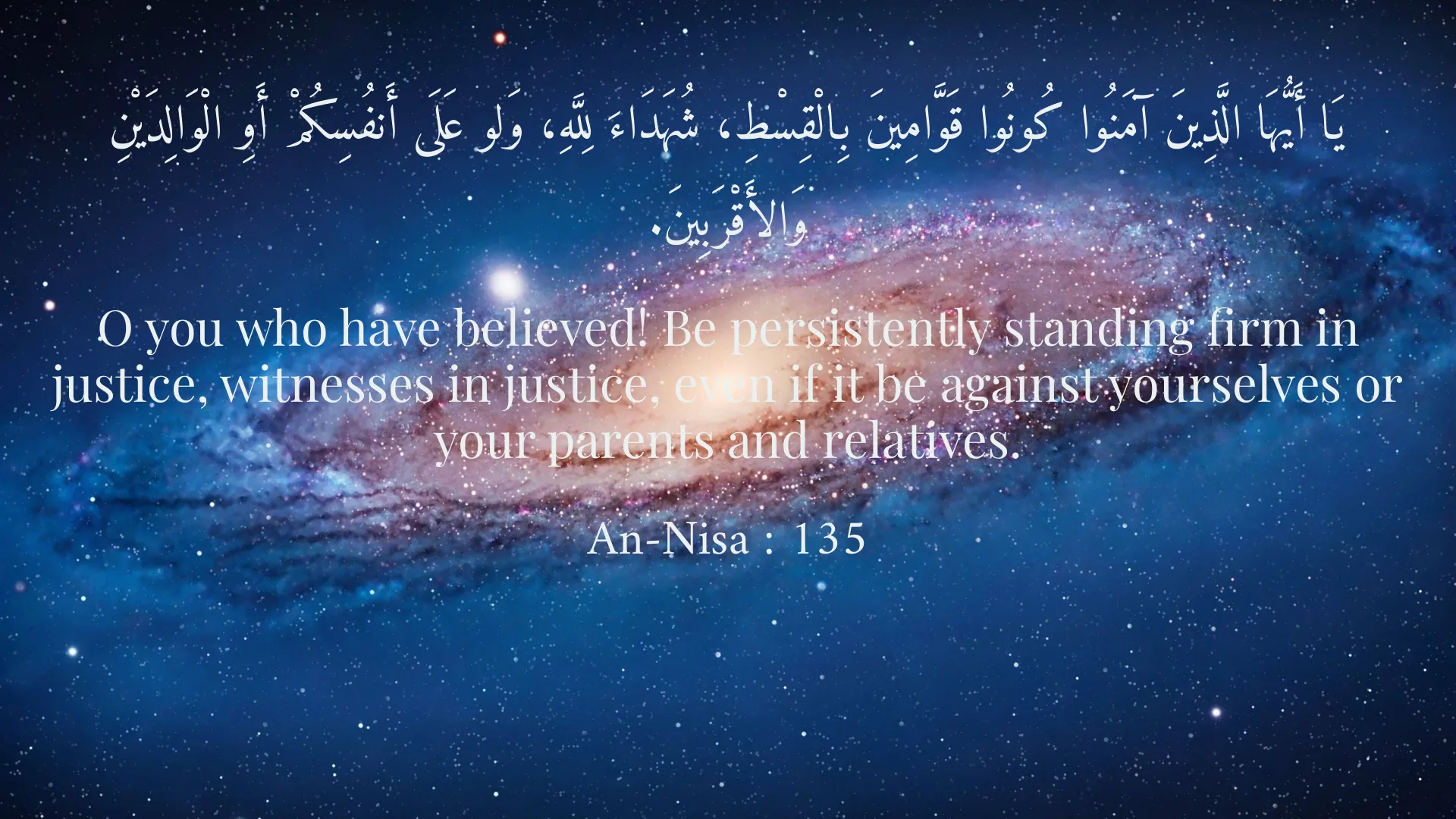
يَا أَيُّهَا الَّذِينَ آمَنُوا كُونُوا قَوَّامِينَ بِالْقِسْطِ، شُهَدَاءَ لِلَّهِ، وَلو عَلَى أَنفُسِكُمْ أَوِ الْوَالِدَيْنِ وَالأَقْرَبِينَ.
O you who have believed! Be persistently standing firm in justice, witnesses in justice, even if it be against yourselves or your parents and relatives.
An-Nisa : 135
يَا أَيُّهَا الَّذِينَ آمَنُوا كُونُوا قَوَّامِينَ لِلَّهِ شُهَدَاءَ بِالْقِسْطِ، وَلا يَجْرِمَنَّكُمْ شَنَانُ قَوْمٍ على أَلَّا تَعْدِلُوا.
O you who have believed, be persistently standing firm in justice, witnesses for Allah, even if it be against yourselves, or your parents or your relatives.
Al-Ma'idah : 8
Short Story
Once upon a time, a man named Hassan lived in a village. He was a just and kind person who always tried to solve problems fairly. One day, one of his neighbors faced injustice and Hassan helped him obtain his rights. His act not only freed his neighbor but also earned him more respect and love among the villagers, which brought peace to Hassan's heart.