Quranic Answer
The profound question of whether all hardships we encounter in life are truly pathways to growth and perfection is one that every human being confronts at various stages. From the perspective of the Holy Quran, the answer to this query holds vast dimensions, indicating that adverse events and challenges in a believer's life are not without purpose. On the contrary, they are often ordained with divine wisdom, meticulously designed for the elevation and refinement of the human being. The Quran, emphasizing the concept of "Ibtila" or divine testing, clarifies that hardships serve as instruments to gauge faith, strengthen resolve, and nurture the human spirit. This Quranic outlook offers a hopeful and constructive approach to difficulties, portraying them not merely as fruitless suffering but as unparalleled opportunities for unleashing hidden potentials and attaining higher spiritual ranks. This understanding transforms our perception of adversity from a curse to a powerful catalyst for profound personal and spiritual development, guiding us to embrace challenges with patience and an understanding of their underlying divine wisdom. The Holy Quran repeatedly highlights that worldly life is a realm of trials and tests. Allah the Almighty tests His servants under various circumstances to ascertain the extent of their patience, gratitude, reliance on Him (Tawakkul), and steadfastness on the path of truth. Surah Al-Baqarah, verse 155, explicitly states: "And We will surely test you with something of fear and hunger and a loss of wealth and lives and fruits, but give good tidings to the patient." This verse unequivocally demonstrates the purposeful nature of hardships. These trials are not merely for sifting the truthful from the liars, but also to fortify faith and establish it firmly in the hearts of believers. The stronger one's faith, the greater the tests endured, and each successfully navigated trial leads to spiritual growth and elevation. In essence, hardships are like furnaces that separate gold from impurities, refining the essence of human existence. This perspective liberates individuals from being mere victims, transforming them into active and responsible agents in the face of challenges, equipped to learn and evolve from every difficulty they encounter, which significantly aids in enhancing their adaptability and resilience against life's vicissitudes. Another profound wisdom behind hardships, according to the Quran, is the purification from sins and atonement for past transgressions. Sometimes, calamities and adversities are a direct consequence of one's own actions, yet the Merciful Allah, through these very difficulties, provides an great opportunity for redemption and cleansing. These hardships can not only purify individuals from their sins but also elevate their status in the sight of their Lord. Consider how a prolonged illness or a significant financial loss might serve as a means for the forgiveness of past misdeeds. This perspective brings solace to the human heart, assuring that even in the throes of extreme difficulty, divine mercy encompasses them, and every moment can be a step towards perfection. This purification process helps individuals view their lives and actions with a fresh perspective, enabling them to walk more steadfastly on the path of servitude to God. It is a reminder that Allah's justice is always intertwined with His immense mercy, turning what appears to be a punishment into a profound opportunity for spiritual betterment. Do trees bend before wind and storm, or do their roots deepen? Hardships act similarly for humans. They uncover hidden capacities within individuals and propel them towards greater strength. Surah Ash-Sharh (The Relief), with its reassuring promise "Fa inna ma'al usri yusra. Inna ma'al usri yusra." (Indeed, with hardship [will be] ease. Indeed, with hardship [will be] ease. 94:5-6), emphasizes this point. These verses teach us that difficulties are transient, and after every period of hardship, relief and ease await. This cycle instructs humanity to persevere, never to despair, and to find a way forward through reliance on Allah. Each time an individual overcomes a problem, they learn a new lesson, their experiences multiply, and they become better prepared for subsequent challenges. This cumulative experience instills self-confidence, affirming that they can overcome any obstacle, for they are not alone and Allah is always their helper. The resilience forged in the crucible of adversity becomes a permanent asset, enabling a person to face future trials with greater fortitude and an unshakeable belief in divine assistance. At times, excessive comfort and prosperity can lead individuals to forget God, drawing them towards worldliness and self-centeredness. In such instances, hardships serve as a powerful awakening. They remind individuals of their weakness and helplessness, compelling them to seek refuge in the only true power: Allah the Almighty. This return to the monotheistic nature (fitra) is one of the greatest achievements of hardships. When all doors seem closed and an individual feels that there is no helper except God, they turn to Him with their entire being. This profound connection brings about unparalleled spiritual growth. This awakening can lead to sincere repentance (tawbah nasuh), a change in lifestyle, and a renewed focus on enduring divine values. This process rescues individuals from heedlessness and guides them towards true felicity. The pain of loss or the weight of adversity can strip away worldly distractions, allowing the soul to reconnect with its Creator, fostering a humility and reliance that is crucial for spiritual development. Hardships act as a filter, distinguishing true believers from those whose faith is weak. In Surah Al-Ankabut (The Spider), verses 2-3, Allah states: "Do people think that they will be left alone because they say, 'We believe,' and will not be tested? But We have certainly tested those before them, and Allah will surely make evident those who are truthful, and He will surely make evident the liars." These verses demonstrate that trials and hardships are meant to distinguish truth from falsehood and to reveal true believers from those who merely claim faith. In times of ease, it is difficult to discern a genuine believer, but in times of hardship, one who clings to their faith and trusts in Allah reveals their true steadfastness. This distinction helps the Muslim community identify individuals with strong will and genuine faith, allowing them to find their rightful place. It is through these tests that the strength of conviction is proven, and those who remain steadfast emerge as exemplary figures for others, strengthening the collective fabric of the faithful. Therefore, by reflecting upon the verses of the Holy Quran, one can conclude that all hardships and challenges in life, though outwardly painful, encapsulate profound wisdom and divine purposes. They are not merely channels for testing and assessing our faith, but also instruments for purifying sins, strengthening the spirit, increasing patience and resilience, awakening the monotheistic innate nature (fitra) and returning to God, and also distinguishing true believers from others. If an individual confronts these difficulties with a monotheistic worldview and with unwavering reliance on Allah, drawing lessons from them, then every hardship can undoubtedly transform into a ladder for ascending to higher spiritual ranks and achieving unprecedented growth and perfection. This perspective instills hope and solace, assuring us that no suffering is without wisdom, and everything that comes from Allah is ultimately good, even if it initially appears arduous and unpleasant. It is this perseverance and patience in the face of problems that not only brings us closer to God but also prepares us for eternal life. Ultimately, with this Quranic understanding, hardships are no longer seen as curses, but as blessings in disguise, each one a potential stepping stone towards a more enlightened and devout existence.
Related Verses
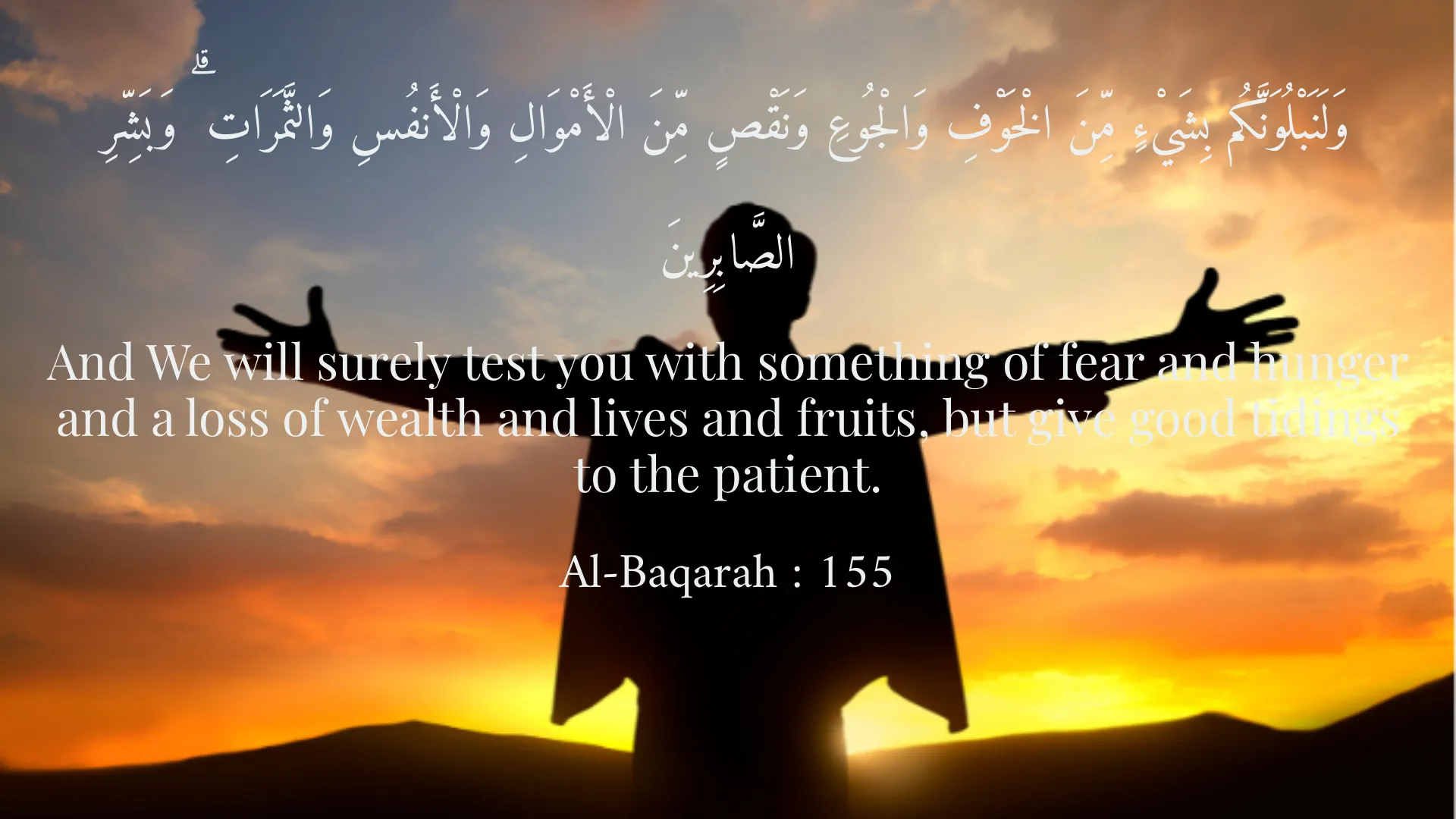
وَلَنَبْلُوَنَّكُم بِشَيْءٍ مِّنَ الْخَوْفِ وَالْجُوعِ وَنَقْصٍ مِّنَ الْأَمْوَالِ وَالْأَنفُسِ وَالثَّمَرَاتِ ۗ وَبَشِّرِ الصَّابِرِينَ
And We will surely test you with something of fear and hunger and a loss of wealth and lives and fruits, but give good tidings to the patient.
Al-Baqarah : 155
أَحَسِبَ النَّاسُ أَن يُتْرَكُوا أَن يَقُولُوا آمَنَّا وَهُمْ لَا يُفْتَنُونَ
Do people think that they will be left alone because they say, 'We believe,' and will not be tested?
Al-Ankabut : 2
وَلَقَدْ فَتَنَّا الَّذِينَ مِن قَبْلِهِمْ ۖ فَلَيَعْلَمَنَّ اللَّهُ الَّذِينَ صَدَقُوا وَلَيَعْلَمَنَّ الْكَاذِبِينَ
But We have certainly tested those before them, and Allah will surely make evident those who are truthful, and He will surely make evident the liars.
Al-Ankabut : 3
فَإِنَّ مَعَ الْعُسْرِ يُسْرًا
For indeed, with hardship [will be] ease.
Ash-Sharh : 5
إِنَّ مَعَ الْعُسْرِ يُسْرًا
Indeed, with hardship [will be] ease.
Ash-Sharh : 6
Short Story
It is recounted that a destitute dervish, one day lost his way in a hot, barren desert. The scorching sun beat down on him, and thirst and hunger had stripped him of his strength. With every step he took, a moan and a complaint escaped his heart, and he murmured to himself, "Oh God! Why all this hardship? Is there no path but suffering and tribulation in this world?" He spent several days in this state until, from extreme weakness, he fainted under a withered tree. In his unconscious state, he heard a voice say, "O complaining servant! Did you not see that tall, majestic trees drive their roots deep into the heart of stone to find water from the depths of the earth? And they nurture their sweet fruits only under the scorching sun? You too, if you wish to attain perfection and bear fruit, must pass through these hardships. Every suffering that does not make you stronger merely prepares you for a greater suffering, and every suffering that does make you stronger is your ladder to wisdom and peace." The dervish awoke with this voice. His frail body still ached, but his heart was enlightened. He no longer complained. He looked up at the sky and, with eyes full of tears and hope, said, "My Lord! I thank You for awakening me with these hardships. Now I know that every painful step I take brings me closer to You, and every drop of sweat is a seed of wisdom planted within my being." After that, despite his physical weakness, he rose with a renewed spirit and traversed the path with steadfastness until he reached a populated area. People were astonished to see his radiant face and the strange tranquility in his being. The dervish recounted his tale of suffering and his awakening, adding, "Indeed, sometimes God caresses us with difficulties so that we may appreciate health and ease, awaken from the slumber of heedlessness, and remember that perfection is achieved only through patience in hardships and reliance upon Him." And thus, that dervish, through the hardships of the desert, reached the pinnacle of wisdom and peace.