Quranic Answer
From the perspective of the Holy Quran and Islamic teachings, the concept of 'test' or 'trial' (Imtihan/Ibtila) is a fundamental pillar of human existence in this world. The Quran explicitly states that worldly life is a place of examination and evaluation for human beings, to determine the extent of their faith, patience, gratitude, and resilience in the face of hardships and blessings. However, can we say that all worldly problems are merely divine tests in the direct sense of the word? The answer to this question requires clarification and elaboration. The Quran repeatedly addresses this issue, mentioning that God tests human beings with fear, hunger, loss of wealth, lives, and fruits (Surah Al-Baqarah, verse 155). The purpose of these tests is to reveal the truth of believers' faith and patience, and to distinguish the truthful from the liars (Surah Al-Ankabut, verses 2-3). These types of problems are undoubtedly direct divine tests, aiming at spiritual elevation, purification of the heart, and raising human ranks on the path of perfection. A believer faces these problems with reliance on God, exercising patience, and seeing them as an opportunity for drawing closer to Allah. Nevertheless, not all problems and calamities in life can be placed solely within the framework of a 'divine test' in the sense of a mere examination. A part of the difficulties that humans encounter in this world are the direct consequences of their own actions and choices, or those of the society in which they live. The Holy Quran states: 'Whatever misfortune befalls you, it is because of what your hands have earned' (Surah Ash-Shura, verse 30). This verse indicates that many afflictions and hardships are natural and sometimes unavoidable consequences of sins, oppressions, injustices, and disregard for divine and natural laws. For instance, problems arising from environmental pollution, wars, economic corruption, or illnesses due to negligence, all can have human and social roots. Although these may appear as 'problems,' they are essentially warnings from God or results of His justice for the correction of humanity's path. These kinds of problems provide an opportunity for introspection, repentance, and reconciliation. Furthermore, some problems are an inherent part of the structure and nature of worldly life. This world is a realm of imperfection, transience, and change, and it is inevitably accompanied by phenomena such as illness, old age, death, loss of loved ones, and physical disabilities. These are not necessarily the result of sin or a specific test, but rather a part of the creation's system. However, even these natural matters can be considered as 'tests' for human beings; tests in how they react to them, in their patience and gratitude in the face of divine decree, and in reminding them of the impermanence of this world and the necessity of preparing for the Hereafter. Any suffering that befalls a person in this world, whether due to their own fault, a natural disaster, or a direct test, can be transformed into an opportunity for growth and closeness to God for a believer, if approached with the right perspective and reliance. In conclusion, the Quranic perspective on life's problems is very comprehensive. Although not all problems are, in the strict sense, 'direct divine tests,' every problem can serve as a ground for testing human beings; a test of patience, for correction, for gratitude, for repentance, and for returning to God. A true believer is one who, in every circumstance, whether in hardship or ease, does not forget the ultimate purpose of life, which is servitude to God and attaining closeness to Him. Problems, whether direct or indirect, can be a means to remind human beings of their weakness and need for God, and compel them to reflect on divine wisdom. This perspective not only prevents despair and hopelessness but also empowers individuals to navigate through crises, knowing that 'with hardship comes ease' and 'after patience comes victory.' This view grants insight, enabling one to identify the roots of problems and, with reliance on God and intelligent effort, move towards a more spiritual and responsible life. In this journey, problems are not mere threats but opportunities for inner blossoming and attaining higher degrees of faith and knowledge, provided that one views them with Quranic insight and learns a lesson from every experience for their own perfection. Therefore, the philosophy of problems in the Quran goes beyond a mere examination; rather, they are divine signs that invite humans to contemplation and inner transformation. Every hardship is a ground for discovering hidden human capacities, cultivating patience and gratitude, and gaining a deeper understanding of the meaning of reliance and submission to divine will. From this perspective, everything that happens in a person's life, whether good or bad, is situated within a larger test called worldly life, whose ultimate goal is to reach human perfection and divine closeness. This outlook transforms one's view of problems, turning them from mere afflictions into opportunities for spiritual growth.
Related Verses
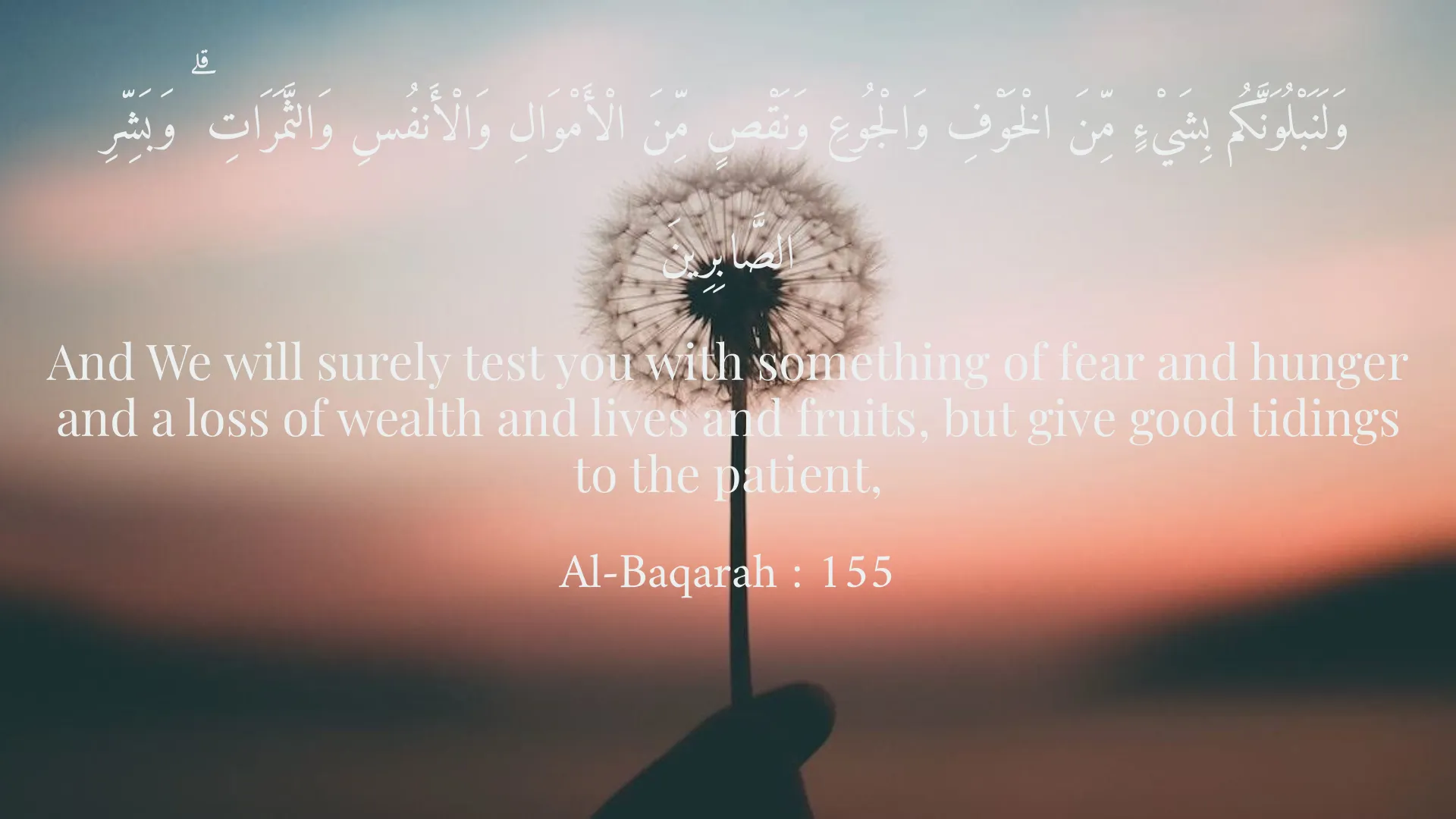
وَلَنَبْلُوَنَّكُم بِشَيْءٍ مِّنَ الْخَوْفِ وَالْجُوعِ وَنَقْصٍ مِّنَ الْأَمْوَالِ وَالْأَنفُسِ وَالثَّمَرَاتِ ۗ وَبَشِّرِ الصَّابِرِينَ
And We will surely test you with something of fear and hunger and a loss of wealth and lives and fruits, but give good tidings to the patient,
Al-Baqarah : 155
أَحَسِبَ النَّاسُ أَن يُتْرَكُوا أَن يَقُولُوا آمَنَّا وَهُمْ لَا يُفْتَنُونَ
Do people think that they will be left alone because they say, 'We believe,' and will not be tested?
Al-Ankabut : 2
وَلَقَدْ فَتَنَّا الَّذِينَ مِن قَبْلِهِمْ ۖ فَلَيَعْلَمَنَّ اللَّهُ الَّذِينَ صَدَقُوا وَلَيَعْلَمَنَّ الْكَاذِبِينَ
But We have certainly tested those before them, and Allah will surely make evident those who are truthful, and He will surely make evident the liars.
Al-Ankabut : 3
وَمَا أَصَابَكُم مِّن مُّصِيبَةٍ فَبِمَا كَسَبَتْ أَيْدِيكُمْ وَيَعْفُو عَن كَثِيرٍ
And whatever disaster strikes you – it is because of what your [own] hands have earned; and He pardons much.
Ash-Shura : 30
Short Story
In Saadi's Gulistan, it is told that a dervish lived a life of great hardship and suffering. In his utter despair, he complained to God about his life's troubles, asking: "O Lord, is everything that befalls me merely a severe test?" One night, he dreamt that a wise old man said to him: "O dervish, every morning when you awaken, you have two paths before you: one of gratitude and the other of patience. If you encounter a blessing, be grateful, and if you face a hardship, be patient. Know that whatever comes to a person, be it good or unpleasant, is an opportunity to see God's hidden wisdom. Sometimes the bitterness of medicine brings healing, and sometimes the sweetness of honey is a prelude to pain. What matters is your heart, how it perceives and copes with these events. So never despair, and in every state, turn towards the Friend, for He is the best Helper." The dervish woke up, his heart at peace, and he understood that problems, however difficult, can be stepping stones to divine knowledge and tranquility, and that every suffering carries a lesson for him.