Quranic Answer
Yes, absolutely. The Holy Quran, with profound emphasis and clarity, provides explicit instructions regarding the respect and kind treatment of the elderly, especially parents. These directives are not merely ethical recommendations but divine commands and a cornerstone of faith. The primary source of these instructions is found in Surah Al-Isra, verses 23 and 24, which unequivocally stress kindness and goodness towards parents, particularly during their old age. These verses can be considered the focal point of Quranic teachings in this domain; teachings whose scope extends beyond parents to encompass general principles of care for all elderly individuals in society. “And your Lord has decreed that you not worship except Him, and to parents, good treatment. Whether one or both of them reach old age [while] with you, say not to them [so much as], 'uff,' and do not repel them but speak to them a noble word.” (Surah Al-Isra, 17:23) “And lower to them the wing of humility out of mercy and say, 'My Lord, have mercy upon them as they nurtured me when I was small.'” (Surah Al-Isra, 17:24) These verses beautifully and with unparalleled depth articulate the human relationship with their elderly parents. Verse 23 begins with the command to worship Allah alone and immediately follows it with the command to show kindness to parents. This juxtaposition signifies the immense importance of goodness towards parents in the sight of Allah; to the extent that it is placed alongside the Oneness of God and is presented as one of the most significant divine rights upon humanity. This amplified importance stems from the fundamental role parents play in the existence and upbringing of human beings, as well as the tireless sacrifices they make throughout their lives, especially during their children's formative years. The term “Ihsan” (good treatment) in this verse is extremely comprehensive and meaningful. “Ihsan” means doing good, performing good deeds, and reaching the highest level of virtuous conduct that goes beyond mere obligation. This word not only encompasses material aid such as providing financial support, housing, and physical and health care, but also includes deeper dimensions such as profound respect, affectionate speech, patience in the face of their frailties and mood changes, and avoidance of any hurtful behavior or words. Particularly in old age, when parents may suffer from physical weakness, forgetfulness, illness, or even irritability and heightened sensitivity, their need for “Ihsan” becomes greater, and the boundless patience of their children becomes even more crucial. Children must accept their condition with kindness and understanding, and support them through this difficult period with patience and affection. The special emphasis in the verse on “when one or both of them reach old age [while] with you” indicates that the old age of parents is the peak of responsibility and a significant test for children. At this stage of life, parents are more vulnerable, more in need of care and attention, and sometimes become completely dependent on their children. It is here that children must respond to their tireless efforts during their own childhood with limitless patience, sacrifice, and kindness; for they too were once weak and in need of care in a similar manner. Subsequently, the verse explicitly forbids any form of disrespect: “say not to them [so much as], 'uff,' and do not repel them.” The word “Uff,” even a small and seemingly insignificant utterance that expresses the slightest hint of boredom, impatience, dissatisfaction, or irritation, is forbidden in front of parents. This demonstrates the extremely high sensitivity of the Quran regarding how one should interact with the elderly, especially parents. Beyond that, the prohibition of “repelling” (driving away with harshness or anger, or even speaking in a sharp tone) also emphasizes the necessity of gentle and respectful speech and behavior. Any harshness, humiliation, or disregard towards them is considered a grave sin in the sight of Allah. In contrast to these prohibitions, the Quran commands: “but speak to them a noble word.” A “noble word” is speech accompanied by the utmost respect, gentleness, affection, and appreciation; speech that demonstrates profound gratitude for their efforts and acceptance of their esteemed status. This speech must be comforting, pleasant, encouraging, and uttered with humility and good manners, such that they feel valued and at peace. Verse 24 completes this “Ihsan”: “And lower to them the wing of humility out of mercy.” This phrase paints a beautiful picture of profound humility and deference towards parents. “Lowering the wing of humility” is an idiom signifying utmost submission, politeness, and humility; behavior filled with kindness and compassion. This humility is not one of humiliation or insignificance, but a humility that stems from mercy, affection, understanding of the exalted position of parents, and a sense of responsibility towards them; a humility that indicates the dignity and greatness of the soul. And finally, the command to pray for parents: “and say, 'My Lord, have mercy upon them as they nurtured me when I was small.'” This prayer is a reminder of their tireless efforts during childhood and encourages children to express gratitude and seek mercy for them. This continuous prayer indicates that the child’s duty towards parents continues even after their death, including praying for their forgiveness and Allah’s mercy upon them. While these verses directly refer to parents, the principles and spirit derived from them are generally applicable to the respect and kindness shown to all elderly individuals in society. Elders, whether they are our parents, relatives, neighbors, or community members, are a treasure trove of experience, wisdom, and the past of a nation. Respecting them is respecting oneself, history, and the future. A society that disregards its elders has deviated from human values and forgotten its roots. Upholding the rights of the elderly indicates the civilization and cultural maturity of a society and helps in the sustainability of generations and the transmission of values. Furthermore, the Quran contains other general principles that indirectly indicate the necessity of respecting the elderly: * Kindness to relatives and the needy: (Surah An-Nisa, 4:36) “And worship Allah and associate nothing with Him, and to parents do good, and to relatives, orphans, the needy, the neighbor at hand, the neighbor farther away, the companion by your side, the traveler, and those whom your right hands possess.” This verse expands the circle of “Ihsan” to include all segments of society, including the elderly who may fall into the categories of relatives or the needy, and emphasizes the social responsibility of every individual towards others. * Mercy and compassion: In numerous verses, Allah emphasizes His attribute of mercy and invites people to show mercy and compassion towards one another. The elderly, due to their weakness, illness, and greater vulnerability, are in greater need of this mercy and compassion. Dealing with them should be accompanied by empathy and leniency. * Gratitude for blessings: Parents are a great blessing from Allah, from whom human existence originated. Respecting and being kind to them is part of showing gratitude for this invaluable blessing, and neglecting their rights is considered ingratitude. In conclusion, the Holy Quran, with a firm yet profoundly compassionate tone, has laid out the indispensable importance of respecting and showing kindness to the elderly, especially parents. These teachings not only contribute to the moral well-being of the family and society but also pave the way for gaining divine pleasure and true felicity. Caring for and paying attention to the elderly is a reflection of true faith, commitment to lofty human values, and an ethical society that is manifested throughout the Divine word. This duty stems not merely from obligation but from pure love, gratitude, and a deep understanding of their exalted human status, residing in the hearts of believers. This respect binds generations together and creates a society with deep human connections.
Related Verses
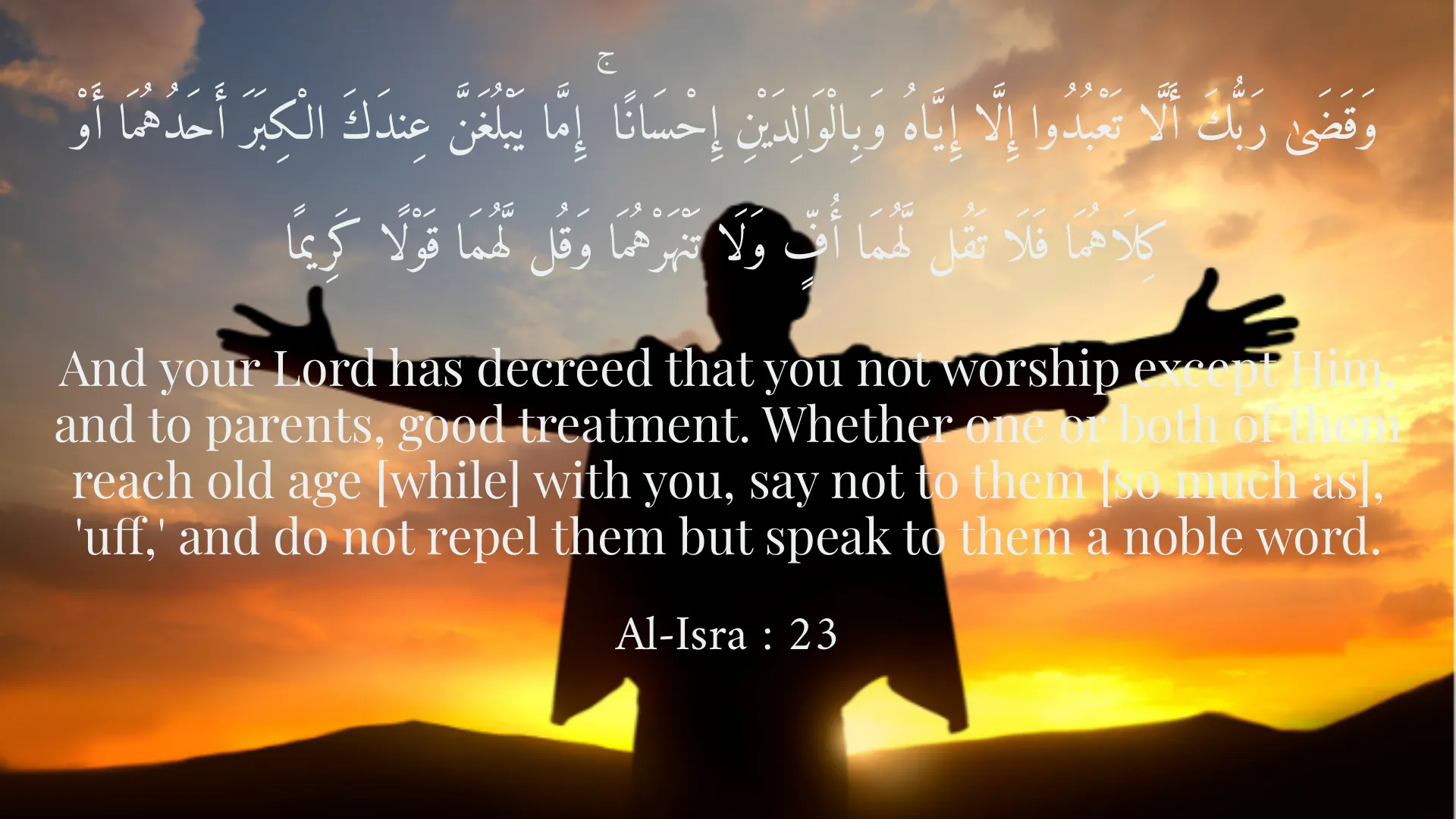
وَقَضَىٰ رَبُّكَ أَلَّا تَعْبُدُوا إِلَّا إِيَّاهُ وَبِالْوَالِدَيْنِ إِحْسَانًا ۚ إِمَّا يَبْلُغَنَّ عِندَكَ الْكِبَرَ أَحَدُهُمَا أَوْ كِلَاهُمَا فَلَا تَقُل لَّهُمَا أُفٍّ وَلَا تَنْهَرْهُمَا وَقُل لَّهُمَا قَوْلًا كَرِيمًا
And your Lord has decreed that you not worship except Him, and to parents, good treatment. Whether one or both of them reach old age [while] with you, say not to them [so much as], 'uff,' and do not repel them but speak to them a noble word.
Al-Isra : 23
وَاخْفِضْ لَهُمَا جَنَاحَ الذُّلِّ مِنَ الرَّحْمَةِ وَقُل رَّبِّ ارْحَمْهُمَا كَمَا رَبَّيَانِي صَغِيرًا
And lower to them the wing of humility out of mercy and say, 'My Lord, have mercy upon them as they nurtured me when I was small.'
Al-Isra : 24
وَوَصَّيْنَا الْإِنسَانَ بِوَالِدَيْهِ حَمَلَتْهُ أُمُّهُ وَهْنًا عَلَىٰ وَهْنٍ وَفِصَالُهُ فِي عَامَيْنِ أَنِ اشْكُرْ لِي وَلِوَالِدَيْكَ إِلَيَّ الْمَصِيرُ
And We had enjoined upon man [care] for his parents. His mother carried him with hardship upon hardship, and his weaning is in two years. Be grateful to Me and to your parents; to Me is the [final] destination.
Luqman : 14
Short Story
It is narrated that in ancient times, a zealous and inexperienced young man, serving in a king's court, deemed consulting with elders as futile. He boastfully said, 'These grey-haired ones are unaware of modern times and know nothing of new strategies.' The wise king, one day, summoned him and said, 'O young man, many hardships did we endure for you to sit comfortably in this position. Knowledge does not come solely from books, but also from experience and years of living in the world.' Then he brought forth a sagacious old man who had served the king for many years and said, 'Though his eyes may be dim and his back bent, his heart is a bright lamp of wisdom.' From then on, the young man listened to the words of the elders and learned that respecting the elderly is not merely out of politeness, but a path to hidden treasures of knowledge and experience. From that day, he not only honored the elders but also sought their counsel in important matters, thereby gaining a place in the hearts of the people and achieving success in his endeavors.