Quranic Answer
The Holy Quran, as the divine book of guidance, explicitly presents numerous signs and criteria for distinguishing truth (Haqq) from falsehood (Batil), guiding humanity towards ultimate reality. These Quranic criteria not only offer general principles but also possess a profound depth and breadth that can serve as a guiding light for individuals in all dimensions of their personal and social lives. The Quran acts as a beacon, illuminating the path and liberating humanity from the darkness of ignorance and deviation. For a believer, recognizing these signs is crucial for navigating the correct path and avoiding the traps of Satan and misguidance. The Holy Quran, with its eloquent and profound language, repeatedly invites humanity to contemplate, reason, and reflect on the verses of creation and the destinies of past nations, so that with insight and awareness, they can distinguish truth from falsehood and choose the path of salvation. One of the most fundamental signs of truth in the Quran is 'Tawhid' or the Oneness of God. Truth is always accompanied by the worship of the One God and avoiding any form of polytheism or associating partners with Him. Falsehood, in contrast, often manifests through polytheism, idolatry, or the worship of anything other than Allah. The Quran repeatedly emphasizes the principle that there is no deity worthy of worship except Allah, and this is the clearest demarcation between truth and falsehood. Any ideology or belief that leads a person towards polytheism or the worship of other than God is false, while anything that calls to the Oneness and Greatness of the Almighty God is truth. This principle applies not only to acts of worship but also permeates all aspects of life; in this sense, absolute reliance on anything other than God or disregarding His will and apparent worldly powers can be considered a form of falsehood that distances a person from the path of servitude and truth. This is the first and most important benchmark for assessing any belief or action. A second crucial criterion is 'Justice' and upholding fairness. Truth is consistently associated with justice, equality, upholding the rights of the oppressed, and avoiding oppression and tyranny. Conversely, falsehood is recognized by injustice, discrimination, and infringement upon the rights of others. The Holy Quran repeatedly stresses the establishment of justice in society, considering it one of the primary objectives of the prophets' missions. As stated in Surah Al-Hadid (57:25): "We have already sent Our messengers with clear evidences and sent down with them the Scripture and the balance that mankind may observe justice." Any speech, action, or system that leads to injustice and oppression is a sign of falsehood, while anything that calls for justice, equity, and righteousness is on the path of truth. This encompasses justice in judgment, in transactions, in family relations, and even justice in speech and thought. One who truly recognizes truth cannot condone injustice and oppression and will always strive to establish justice and eliminate oppression. The third sign is 'Rationality' and the invitation to contemplation and reflection. The Quran frequently invites humanity to ponder upon creation, divine verses, and the destiny of past nations. Truth is consistent with sound reason and clear evidence, whereas falsehood often relies on superstitions, blind imitation, fleeting emotions, or flimsy, illogical arguments. The Quran describes any call to falsehood as baseless and devoid of argumentation, urging its followers to distinguish truth from falsehood with open eyes and awakened minds. Many verses in the Quran use phrases like "Will they not then ponder?", "Do they not then understand?", or "Indeed in that are signs for a people who reason" to call humanity to use their intellect. This implies that if something contradicts sound reason and pure human nature (fitra), it is likely not truth and should be doubted. Truth proves itself through rational proofs and solid evidence, and it opens a path for inquiry and the pursuit of knowledge. The fourth criterion is 'Beneficence and Benevolence' towards humanity and society. Truth invariably leads to human prosperity, salvation, reform, and welfare in both this world and the hereafter. Falsehood, however, results in nothing but corruption, decay, misery, and harm. The Quran identifies many false actions by their destructive outcomes, such as usury, lying, backbiting, and hypocrisy, all of which cause corruption in society and jeopardize individual and social well-being. The primary objective of Islamic law (Sharia) is to establish goodness and repel corruption. Therefore, if something leads to the general welfare and good of society and individuals, and does not result in corruption or decay, it is a sign of its truthfulness. Quranic teachings consistently guide humanity towards goodness, benevolence, and cooperation for the common good, and warn against anything that leads to decay and wickedness. The fifth sign is 'Consistency and Absence of Contradiction'. Truth possesses a stable and enduring nature and does not undergo fundamental changes or contradictions over time. The Holy Quran presents itself as a book in which no contradiction can be found, and this is one of the signs of its divine origin. "Do they not then ponder on the Quran? Had it been from other than Allah, they would surely have found therein much discrepancy." (An-Nisa: 82). In contrast, falsehood is usually unstable, contradictory, and changes its nature with the alteration of time and circumstances. Truth is explicit and clear, while falsehood is often accompanied by complexity, ambiguity, and deception. This stability and clarity are also evident in divine moral principles and laws, assuring humans that they stand on a firm and unchangeable foundation. The sixth criterion is 'Pure Human Nature' (Fitra). Truth is compatible with human nature, and the human soul accepts it, whereas falsehood contradicts fitra, and a sound heart cannot tolerate it. Allah created humanity with a monotheistic and truth-seeking nature. The Prophet Muhammad (PBUH) said: "Every child is born upon Fitra [pure disposition]." Many truths, especially fundamental ethical principles like honesty, trustworthiness, and benevolence, are inherent within every human being, and every sound heart inclines towards them. If something clearly contradicts one's conscience and pure nature, its truthfulness should be doubted, and one should seek pure truth that is in harmony with human essence. Ultimately, by providing these signs, the Holy Quran has paved the way for humanity to distinguish truth from falsehood. By contemplating divine verses, utilizing reason, and emulating the conduct of the prophets, humans can find the light of guidance on this difficult path and free themselves from the darkness of misguidance. This distinction is not merely an intellectual choice but a practical one that determines the destiny of a person in this world and the hereafter. Therefore, distinguishing truth from falsehood is a great responsibility for every Muslim, one that must be approached with full awareness and insight, always seeking Allah's help to illuminate the path of truth. These verses and principles serve as a guiding light to help us grasp the truth amidst a multitude of information and diverse beliefs, and to follow the correct path, protecting ourselves from any deviation or error.
Related Verses
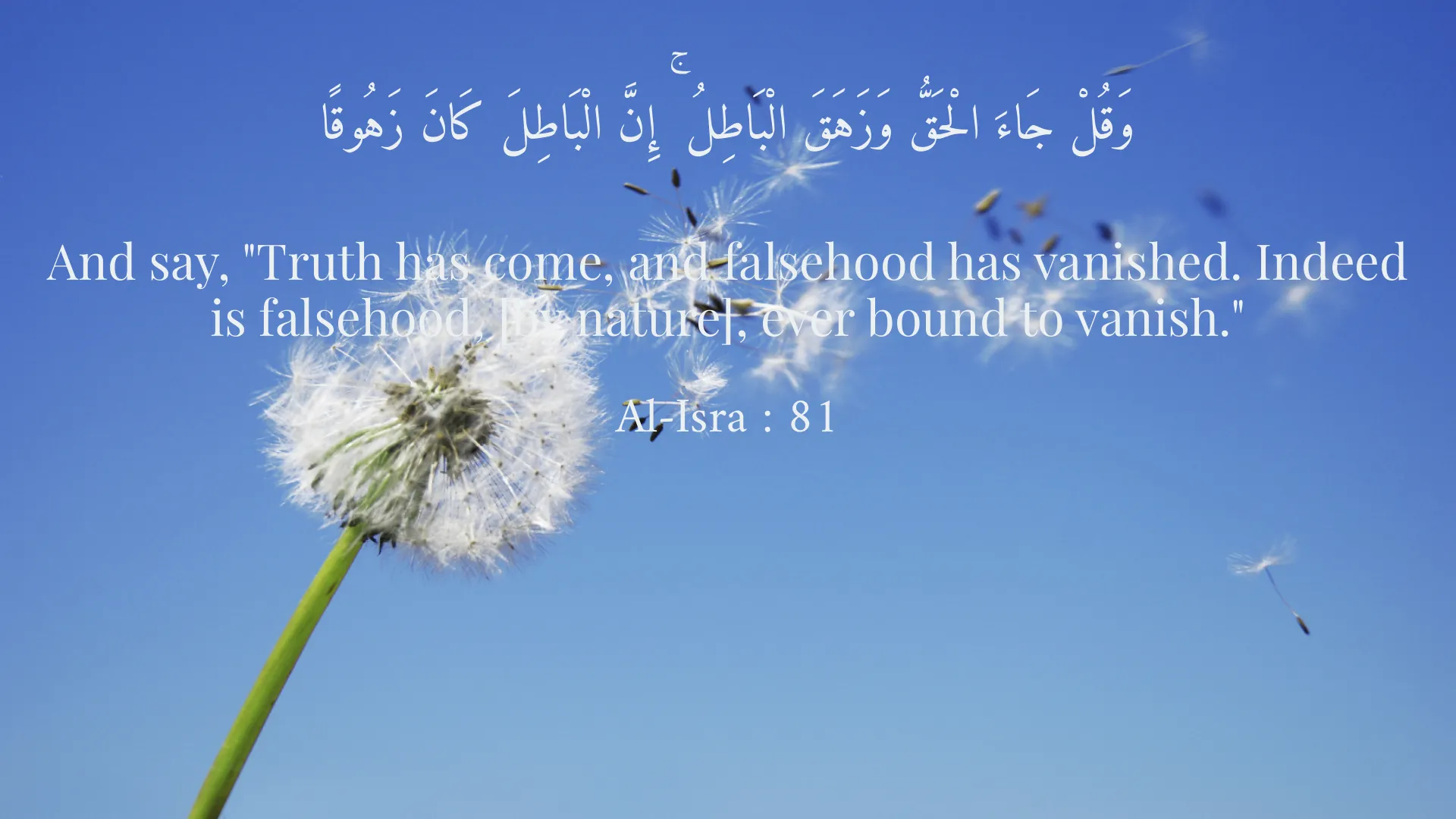
وَقُلْ جَاءَ الْحَقُّ وَزَهَقَ الْبَاطِلُ ۚ إِنَّ الْبَاطِلَ كَانَ زَهُوقًا
And say, "Truth has come, and falsehood has vanished. Indeed is falsehood, [by nature], ever bound to vanish."
Al-Isra : 81
لَا إِكْرَاهَ فِي الدِّينِ ۖ قَد تَّبَيَّنَ الرُّشْدُ مِنَ الْغَيِّ ۚ فَمَن يَكْفُرْ بِالطَّاغُوتِ وَيُؤْمِن بِاللَّهِ فَقَدِ اسْتَمْسَكَ بِالْعُرْوَةِ الْوُثْقَىٰ لَا انفِصَامَ لَهَا ۗ وَاللَّهُ سَمِيعٌ عَلِيمٌ
There shall be no compulsion in [acceptance of] the religion. The right course has become clear from the wrong. So whoever disbelieves in Taghut and believes in Allah has grasped the most trustworthy handhold with no break in it. And Allah is Hearing and Knowing.
Al-Baqarah : 256
فَذَٰلِكُمُ اللَّهُ رَبُّكُمُ الْحَقُّ ۖ فَمَاذَا بَعْدَ الْحَقِّ إِلَّا الضَّلَالُ ۖ فَأَنَّىٰ تُصْرَفُونَ
For that is Allah, your Lord, the Truth. So what [remains] beyond truth except error? Then how are you averted?
Yunus : 32
Short Story
It is narrated that in ancient times, Sheikh Sa'di was asked: "What is the sign of a wise person, and how can one distinguish them from false pretenders?" The Sheikh pondered for a moment and said: "A true wise person is one whose words, when spoken, settle like clear water on a thirsty soul, guiding hearts towards honesty and righteousness. But a false pretender, though their tongue may be sweet and deceiving, their words are like a mirage that leads the thirsty astray, bringing nothing but anxiety and turmoil." He continued: "One day in a city, a man claimed greatness and gathered people around him with pleasant words and and a well-groomed appearance. Everyone praised him. But a poor man sat in a corner and paid him no heed. They asked the poor man: 'Why do you not desire to listen to this man's words?' The poor man replied: 'I do not say his words are not pleasant, but I see no fruit from his deeds. The word of truth springs from the fount of reality and bears the fruit of righteous action, but the word of falsehood is merely wind in the mouth that yields nothing but deception and empty promises.' And indeed, after a while, the true nature of that man was revealed, and it became clear that he was nothing but a fraud. Thus, truth can be distinguished from falsehood by its outcome and its effect.