Quranic Answer
In response to the very important and profound question of whether excessive worship can lead to arrogance, one must provide a detailed and comprehensive answer rooted in the teachings of the Holy Quran and Islamic wisdom. From the Quranic perspective, worship in itself is a path and a means to draw closer to Allah, to purify the soul, and to cultivate virtues such as humility, gratitude, and inner peace. The primary purpose of worship is not merely to perform a series of outward rituals, but rather to bring about an inner transformation and to deepen the spirit of servitude and submission before the One Creator. Therefore, ideally and according to the pure teachings of the Quran, true worship should never result in arrogance or self-superiority; instead, the more a person progresses on the path of worship, the more humble, modest, and aware they should become of Allah's grandeur and their own limitations in the face of that majesty. However, there is a serious potential danger: if worship is not accompanied by pure intention and a correct understanding of the nature of servitude, it can indeed transform into a spiritual ailment known as 'self-admiration' (ujb) or 'worship-induced arrogance.' This type of arrogance emerges when an individual, instead of recognizing Allah's grace and mercy in enabling them to worship, exaggerates their own deeds and considers themselves superior to others, deeming themselves worthy of special divine status. The Holy Quran vehemently condemns this type of self-conceit and pride, considering it a cause for deviation and downfall. The best and most famous example in this regard is the story of Iblis (Satan). Despite years of worship and proximity to Allah's presence, due to his arrogance and self-superiority stemming from his creation (of fire in contrast to Adam's clay), he refused to prostrate before Adam and was eternally cast out from divine mercy. This Quranic narrative clearly demonstrates that even prolonged and abundant worship, if mixed with a spirit of pride and selfishness, not only yields no benefit but can lead to irreparable spiritual destruction. The Holy Quran repeatedly and emphatically stresses the importance of 'sincerity in intention' (ikhlas). Worship must be performed purely for the sake of earning Allah's pleasure, not for gaining people's attention, seeking praise, or feeling superior to others. Verse 32 of Surah An-Najm states: "…So do not purify yourselves; He is most knowing of who is righteous." This verse is a stern warning that a person should not attempt to 'purify' themselves through their deeds or claim superiority, because only Allah is aware of the most hidden intentions and the depths of hearts. Arrogance in worship stems from a distorted understanding of the nature of servitude and the humble position of a servant before the boundless majesty of Allah. The true servant, the more they worship, the more they become aware of their own helplessness, weakness, and dire need for Allah, and the more they perceive themselves as insignificant before His power and glory. This self-awareness and genuine humility lead them to greater modesty and deeper reverence before the Lord. Symptoms and signs of this spiritual arrogance can include belittling and despising others, judging them, viewing oneself as 'chosen' or 'closer to God' than others, and feeling immune to advice, admonition, and guidance. Such an individual might find that their worship, instead of leading them to serve humanity, empathize with them, and foster humility in society, separates them from people and traps them within the confines of their imagined 'spiritual achievements.' In contrast, the Holy Quran describes true believers by saying: "And the servants of the Most Merciful are those who walk upon the earth humbly, and when the ignorant address them [with foolish or aggressive words], they reply with words of peace" (Al-Furqan, verse 63). This verse illustrates that humility and good conduct towards people, even the ignorant, are prominent characteristics of the 'Servants of the Most Merciful,' not arrogance or self-aggrandizement. To prevent this dangerous spiritual affliction, Islam emphasizes several fundamental principles: Firstly, always remember that every act of worship we perform is a divine favor from Allah and a result of His grace and mercy, not merely our own strength and will. Secondly, focus on the sincerity of intention and the quality of worship, not merely its quantity or outward appearance. Thirdly, maintain a humble and non-judgmental view of others, avoiding any sense of self-superiority. It is quite possible that someone who performs fewer outward acts of worship may possess a purer heart, a more sincere intention, and a higher standing in the sight of Allah. Fourthly, continuously study and reflect upon the Quranic verses that repeatedly emphasize humility and condemn arrogance. Verses 18 and 23 of Surah Luqman and verse 37 of Surah Al-Isra, all explicitly warn humanity against pride and arrogance, inviting them to modesty. Ultimately, the true path to worship that leads to genuine spiritual growth and keeps one far from arrogance lies in a deep connection with the Divine Essence, understanding one's servitude and absolute need for Him, and maintaining humility before Him and all His creation. Pure worship cultivates a person who, the closer they draw to God, the more they perceive their absolute need for His grace and distance themselves from any self-conceit and pride, and this is the pinnacle of servitude.
Related Verses
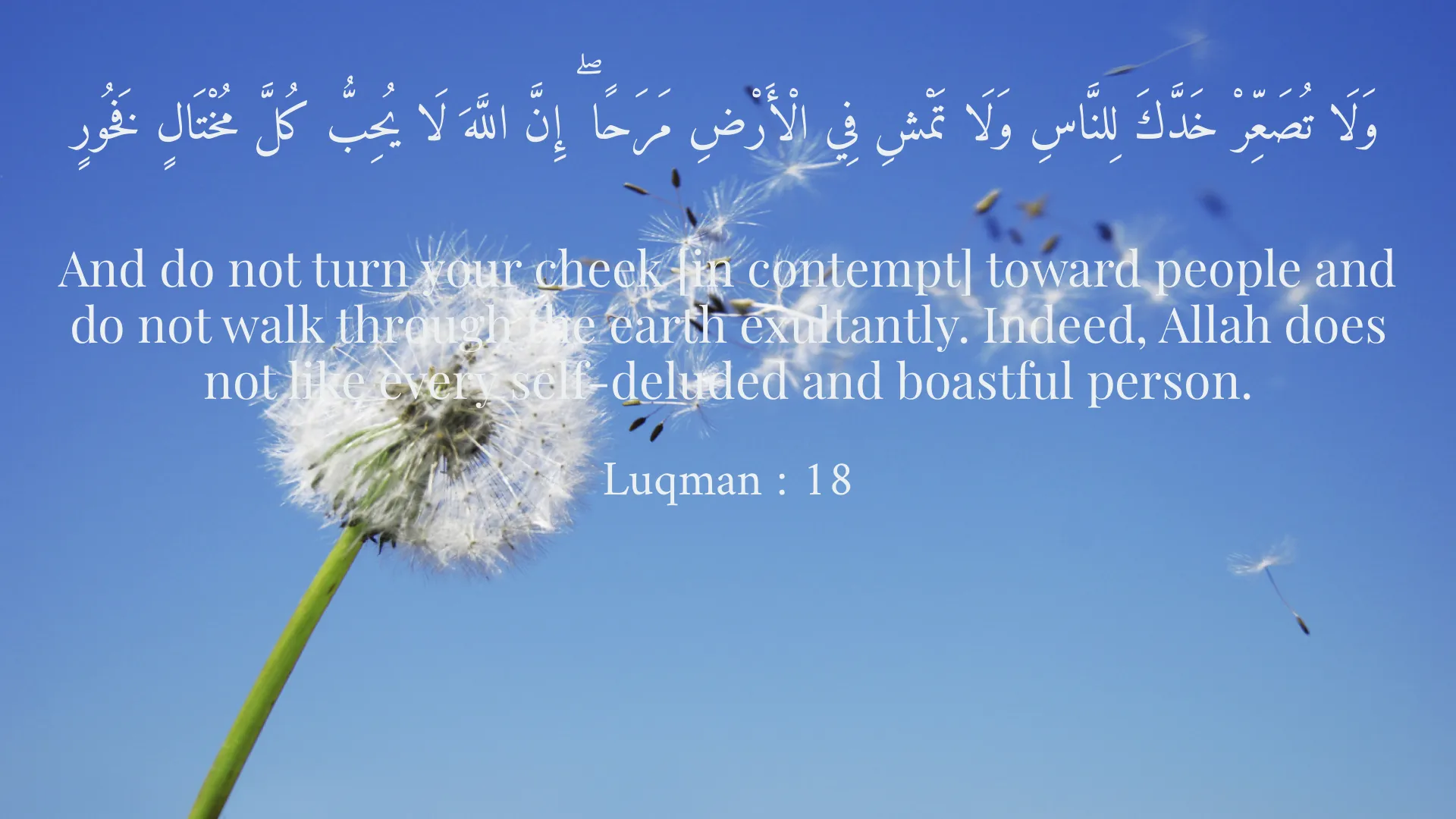
وَلَا تُصَعِّرْ خَدَّكَ لِلنَّاسِ وَلَا تَمْشِ فِي الْأَرْضِ مَرَحًا ۖ إِنَّ اللَّهَ لَا يُحِبُّ كُلَّ مُخْتَالٍ فَخُورٍ
And do not turn your cheek [in contempt] toward people and do not walk through the earth exultantly. Indeed, Allah does not like every self-deluded and boastful person.
Luqman : 18
وَلَا تَمْشِ فِي الْأَرْضِ مَرَحًا ۖ إِنَّكَ لَن تَخْرِقَ الْأَرْضَ وَلَن تَبْلُغَ الْجِبَالَ طُولًا
And do not walk upon the earth exultantly. Indeed, you will never tear the earth [apart] and you will never reach the mountains in height.
Al-Isra : 37
لَا جَرَمَ أَنَّ اللَّهَ يَعْلَمُ مَا يُسِرُّونَ وَمَا يُعْلِنُونَ ۚ إِنَّهُ لَا يُحِبُّ الْمُسْتَكْبِرِينَ
Undoubtedly, Allah knows what they conceal and what they declare. Indeed, He does not like the arrogant.
An-Nahl : 23
Short Story
It is narrated that there was a worshipper who had spent many years engaged in worship and asceticism, and due to the abundance of his righteous deeds, he became afflicted with self-admiration and arrogance. He considered himself superior to other beings and looked down upon others with contempt. One day, on his way, he saw a weak and poor beggar, who with a broken heart and bent stature, was supplicating to God for sustenance. The worshipper thought to himself: 'Where am I, and where is this beggar? God hears my prayers more and rewards my deeds greatly.' Suddenly, a voice from the unseen reached him: 'O servant! You boast of your deeds, but this beggar, despite all his poverty and destitution, has a heart free from arrogance and seeks refuge in none but Us. Indeed, one moment of his true humility and servitude before Our Majesty is superior to years of your arrogant worship. Your deeds have become a veil between you and the truth, but the poverty and need of this beggar have become his means of reaching Us.' The worshipper became aware of this saying and regretted his self-conceit, realizing that the value of worship lies in sincerity of intention and humility, not in its quantity nor in self-admiration. From then on, he too engaged in worship with greater humility and cleansed his heart from pride.