Quranic Answer
In Islamic culture, faith (Iman) is by no means a static or fixed concept; rather, it is a dynamic, living force that requires continuous nurturing and practice. Much like a muscle that strengthens with exercise and training, faith gains greater solidity and depth through performing righteous deeds, constant remembrance of God, and spiritual contemplation. The Holy Quran repeatedly links faith with good deeds (Amal Salih), indicating that true faith is not merely a verbal affirmation but must manifest in one's actions and behavior. Through these actions, faith is strengthened and grows. It can be said that a faithful life itself is a continuous practice for strengthening and deepening one's Iman. One of the most significant ways to practice faith is through 'Salat' (prayer). The five daily prayers provide a consistent and regular connection with Allah. This obligatory act is not just a series of physical movements and recitations but an opportunity for spiritual purification, concentration on God, and a reminder of the primary purpose of creation. When an individual consistently bows before their Lord throughout the day and night, feelings of humility, dependence, and reliance on Allah are reinforced within them. The repetition of phrases like 'Iyyaka Na'budu wa Iyyaka Nasta'in' (You alone we worship, and You alone we ask for help) in prayer instills the belief in Allah's oneness and uniqueness deep within one's soul. Patience and persistence in prayer instill spiritual discipline and make an individual more resilient against temptations and life's difficulties, all of which are manifestations of dynamic and active faith. Recitation and contemplation of the 'Holy Quran' is another highly effective way to practice faith. The Quran is the word of Allah, and connecting with it is a direct connection with the source of guidance and truth. Each time a believer reads and reflects upon the verses of the Quran, their knowledge of Allah, His names and attributes, the wisdom of creation, and the purpose of life increases. This increase in knowledge directly leads to an increase in faith, for the better one knows Allah and comprehends His greatness, the deeper one's faith in Him becomes. Quranic verses, including those mentioned in Surah Al-Anfal, clearly state that listening to and contemplating divine verses increases faith. This continuous act illuminates the heart and purifies it from heedlessness and doubt. 'Dhikr' (remembrance of Allah) at all times and in all situations is another practice for strengthening faith. Dhikr is not merely uttering words but signifies the presence of the heart and a continuous recollection of Allah's greatness and presence in all moments of life. When an individual acknowledges Allah's presence and observation in every action, from eating and drinking to working and socializing, this constant remembrance prevents the commission of sins and guides them towards good deeds. The remembrance of Allah brings tranquility to hearts, as indicated in the Quran: 'Unquestionably, by the remembrance of Allah hearts are assured' (13:28). This tranquility is the fruit of faith attained through continuous practice and perseverance. 'Amal Salih' (righteous deeds) is perhaps the most evident manifestation of practicing faith. Faith without deeds is like a seed that has been planted but never watered or cared for; it will never bear fruit. Righteous deeds encompass a wide range of behaviors: from fulfilling the rights of others, helping the needy, truthfulness, trustworthiness, and upholding justice, to maintaining family ties, kindness to parents, and good character. Every good deed performed with sincere intention and for Allah's pleasure not only brings spiritual reward but also strengthens the individual's faith in this world. When a person performs a good deed because of their faith and witnesses its positive outcome, their faith in divine promises becomes stronger. Similarly, when they resist sinful temptations and abandon them for Allah's sake, their willpower and inner stability increase, both of which are signs of strong faith. 'Sabr' (patience) and 'Shukr' (gratitude) are two essential wings for the flight of faith. Life is full of ups and downs. Facing hardships and tribulations with patience and without complaint is a sign of reliance and trust in divine wisdom. This patience itself is a great practice for faith, compelling an individual to trust in Allah's power and planning. Similarly, gratitude for blessings deepens faith. When a person reflects on their blessings and thanks Allah instead of complaining about deficiencies, their heart becomes filled with contentment and certainty. The Quran repeatedly promises immense rewards to the patient and the grateful, and these promises themselves serve as motivation to practice these aspects of faith. 'Seeking knowledge' is also an integral part of practicing faith. True faith is built upon knowledge and understanding. One who seeks to know Allah, the prophets, and their religion will have their faith transcend mere imitation and transform into certainty. Studying and researching the signs of Allah's greatness in creation, contemplating the history of prophets and past nations, and deeply understanding religious rulings and philosophy all contribute to strengthening the intellectual foundations of faith, protecting it from doubts and ambiguities. Knowledge saves faith from superficiality and transforms it into a deep, well-reasoned conviction. Finally, 'Tazkiyah al-Nafs' (purification of the soul) – cleansing oneself from blameworthy traits and adorning oneself with praiseworthy qualities – is a continuous and internal practice of faith. Struggling against the commanding self (nafs al-ammarah), controlling anger, overcoming envy, arrogance, and greed, and, in contrast, cultivating humility, sincerity, generosity, and love, are all manifestations of the practical exercise of faith. This internal struggle is called the greater jihad and has a profound impact on the quality and endurance of faith. Faith is like a tree rooted in the heart, and its branches are human actions. This tree needs continuous watering, and that watering consists of these spiritual and ethical practices that must continue throughout life. Therefore, faith is not only capable of being practiced but, without continuous practice and spiritual vigilance, it may weaken and falter. In summary, faith is a journey, not a destination. This journey requires continuous movement, persistent effort, and spiritual and practical practices. From prayer and Quran recitation to remembrance of God, righteous deeds, patience, gratitude, and self-purification, all these are practices that a believer can undertake to strengthen and deepen their relationship with Allah and solidify their faith. These practices not only provide peace and guidance in this worldly life but also prepare an individual for ultimate success in the hereafter.
Related Verses
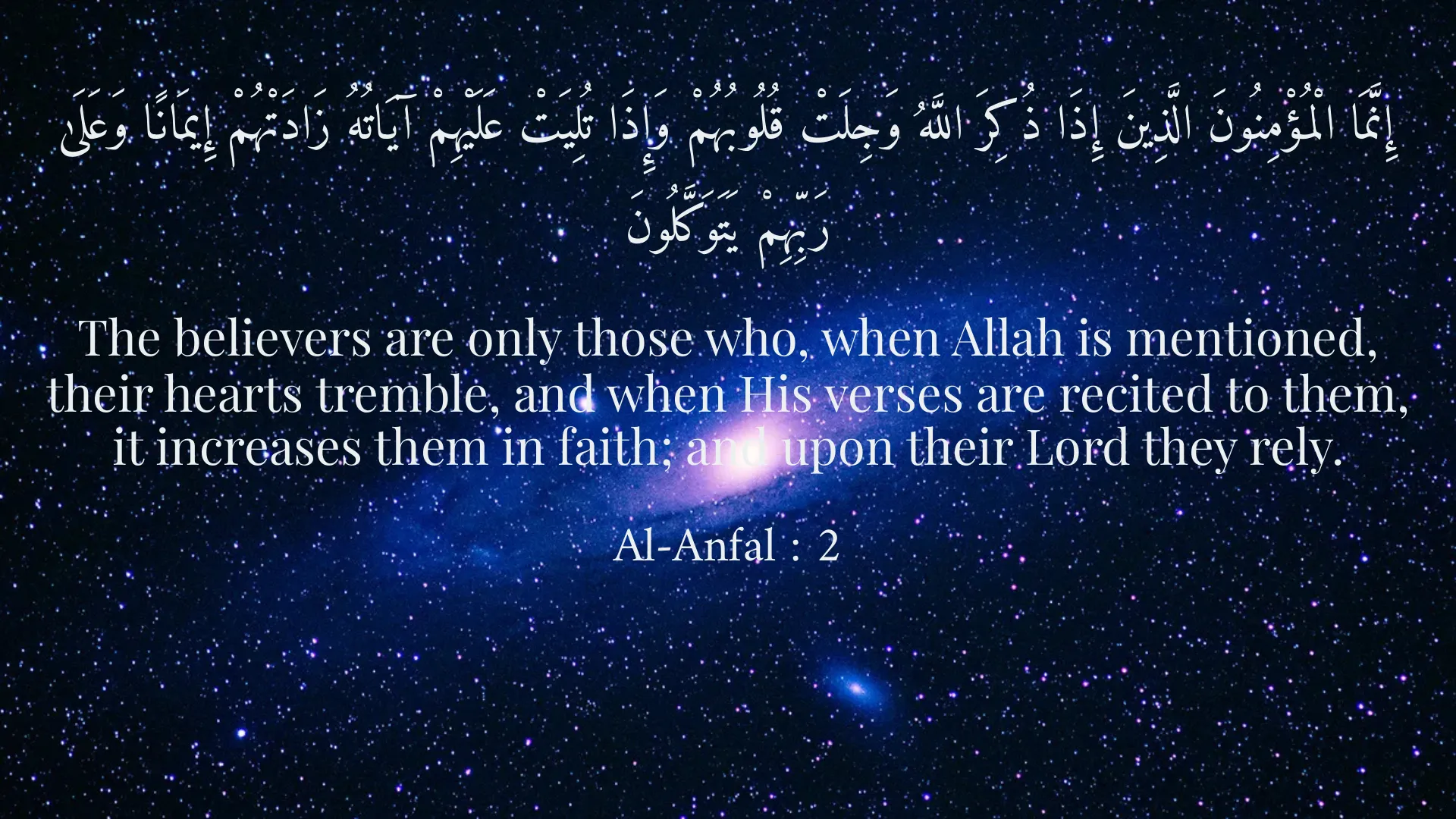
إِنَّمَا الْمُؤْمِنُونَ الَّذِينَ إِذَا ذُكِرَ اللَّهُ وَجِلَتْ قُلُوبُهُمْ وَإِذَا تُلِيَتْ عَلَيْهِمْ آيَاتُهُ زَادَتْهُمْ إِيمَانًا وَعَلَىٰ رَبِّهِمْ يَتَوَكَّلُونَ
The believers are only those who, when Allah is mentioned, their hearts tremble, and when His verses are recited to them, it increases them in faith; and upon their Lord they rely.
Al-Anfal : 2
وَالْعَصْرِ
By time,
Al-Asr : 1
إِنَّ الْإِنْسَانَ لَفِي خُسْرٍ
Indeed, mankind is in loss,
Al-Asr : 2
إِلَّا الَّذِينَ آمَنُوا وَعَمِلُوا الصَّالِحَاتِ وَتَوَاصَوْا بِالْحَقِّ وَتَوَاصَوْا بِالصَّبْرِ
Except for those who have believed and done righteous deeds and advised each other to truth and advised each other to patience.
Al-Asr : 3
Short Story
One of the wise masters used to tell his students: "Many are those who speak of religion and boast of faith, but when it comes to action, there is nothing. True faith is like the art of pottery. The potter first mixes clay with water, then with strong hands and firm resolve, places it on the wheel, shaping it with every turn and press. If he only contented himself with the knowledge of pottery and never touched the clay, how could he ever make a pot? Faith is similar; it is not perfected by words alone, nor by knowledge without action. Rather, every prayer, every charity, every patience in adversity, and every avoidance of sin is like a turn and a press that shapes and strengthens faith in the believer's heart. So, strive every day to nurture your faith with good deeds and morals, for on this path, you will not reach perfection without continuous practice." Thus, the students understood that faith is not merely a belief, but a way of life and a constant practice.