Quranic Answer
Faith, at its core, is a deeply personal and intimate connection with the Creator; an inner conviction and heartfelt belief rooted in human nature. Each individual is personally accountable for their faith and deeds before God. However, does this imply that the growth and flourishing of faith can occur independently, without the presence and support of a believing community? By referring to the teachings of the Holy Quran, we discover that while the foundation of faith is individual, its development, stability, and practical manifestation are deeply intertwined with the concepts of 'Ummah' (community) and 'Jama'ah' (congregation). The Quran repeatedly emphasizes the importance of unity, cooperation, and mutual support among believers, identifying the community as the primary environment for the individual and collective growth of faith. Indeed, one could say that faith is like a seed that, while capable of sprouting individually, requires fertile soil and continuous care—which is precisely what the believing community provides—to grow into a strong, fruitful tree. 1. Mutual Support and Brotherhood: The Quran explicitly emphasizes the concept of brotherhood and sisterhood among believers, as stated in Surah Al-Hujurat (49:10): "Indeed, the believers are brothers." This brotherhood is not merely a slogan but a reciprocal responsibility that calls upon members of the believing community to support one another, resolve disputes, and assist each other in the path of goodness and righteousness. This mutual support plays a vital role in strengthening individual faith. When an individual's faith wavers or doubts creep in, the presence of believing brothers and sisters who encourage patience, remind them of their purpose, and urge steadfastness can prevent their faith from faltering. Conversely, isolation and detachment from the community of believers can render an individual more vulnerable to temptations, doubts, and despair, as, in the absence of collective support and reminders, one might easily forget the ultimate goal and become engrossed in worldly matters. The communal bond acts as a protective shield, offering solace and encouragement when faced with life's trials and tribulations. 2. Learning and Knowledge Acquisition: Beyond emotional and spiritual support, the community plays a fundamental role in the acquisition and dissemination of religious knowledge. Much of Quranic wisdom and prophetic tradition is gained through interaction and exchange with others. Mosques, Islamic centers, and Quranic circles are all examples of social institutions that provide a platform for deeper understanding of the religion. Without access to these gatherings and knowledgeable individuals, one's comprehension of faith can remain incomplete, superficial, or even lead to misinterpretations. Many verses emphasize the importance of reflection, contemplation, and asking questions, activities that are best facilitated within a social context. For instance, in Surah Al-Imran (3:104), Allah states: "And let there be [arising] from you a nation inviting to [all that is] good, enjoining what is right and forbidding what is wrong, and those will be the successful." This verse clearly defines the duty of enjoining good and forbidding evil as a communal responsibility, which can only be properly fulfilled within an organized and purposeful community. The execution of this duty inherently purifies society and fosters moral and spiritual virtues within it. 3. Collective Worship and Spiritual Enhancement: Collective acts of worship hold an unparalleled role in strengthening faith. Congregational prayers, especially the Friday (Jumu'ah) prayer, and Hajj are prime examples of such devotions. In congregational prayer, believers stand side-by-side with a singular purpose before Allah, which reinforces a sense of unity, equality, and empathy. During Hajj, millions of Muslims from diverse races and languages gather from around the world to pursue a common goal, an experience that showcases the grandeur of Islam and the power of the Muslim Ummah, elevating individual faith to an unimaginable level. These collective acts of worship not only strengthen an individual's sense of belonging to a larger group but also remind them that they are not alone and that others are walking the same path. This spiritual and moral solidarity transforms faith from a theoretical concept into a living, practical experience. 4. Practical Application and Social Responsibility: Finally, a believing life in Islam is not confined solely to individual acts but also encompasses extensive social responsibilities. Giving Zakat (obligatory charity), sadaqah (voluntary charity), caring for the poor and needy, and striving for justice are all social dimensions of faith that can only be fully realized within the context of a believing community. A faith that does not serve society in practice and retreats into isolation is incomplete and cannot truly 'grow'. The Quran emphasizes "cooperate in righteousness and piety" (Al-Ma'idah 5:2), which inherently necessitates the existence of a community. Thus, while the initial spark of faith may ignite in the individual heart, its sustained glow and resilience against life's storms and coldness require the fuel and warmth of the believing community. The community of believers not only provides a supportive environment but also serves as a fertile ground for learning, action, and the practical manifestation of faith in individual and collective life. Therefore, it can be definitively stated that the sustained and complete growth of faith, though originating from a personal conviction, requires the vital ecosystem of a dynamic and active community for its maturity and fruitfulness.
Related Verses
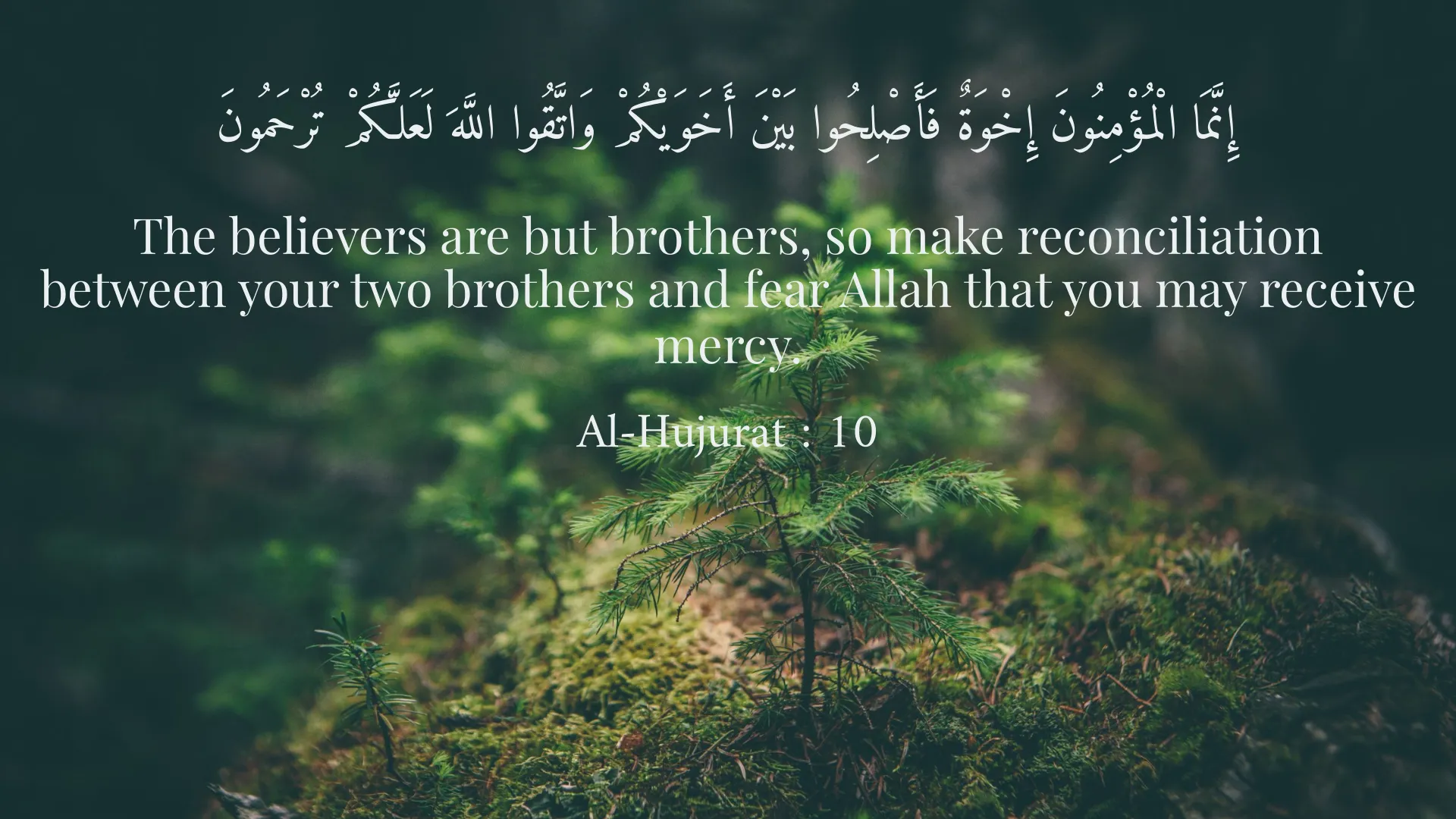
إِنَّمَا الْمُؤْمِنُونَ إِخْوَةٌ فَأَصْلِحُوا بَيْنَ أَخَوَيْكُمْ وَاتَّقُوا اللَّهَ لَعَلَّكُمْ تُرْحَمُونَ
The believers are but brothers, so make reconciliation between your two brothers and fear Allah that you may receive mercy.
Al-Hujurat : 10
وَاعْتَصِمُوا بِحَبْلِ اللَّهِ جَمِيعًا وَلَا تَفَرَّقُوا ۚ وَاذْكُرُوا نِعْمَتَ اللَّهِ عَلَيْكُمْ إِذْ كُنتُمْ أَعْدَاءً فَأَلَّفَ بَيْنَ قُلُوبِكُمْ فَأَصْبَحْتُم بِنِعْمَتِهِ إِخْوَانًا وَكُنتُمْ عَلَىٰ شَفَا حُفْرَةٍ مِّنَ النَّارِ فَأَنقَذَكُم مِّنْهَا ۗ كَذَٰلِكَ يُبَيِّنُ اللَّهُ لَكُمْ آيَاتِهِ لَعَلَّكُمْ تَهْتَدُونَ
And hold firmly to the rope of Allah all together and do not become divided. And remember the favor of Allah upon you when you were enemies and He brought your hearts together so you became, by His favor, brothers. And you were on the edge of a pit of the Fire, and He saved you from it. Thus does Allah make clear to you His verses that you may be guided.
Al-Imran : 103
وَلْتَكُن مِّنكُمْ أُمَّةٌ يَدْعُونَ إِلَى الْخَيْرِ وَيَأْمُرُونَ بِالْمَعْرُوفِ وَيَنْهَوْنَ عَنِ الْمُنكَرِ ۚ وَأُولَٰئِكَ هُمُ الْمُفْلِحُونَ
And let there be [arising] from you a nation inviting to [all that is] good, enjoining what is right and forbidding what is wrong, and those will be the successful.
Al-Imran : 104
Short Story
It is narrated that a pious man, seeking solitude, secluded himself far from the city to commune with his Lord and nurture his faith away from any worldly impurities. Days passed, and he initially found peace, but gradually, he felt his faith, like a lone candle in the wind, flickering. Sometimes doubts crept into his heart, and at other times despair overcame him, for there was no one to remind him or lend a hand. One day, by chance, he came to the city and attended a gathering of wise men and believers. He observed how they recited the Quran together, spoke of wisdom, and aided each other in difficulties. His heart instantly warmed from the collective spirit, and he felt his candle of faith transform into a brightly burning torch. He understood that while the beginning of faith is from one's heart, its sustained glow and growth are in the light and warmth of other believers, just like a flower that flourishes more beautifully and vibrantly amidst a garden full of blossoms.