Quranic Answer
The Intention Behind Worldly Deeds: Transforming Actions Through Divine Purpose In today's fast-paced and often chaotic world, individuals often immerse themselves in various activities that serve as a means to survive and thrive. Whether it be through education, work, leisure pursuits, or social engagements, we constantly navigate a landscape of worldly affairs. However, a critical question arises: What if the intention behind these seemingly mundane activities could transform them into divine actions? This idea is deeply rooted in Islamic teachings, emphasizing that the intention of worldly deeds can indeed become divine, provided that the individual’s purpose and motivation stem from the desire to please Allah. Islamic teachings extensively highlight the significance of intention, known as Niya in Arabic. This fundamental concept permeates various aspects of a Muslim’s life and lays the foundation for how individuals engage with the world. The Prophet Muhammad (PBUH) reminds us of this through his profound statement: 'The actions of people are based on their intentions.' This means that regardless of the nature of the action, it is the underlying intention that frames its value and significance. Hence, when one embarks on worldly tasks with the intention to serve Allah and seek His pleasure, these actions are elevated beyond the ordinary to a divine status. The Holy Quran, which acts as the primary source of guidance for Muslims, reinforces this notion. In Surah Al-Baqarah, verse 177, Allah provides insight into the true essence of righteousness by stating, 'Righteousness is not that you turn your faces toward the east or the west, but [true] righteousness is in one who believes in Allah, the Last Day, the Angels, the Book, and the Prophets and gives his wealth, in spite of love for it, to relatives, orphans, the needy, the traveler, those who ask [for help], and for freeing slaves.' This verse serves as a profound reminder that righteousness transcends the superficiality of physical orientations and rituals. Instead, it unveils a deeper truth: true righteousness is embedded in faith and the altruistic intentions behind one’s actions. What stands out from this Quranic verse is the notion that the heart's intention, along with love for Allah, is paramount in performing both good and worldly deeds. In Islam, the pursuit of wealth and success is not inherently discouraged; rather, it is the intention with which individuals engage in these pursuits that defines whether such actions are deemed commendable or otherwise. The celebrated Islamic scholar Imam Al-Ghazali emphasized the importance of intention when he stated, 'Actions are but the shadows of intentions.' Therefore, it is essential for individuals to constantly reflect on their intentions while partaking in everyday activities. Consider education, for instance. A student may pursue knowledge with the primary aim of achieving high grades or securing a prosperous job. However, if this individual shifts their intention to seek knowledge for the sake of serving humanity and pleasing Allah, the same process of learning transforms into an act of worship. The education that once solely catered to personal ambitions now becomes a means of uplifting society and contributing positively to human welfare. Thus, education can transcend mere worldly aspirations and emerge as a path toward divine service, reinforcing the belief that intention is indeed critical in elevating any action’s spiritual significance. Similarly, in the workplace, the opportunity to nurture one’s intentions arises frequently. The professional realm can often be competitive and self-serving, leading individuals to strive solely for personal advancement and recognition. Nevertheless, if one enters the workforce with the mentality of serving others, providing for one’s family, and earning wealth to contribute to societal welfare, their job can become a manifestation of divine service. In this light, even routine office tasks or business dealings are transformed, as the individual is conscious of their intent to perform their role to the best of their ability as a form of worship. Moreover, leisure activities, often viewed as mere pastimes, can also take on a divine aspect when engaged in with the right intention. Activities such as sports, reading, or socializing can cultivate positive relationships, promote wellness, and create opportunities for community building. If one approaches leisure pursuits with a focus on improving their physical and mental health to better serve others and fulfill Allah’s purpose, these recreational activities blend into a holistic approach to life—where the boundaries between worldly and divine become blurred. The concept of intention thus transforms one's worldview. By intertwining the divine with the secular, individuals can experience profound fulfillment and purpose in their lives. It serves as a powerful reminder that every action, whether overtly spiritual or not, can be infused with meaning and value as long as an individual aspires to please Allah through their choices. It's crucial to note that while the intentions must be sincere, one's journey is ultimately a personal one. Everyone is at a different stage along their spiritual path. The acknowledgment of one’s intentions is an ongoing process that involves self-reflection and honesty about one’s motives. This personal exploration fosters spiritual growth and leads toward an authentic life inspired by Islamic principles. In conclusion, the essence of Islamic doctrine teaches that the intention behind worldly deeds is of fundamental importance. As conveyed through the teachings of the Prophet Muhammad (PBUH) and the verses of the Holy Quran, elevating one's intentions transforms every aspect of life. The potential for divine action resides within each individual, awaiting the awakening of a sincere intention to serve Allah through everything they do. By cultivating the right mindset while performing educational pursuits, professional engagements, and even leisure activities, individuals can transcend mere worldly affairs and navigate through life with a purpose rooted in spirituality. Thus, it is not just the act but the heartfelt intention behind the act that ultimately gives rise to a life imbued with divine grace, wisdom, and meaning.
Related Verses
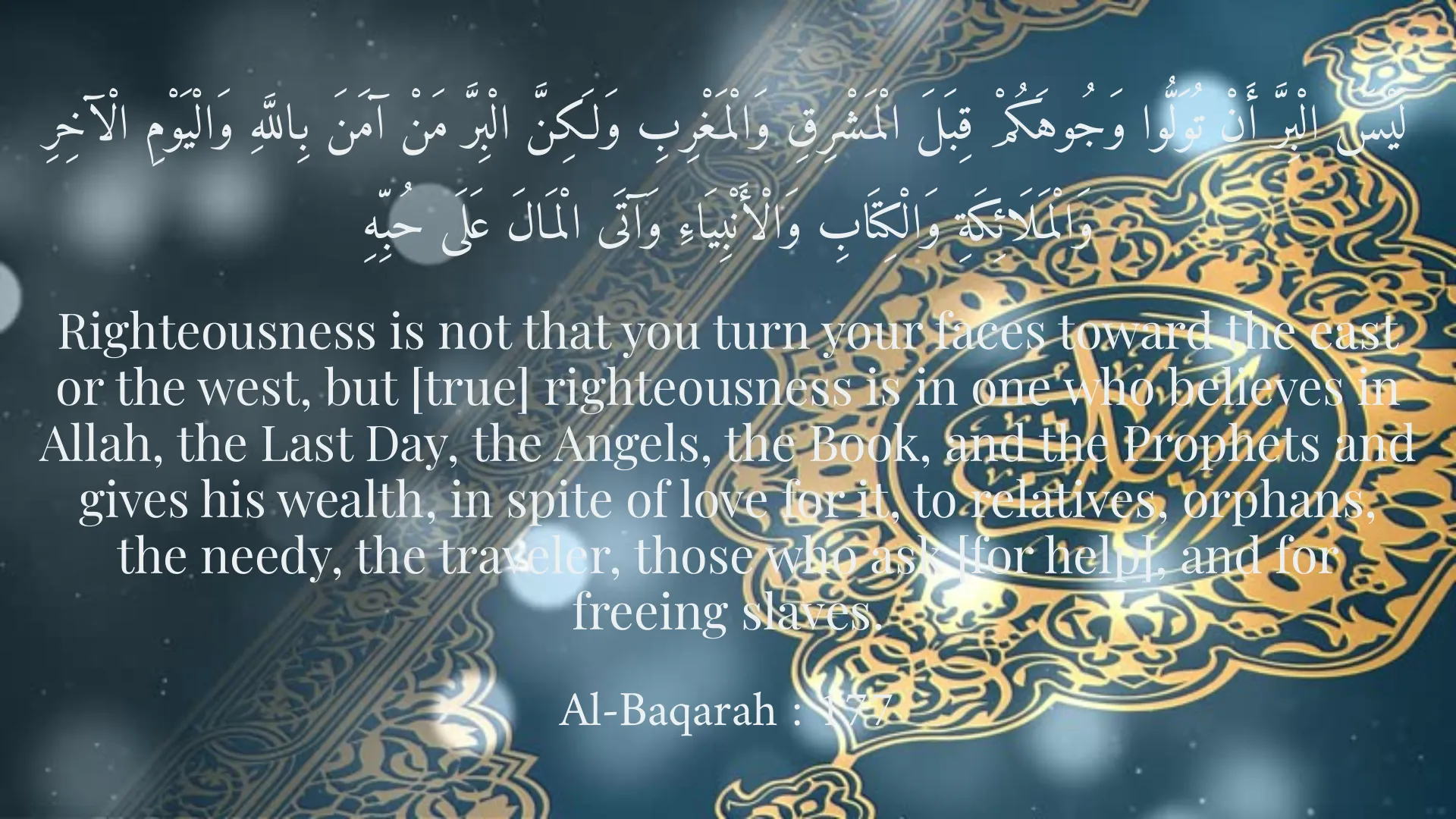
لَيْسَ الْبِرَّ أَنْ تُوَلُّوا وَجُوهَكُمْ قِبَلَ الْمَشْرِقِ وَالْمَغْرِبِ وَلَكِنَّ الْبِرَّ مَنْ آمَنَ بِاللَّهِ وَالْيَوْمِ الْآخِرِ وَالْمَلَائِكَةِ وَالْكِتَابِ وَالْأَنْبِيَاءِ وَآتَى الْمَالَ عَلَى حُبِّهِ
Righteousness is not that you turn your faces toward the east or the west, but [true] righteousness is in one who believes in Allah, the Last Day, the Angels, the Book, and the Prophets and gives his wealth, in spite of love for it, to relatives, orphans, the needy, the traveler, those who ask [for help], and for freeing slaves.
Al-Baqarah : 177
Short Story
One day, Mahdi, a talented and energetic young man, wondered how he could get closer to God in his life. He decided to carry out his daily tasks with a sincere intention for Allah. Every day, as he headed to university, he would pray to fulfill his studies to benefit others and seek Allah's pleasure. Gradually, his friends noticed the changes in him, and soon they also sought pure intentions for their actions. Over time, Mahdi's skills and education not only benefited himself but also served the community, thus dedicating his life to God.