Quranic Answer
Worldly sufferings and life's difficulties are significant subjects addressed in the Holy Quran. As a holy text believed by millions around the globe, the Quran offers profound insights and guidance on the trials and tribulations that individuals face throughout their lives. It emphasizes that these challenges are not merely coincidences of fate, but rather serve as divine tests imposed by Allah. Through these tests, individuals can demonstrate their resilience, patience, and unwavering faith amidst the adversities of life. The Quran consistently reminds us that trials and sufferings are integral to the human experience. For instance, in Surah Al-Baqarah, verse 155, it articulates a clear message: "And We will surely test you with something of fear and hunger and a loss of wealth and lives and fruits, and give good tidings to the patient." This verse encapsulates a deep understanding of the various forms of hardships one may encounter, including physical shortages, emotional distress, financial losses, and the mourning of loved ones. Despite the severity of these tests, the verse ends with a message of hope, emphasizing that patience is a key virtue during such times. The word 'patient' appears twofold in this verse, strongly indicating that patience is not merely a passive acceptance of hardship but an active form of endurance and perseverance. This sense of resilience calls upon individuals to keep their faith alive even when faced with overwhelming odds. Moreover, the Quran further elucidates the idea of divine testing in Surah Al-Imran, verse 186, stating: "Do you think that you will enter Paradise while Allah has not yet made evident those who strive among you and made evident the patient?" This verse serves as a reminder that in order to attain the ultimate reward of Paradise, one must first display their dedication and patience through trials. In this light, every hardship can be viewed as a stepping stone towards achieving spiritual greatness and eternal bliss in the afterlife. By drawing from these verses, one can infer that worldly sufferings are not devoid of purpose. Instead of perceiving tough times merely as obstacles, it becomes essential to recognize them as vital components of spiritual growth. This perspective enables individuals to approach their challenges with a sense of appreciation, realizing that strength can be cultivated through adversity. In today's world, the reality of suffering and hardship presents itself in various forms. Whether it’s economic downturns, social injustice, loss of companionship, or health crises, life poses numerous challenges that can wear down one's spirit. However, it's crucial to acknowledge that such difficulties can serve as opportunities to reinforce our faith and connection to Allah. They can prompt self-reflection, gratitude for blessings, and a deeper understanding of oneself and one’s purpose. Tackling life’s challenges requires more than just passive acceptance. It calls for active engagement—turning to prayer, seeking guidance from the Quran, and surrounding oneself with a support system of family and friends. During challenging times, many individuals find solace in their faith, turning towards their Creator in search of comfort and direction. Engaging in prayer and reflection can provide a profound sense of peace, helping individuals navigate through turmoil with a sense of purpose and hope. Additionally, communal worship and support can play a vital role in reinforcing one's faith during trials. By gathering with others who share similar beliefs and struggles, individuals can find strength in numbers. Sharing experiences can foster a sense of belonging and raise collective resilience, enabling believers to glean encouragement from one another as they share their burdens. As we navigate through our individual struggles, it's essential to remember that every hardship and every tear shed have significance in the eyes of Allah. They are catalysts for growth, maturity, and moral fortitude. The Quran guides us to transform our pain into purpose by motivating us to engage earnestly with our challenges and nurture our faith. To summarize, the themes of testing, suffering, and patient endurance resonate throughout the Holy Quran, offering not just explanations for life's hardships, but also profound wisdom on how to approach them. By embracing patience and maintaining a strong bond with Allah, we can turn adversities into opportunities for spiritual growth. It’s a call to action, inviting us to reflect on our responses when faced with challenges and to strive for resilience in our faith. Ultimately, the rewards of these trials await us in the hereafter, serving as a source of hope and motivation. As we traverse the unpredictable journey of life, let us hold fast to our faith, recognize the tests as avenues for growth, and remain steadfast in our patience and prayer. In doing so, we find peace, direction, and a promise of paradise awaiting us, ensuring that our worldly sufferings are acknowledged and rewarded by Allah.
Related Verses
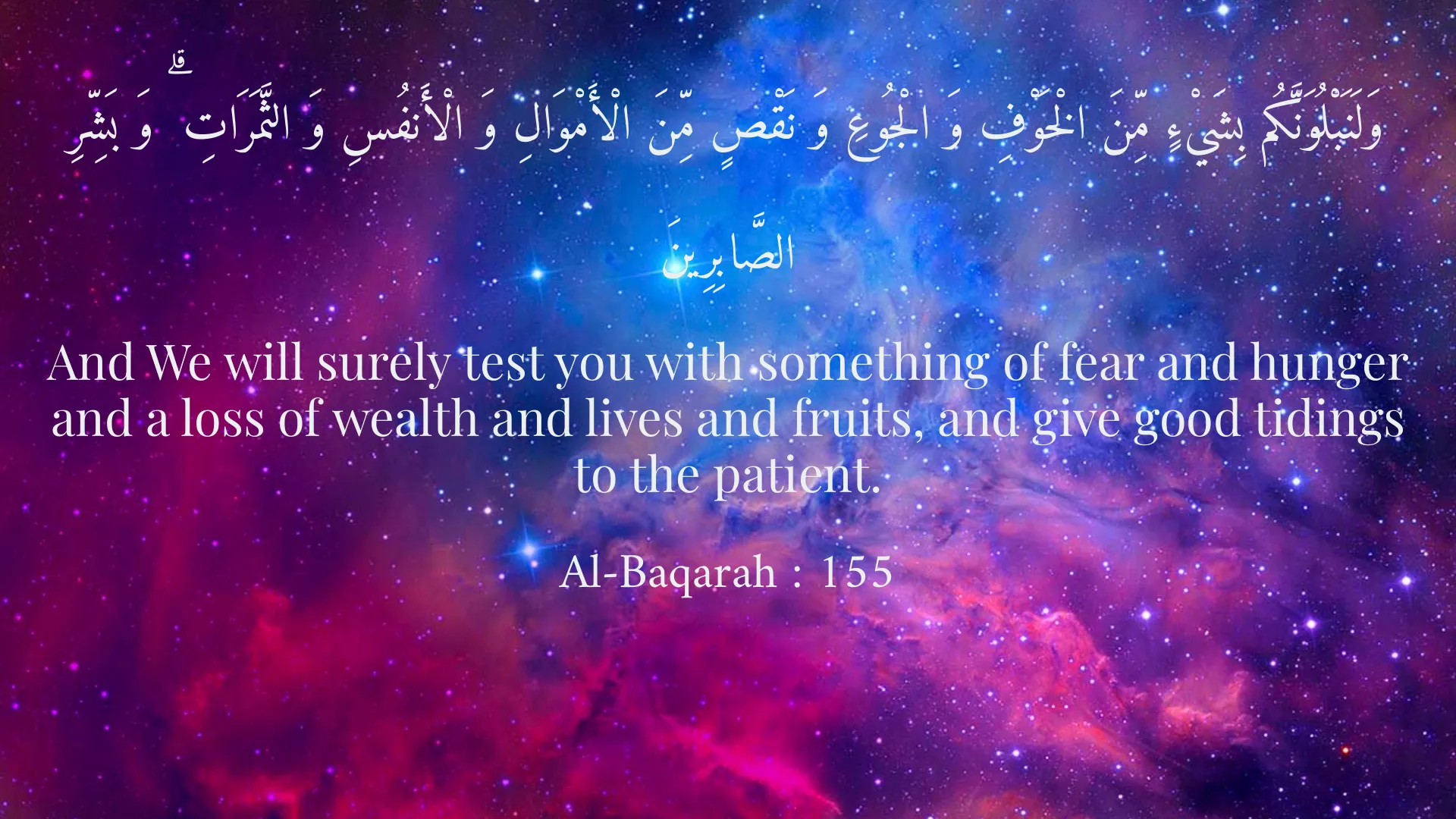
وَلَنَبْلُوَنَّكُم بِشَيْءٍ مِّنَ الْخَوْفِ وَ الْجُوعِ وَ نَقْصٍ مِّنَ الْأَمْوَالِ وَ الْأَنفُسِ وَ الثَّمَرَاتِ ۗ وَ بَشِّرِ الصَّابِرِينَ
And We will surely test you with something of fear and hunger and a loss of wealth and lives and fruits, and give good tidings to the patient.
Al-Baqarah : 155
أَحَسِبْتُمْ أَن تَدْخُلُوا الْجَنَّةَ وَلَمَّا يَعْلَمِ اللَّهُ الَّذِينَ جَاهَدُوا مِنكُمْ وَيَعْلَمَ الصَّابِرِينَ
Do you think that you will enter Paradise while Allah has not yet made evident those who strive among you and made evident the patient?
Al-Imran : 186
Short Story
Once upon a time, a man in the mountains faced numerous difficulties. He felt hopeless and thought that no one shared in his pain. However, one day while crossing a deep valley, he encountered others who were in even worse circumstances than himself. He realized that everyone struggles with their own unique challenges. This experience reminded him of the Quranic passages that explain suffering as an opportunity to draw closer to God. From that day on, he endured his trials with patience and continued his life with a joyful heart.