Quranic Answer
In the Holy Quran, the concepts of hope and hopefulness in God's mercy are integral to the Muslim faith. These themes resonate deeply within the hearts of believers, reinforcing their commitment to a life led by divine guidance and moral integrity. The Quran emphasizes that a true understanding of hope must be accompanied by responsibility, action, and diligence in fulfilling one's duties. This fulfilling of responsibilities not only strengthens individual character but also fosters a compassionate society where Muslims can thrive together. One of the most enlightening verses on hope is found in Surah Az-Zumar, verse 53, where Allah calls out to His servants, urging them to embrace their faith while instilling an understanding of hope in God's boundless mercy. The verse reads: 'Say, 'O My servants who have believed, fear your Lord. For those who do good in this world is good, and the earth of Allah is spacious. Indeed, the patient will be given their reward without account.' This verse is a powerful reminder that while believers should embrace the hope for God's mercy, they must also integrate this hope within the framework of their daily responsibilities. Hope in Islam is presented as a sign of strong faith. It drives individuals to strive for goodness and engage positively with the world around them. However, it is important to recognize that such hope should not lead to carelessness or disregard for the teachings of Islam. It would be a misconception to assume that mere longing or expectation of Allah's mercy does not come with responsibility. Instead, hope must inspire believers to act thoughtfully and purposefully. The call for balance between hope and action is evident throughout the Quran. For instance, Surah Al-Baqarah, verse 286, clearly states: 'Allah does not burden a soul beyond that it can bear.' This verse serves as both a reassurance and a reminder. It reassures believers that they are not given challenges beyond their capacity to handle, while simultaneously urging them to remain aware of their own limits and responsibilities. This intrinsic balance of hope and action is crucial in navigating life's complexities. Hope, in essence, should serve as a catalyst for concrete actions rather than an excuse for inaction or negligence. For a believer, the acknowledgment of one's limitations should not lead to hopelessness, but rather to a deeper understanding of individual capabilities and a commitment to act within those bounds. When combined, hope and concrete efforts form a potent force that propels individuals towards success and fulfillment. In this light, hope becomes a source of motivation, energizing believers to engage more fully with their duties, spiritual practices, and social obligations. The Quran provides numerous examples of individuals who exemplified this balance between hope and responsibility. The Prophets, for instance, faced tremendous challenges and exemplified unwavering faith in God's promise, coupled with diligent work and perseverance. Their stories serve as powerful lessons on the proper application of hope, illustrating how actions fueled by hope can lead to divine support and guidance. Moreover, a believer is encouraged to reflect not only on their own hopes but on the collective hope of their community. The Muslim Ummah (community) thrives on shared aspirations and collective efforts to fulfill good deeds. By fostering an environment of hope, individuals can uplift and encourage one another to contribute positively, work together for communal betterment, and nurture faith among the broader community. The relationship between hope and action is further illuminated by the teachings of the Prophet Muhammad (peace be upon him). His life exemplifies a consistent pursuit of action rooted in profound hope for God's mercy. The Prophet taught us that hard work is inseparable from hope and that we must act with intention and purpose while trusting in Allah's wisdom and mercy. In conclusion, while it is essential for Muslims to harbor hope in God's mercy, this hope must be sincerely linked to diligent actions. This connection ensures that hope does not devolve into negligence or idleness, but instead becomes a proactive force guiding individuals toward good deeds and righteous living. As articulated in the Quran, it is only through the combination of hope, action, and mindfulness of one's responsibilities that a believer can truly embody the principles of Islam and lead a fulfilling life. Hence, Muslims are encouraged to nurture hope within their hearts while diligently fulfilling their obligations, striving for balance in their pursuit of personal and communal success. Only then can they fully experience the richness of God's mercy and grace, ensuring that their lives reflect the beautiful tenets of faith, patience, and action.
Related Verses
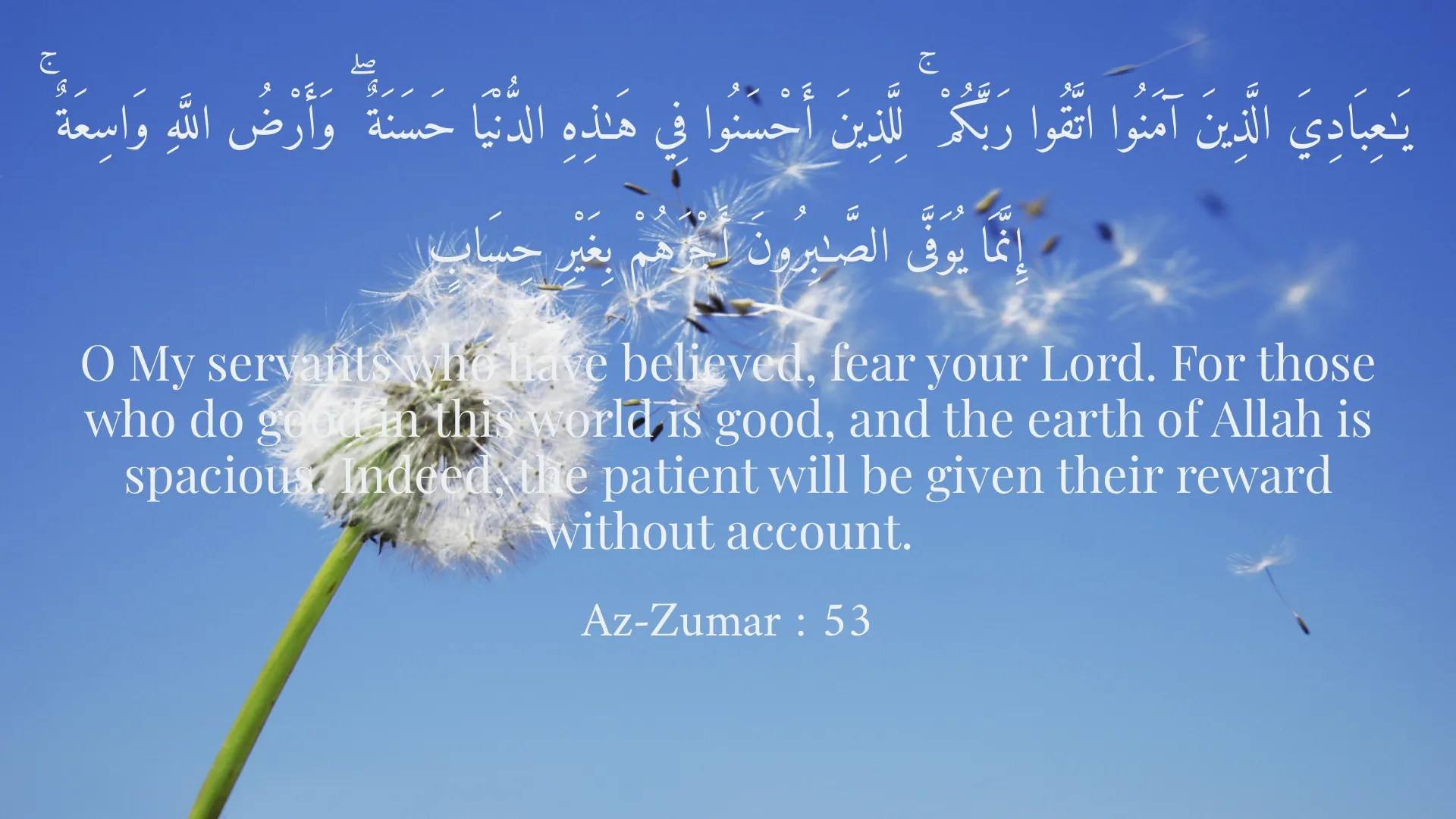
يَـٰعِبَادِيَ الَّذِينَ آمَنُوا اتَّقُوا رَبَّكُمْ ۚ لِلَّذِينَ أَحْسَنُوا فِي هَـٰذِهِ الدُّنْيَا حَسَنَةٌ ۖ وَأَرْضُ اللَّهِ وَاسِعَةٌ ۚ إِنَّمَا يُوَفَّى الصَّـٰبِرُونَ أَجْرَهُمْ بِغَيْرِ حِسَابٍ
O My servants who have believed, fear your Lord. For those who do good in this world is good, and the earth of Allah is spacious. Indeed, the patient will be given their reward without account.
Az-Zumar : 53
لَا يُكَلِّفُ اللَّهُ نَفْسًا إِلَّا وُسْعَهَا ۚ لَهَا مَا كَسَبَتْ وَعَلَيْهَا مَا اكْتَسَبَتْ ۗ رَبَّنَا لَا تُؤَاخِذْنَا إِن نَّسِينَا أَوْ أَخْطَأْنَا ۚ رَبَّنَا وَلَا تَحْمِلْ عَلَيْنَا إِصْرًا كَمَا حَمَلْتَهُ عَلَى الَّذِينَ مِن قَبْلِنَا ۚ رَبَّنَا وَلَا تُحَمِّلْنَا مَا لَا طَاقَةَ لَنَا بِهِ ۚ وَاعْفُ عَنَّا وَاغْفِرْ لَنَا وَارْحَمْنَا ۚ أَنتَ مَوْلَانَا فَانصُرْنَا عَلَى الْقَوْمِ الْكَافِرِينَ
Allah does not burden a soul beyond that it can bear. It will have [the consequence of] what [good] it has gained, and it will bear [the consequence of] what it has earned. Our Lord, do not impose blame upon us if we have forgotten or made a mistake. Our Lord, and lay not upon us a burden like that which You laid upon those before us. Our Lord, and burden us not with that which we have no ability to bear. And pardon us; and forgive us; and have mercy upon us. You are our protector, so give us victory over the disbelieving people.
Al-Baqarah : 286
Short Story
One day, a young man named Ali was practicing reliance and hope in God throughout his life. He was always hopeful for divine mercy, but he realized that life also required planning and effort. Fellow Muslims reminded him that hope should accompany action and effort. Ali learned that he needed to act on his hopes and strive to achieve his goals. Before long, he reached great successes, and his hope continued to grow.