Quranic Answer
Yes, the Holy Quran explicitly and unequivocally states that Almighty God is Most Forgiving and Most Merciful, and He pardons the sins of His servants, even if these mistakes have been repeated many times. This is one of the most fundamental and beautiful teachings of Islam, affirming that the door of repentance (Tawbah) and return to Allah is never closed. Indeed, among Allah's most prominent and central attributes mentioned in the Quran are "Al-Ghafur" (The All-Forgiving), "Ar-Rahim" (The Most Merciful), "At-Tawwab" (The Acceptor of Repentance), and "Al-Afu" (The Pardoner). These attributes signify that Divine mercy and forgiveness are boundless, and no sin – no matter how great – can prevent Allah's forgiveness, provided that His servant returns to Him with sincerity and pure intention. This divine generosity in forgiveness not only demonstrates His absolute power but also expresses the depth of His love and compassion for His creations, offering opportunities for correction and return even after repeated errors. The Holy Quran addresses this topic in numerous verses. For instance, in Surah Az-Zumar, verse 53, Allah Almighty declares: "Say, 'O My servants who have transgressed against themselves [by sinning], do not despair of the mercy of Allah. Indeed, Allah forgives all sins. Indeed, it is He who is the Forgiving, the Merciful.'" This verse is a universal invitation to all humanity, even those who have committed grave sins and feel submerged in their transgressions. The message is clear: never despair of Allah's mercy. Despair of Allah's mercy is considered a major sin in itself, as it implies limiting Allah's power and boundless forgiveness and somewhat questioning His greatness. This verse is a beacon of hope for those who feel helpless and despairing due to the multitude of their sins, calling them back to Allah’s loving embrace. The key to this forgiveness is sincere "Tawbah" (repentance). Tawbah means returning from sin to obedience to Allah, and it has certain conditions that must be diligently met for the repentance to be sincere and acceptable to Allah: 1. Heartfelt Regret: One must truly regret the sin committed and feel remorse. This remorse must come from the depth of one's being, not merely out of fear of punishment or to escape worldly problems. Genuine regret means understanding the ugliness of the sin and feeling deep sorrow for committing it. 2. Firm Resolve to Abandon the Sin: There must be a serious and firm decision not to repeat that sin in the future. This decision signifies a change in the individual's will and intention, requiring a strong resolve to correct behavior and avoid factors leading to sin. 3. Making Amends: If the sin involved the rights of others (Huquq al-Ibad), one must compensate for it or seek forgiveness from the wronged party. If it involved the rights of Allah (Huquq Allah), such as neglecting prayers or fasting, one must make up for them. This amends-making is a sign of sincerity in repentance and an effort to erase the effects of the sin. 4. Seeking Forgiveness (Istighfar): One must verbally and heartily seek forgiveness from Allah. Istighfar is not merely uttering words; it must arise from the depths of the soul, accompanied by humility and supplication. Even if a sin has been repeated many times, the door of repentance remains open. Allah looks upon those who repent repeatedly, and each time a servant returns to Him with sincere intention and true remorse, He forgives them. This does not mean that one can sin, then repent, and then sin again; absolutely not. The point is that if a person has weakness and falls back into a sin, they should not despair but should strive again to return to Allah with sincere repentance. This repetition of repentance demonstrates the individual's inner struggle against the commanding self (Nafs al-Ammara) and Shaytan (Satan), and Allah loves this struggle and effort. Allah does not expect absolute perfection from His servants but rather desires them to move forward on the path of correction and closeness to Him. Humans are fallible and may stumble along the path of life, but it is crucial that after every slip, instead of remaining in despair and hopelessness, we remember that we have a Merciful and Forgiving Lord who is always ready to accept our return. Imam Sadiq (AS) said: "Whenever a servant commits a sin and then repents, Allah forgives him and opens the doors of His mercy to him." This narration further confirms the boundless nature of Divine mercy and encourages repeated repentance. The repetition of sin and repentance should not become a tool for indifference towards sin. The purpose of opening the door of repentance is to provide an opportunity for correction and growth, not a license to repeat sins. Each time a person commits a sin and then repents, they should strive even more to distance themselves from that sin, identify the factors that lead them to it, and eliminate them. This process of repentance is a dynamic path for self-purification and achieving closeness to Allah. It demonstrates the individual's will to change and continuous effort to become a better version of themselves. Indeed, this continuous struggle against the self and Shaytan is considered a type of greater jihad, which Allah highly loves. As an important point, it should not be forgotten that major sins like Shirk (associating partners with Allah) require specific repentance and a complete return, and Allah states in the Quran that He does not forgive Shirk unless the person repents from it before death. However, other sins, no matter how great, are forgivable with sincere repentance. Ultimately, the message conveyed to us from the Quran and Sunnah is one of hope, mercy, and opportunity. Allah desires His servants to always return to Him, and in this path, despair and hopelessness are Shaytan's greatest traps. Even if we stumble and repeat a sin thousands of times, we must remember that He is "Ar-Rahman" (The Most Gracious) and "Ar-Rahim" (The Most Merciful), and as long as there is life and opportunity to make amends, we can purify ourselves from sin with sincere and pure repentance (Tawbatun Nasuh) and step back towards Him. This unparalleled forgiveness is a testament to the immense and limitless grandeur and kindness of the Lord of all worlds, and a sign of His boundless grace upon His servants.
Related Verses
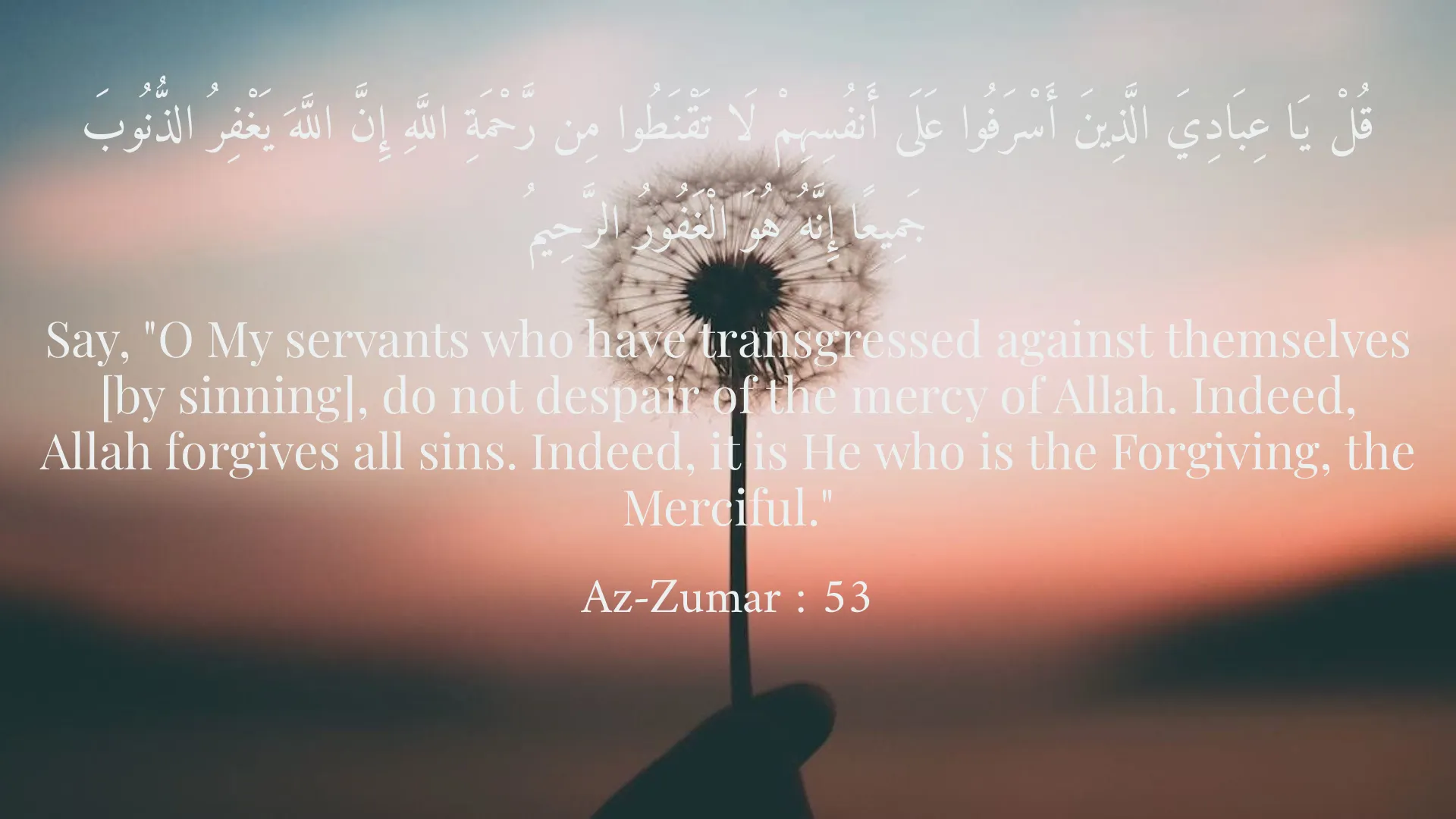
قُلْ يَا عِبَادِيَ الَّذِينَ أَسْرَفُوا عَلَى أَنفُسِهِمْ لَا تَقْنَطُوا مِن رَّحْمَةِ اللَّهِ إِنَّ اللَّهَ يَغْفِرُ الذُّنُوبَ جَمِيعًا إِنَّهُ هُوَ الْغَفُورُ الرَّحِيمُ
Say, "O My servants who have transgressed against themselves [by sinning], do not despair of the mercy of Allah. Indeed, Allah forgives all sins. Indeed, it is He who is the Forgiving, the Merciful."
Az-Zumar : 53
وَمَن يَعْمَلْ سُوءًا أَوْ يَظْلِمْ نَفْسَهُ ثُمَّ يَسْتَغْفِرِ اللَّهَ يَجِدِ اللَّهَ غَفُورًا رَّحِيمًا
And whoever does evil or wrongs himself but then seeks forgiveness of Allah will find Allah Forgiving and Merciful.
An-Nisa : 110
وَالَّذِينَ إِذَا فَعَلُوا فَاحِشَةً أَوْ ظَلَمُوا أَنفُسَهُمْ ذَكَرُوا اللَّهَ فَاسْتَغْفَرُوا لِذُنُوبِهِمْ وَمَن يَغْفِرُ الذُّنُوبَ إِلَّا اللَّهُ وَلَمْ يُصِرُّوا عَلَىٰ مَا فَعَلُوا وَهُمْ يَعْلَمُونَ
And those who, when they commit an immorality or wrong themselves, remember Allah and seek forgiveness for their sins – and who can forgive sins except Allah? – and do not persistently repeat [the sin] while they know.
Al-Imran : 135
Short Story
It is recounted in the tales of Saadi that a devout merchant, despite his pure intentions, sometimes succumbed to the temptations of the self or the deceptions of the world. Each time he erred, an inner voice, or perhaps the counsel of a wise friend, would remind him of the grandeur and mercy of the Lord. With a broken heart, he would repent, shed tears of remorse, and vow to himself never to return to that sin. Yet, human weakness being what it is, he would sometimes stumble again. One day, overwhelmed by the repetition of his errors, he approached a sage with heavy sorrow and despairingly asked, "O wise one, I repent every time, but I keep falling back into the same mistakes. Will the Lord ever forgive such a sinner who repeatedly breaks his repentance?" The sage smiled gently and said, "My dear friend, do not think of how many times you have stumbled, but rather how many times you have risen after stumbling and sought forgiveness. The door of Divine mercy is never closed to those who knock, even if they knock a hundred times a day with the same plea. Your effort to return to Him, even after falling, is itself a sign of your faith and His boundless love. Keep knocking, for He loves those who turn to Him. A broken heart that seeks His pardon is dearer to Him than the prayers of the arrogant." The merchant found solace in these words, understanding that his repeated acts of repentance, despite his weaknesses, were continuous acts of devotion, and he vowed to always return to Him, relying on the infinite grace of Allah.