Quranic Answer
In the Holy Quran, Allah emphasizes His infinite mercy and forgiveness, encouraging His servants to never despair of His Grace. The very essence of His teachings revolves around the concept of repentance and the boundless chance for redemption. One of the striking verses that echo this sentiment is found in Surah Az-Zumar, verse 53, where Allah directly addresses His servants: 'O My servants who have believed, fear your Lord. For those who do good in this world is good, and the earth of Allah is spacious. Indeed, the patient will be given their reward without account.' This verse serves as a beacon of hope for those who may feel lost in their shortcomings, reassuring them that no matter the weight of their sins, Allah is always ready to forgive and embrace them once again. The notion of mercy is central to Islamic teachings, transcending beyond mere forgiveness of sins. It is intertwined with the very fabric of our existence, providing comfort and guidance to individuals amid the trials of life. The Quran consistently urges individuals to turn back to Allah, emphasizing that our connection with Him is never severed, even when we err. This spiritual tether remains intact, awaiting our acknowledgment of our waywardness. Through sincere repentance, we reestablish our relationship with the Divine, paving the way for a renewed commitment to righteousness and piety. Moving forward to Surah Al-Baqarah, verse 222, the Quran elucidates Allah's delight in the repentance of His servants: 'Indeed, Allah loves those who are constantly repentant and loves those who purify themselves.' Here, the emphasis is placed on the importance of turning back toward Allah sincerely, with a heart filled with remorse for past actions. Allah's joy in our repentance serves as a powerful motivator for believers to strive for improvement and spiritual growth. It reminds us that every step we take towards forgiveness brings us closer to our Creator, who is ever-watchful and compassionate. The notion of divine forgiveness is neither a one-time occurrence nor an exclusive privilege reserved for a select few. As described in Surah Al-Furqan, verse 70, Allah assures believers that: 'And those who do not invoke with Allah another deity or kill the soul which Allah has forbidden, except by right, and do not commit unlawful sexual intercourse. And whoever should do that will meet a penalty. The punishment will be doubled for him on the Day of Resurrection, and he will abide therein humiliated.' Yet Allah, in His infinite mercy, also states that those who repent and believe, their sins will indeed be erased, and they will be counted among the righteous. This illustrates that the pathway to redemption is open and accessible to all, providing hope for those who have strayed from the righteous way. The continuous encouragement to seek forgiveness through repentance reinforces the idea that every soul is deserving of mercy. It instills within believers a sense of accountability and encourages righteous living. By acknowledging one’s mistakes and striving to better oneself, a believer can foster a deeper connection with Allah. This connection is vital as life is replete with tests, trials, and tribulations, and Allah's guidance serves as a source of strength and solace during these challenging times. Moreover, the concept of Allah's mercy sends a clear message: we must not allow our sins to hinder our spiritual journey. The oppressive weight of guilt can be overwhelming, often leading individuals to draw away from their faith rather than seeking comfort within it. This is where understanding Allah's boundlessness in mercy comes into play; it frees us from despair. The acknowledgment that Allah listens not only to our prayers but also our silent struggles fosters an environment of healing and growth. Believers are reminded that despair is counterproductive, as Allah's love and compassion are ever-present. In a world that often seeks to trap us in cycles of guilt and regret, the Quran serves as a reminder of the transformative power of repentance. Islam teaches that recognizing one's faults is the first step toward healing. It is crucial to internalize that the act of returning to Allah after straying is not a sign of weakness but rather one of strength and courage. The willingness to admit one’s flaws and seek forgiveness is a hallmark of a believer, reflecting humility and self-awareness. Consider the profound implications of believing in such a merciful God. This belief not only shapes one's spiritual identity but also impacts interactions with others. It cultivates compassion, empathy, and understanding among communities, reminding us that if Allah can forgive the greatest of sins, so should we strive to forgive one another. Thus, the mercy of Allah is not only a personal experience but also a communal one, encouraging a cycle of kindness and support within society. In conclusion, the themes of mercy and forgiveness outlined in the Quran invite individuals to reflect upon their lives with a sense of hope and renewal. The verses from Surah Az-Zumar, Al-Baqarah, and Al-Furqan collectively capture the essence of Allah's compassion toward His servants, encouraging them to seek forgiveness and trust in His eternal mercy. No sin is too great to be forgiven; all that is required is sincerity in repentance and a desire to return to the right path. This powerful message serves as a source of empowerment, urging believers to maintain their connection with Allah through both triumphs and tribulations. It reaffirms that Allah not only hears our voices but welcomes us back with open arms, renewing our strength and spirit as we navigate the complexities of life.
Related Verses
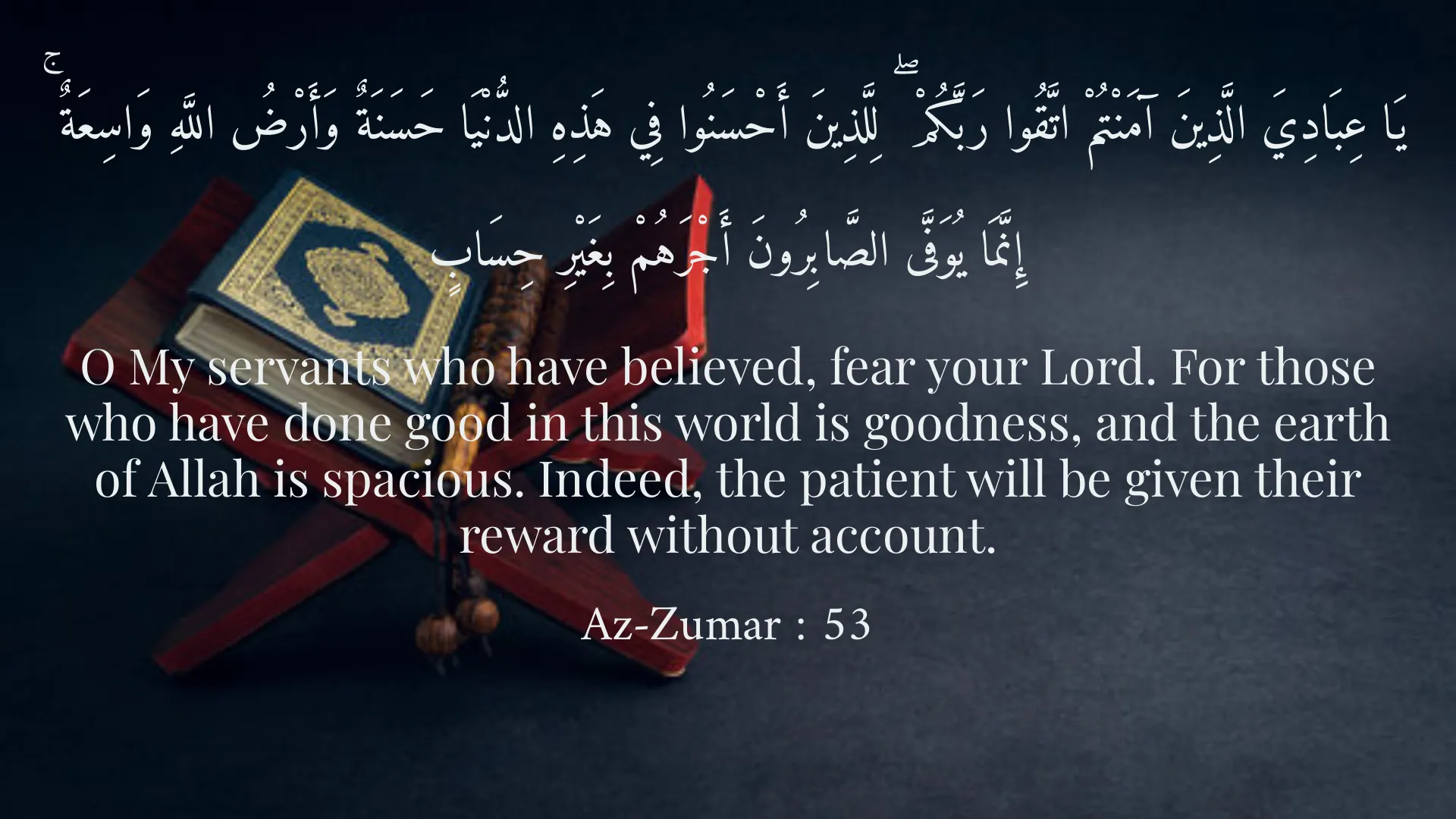
يَا عِبَادِيَ الَّذِينَ آمَنْتُمْ اتَّقُوا رَبَّكُمْ ۖ لِلَّذِينَ أَحْسَنُوا فِي هَذِهِ الدُّنْيَا حَسَنَةٌ وَأَرْضُ اللَّهِ وَاسِعَةٌ ۚ إِنَّمَا يُوَفَّى الصَّابِرُونَ أَجْرَهُمْ بِغَيْرِ حِسَابٍ
O My servants who have believed, fear your Lord. For those who have done good in this world is goodness, and the earth of Allah is spacious. Indeed, the patient will be given their reward without account.
Az-Zumar : 53
إِنَّ اللَّهَ يُحِبُّ التَّوَّابِينَ وَيُحِبُّ الْمُتَطَهِّرِينَ
Indeed, Allah loves those who repent and loves those who are clean.
Al-Baqarah : 222
إِلَّا مَنْ تَابَ وَآمَنَ وَعَمِلَ عَمَلًا صَالِحًا فَأُولَـٰئِكَ يَدْخُلُونَ الْجَنَّةَ وَلَا يُظْلَمُونَ شَيْئًا
Except for those who repent, believe and do righteous work. For them Allah will enter Paradise, and they will not be wronged at all.
Al-Furqan : 70
Short Story
Once upon a time, in a small town, there lived a man named Sohrab who was deeply saddened and desperate about the sins he had committed. He went to a mountain and began to pray. In his heart, he wondered, 'Does Allah still hear my voice?' With a broken heart, Sohrab recalled Surah Az-Zumar, verse 53, and remembered that Allah's mercy is limitless. He decided to return to God and repent sincerely. As he pursued this path, he felt new capacities emerging in his life. His breath became lighter, and a special peace settled within him. He realized that Allah always hears his calls and that His mercy is greater than any sin.