Quranic Answer
The concept of 'halal gaze' is a significant topic in Islamic teachings, particularly emphasized in the Holy Quran. The Quran establishes clear guidelines on how believers should conduct themselves regarding their gaze, especially in a society where interactions between genders are complex and often challenging. This article aims to explore the Quranic injunctions concerning the halal gaze and its implications for personal conduct and social interactions, emphasizing the verses from Surah An-Nur, which serve as foundational texts for understanding this subject. In Surah An-Nur, verse 30, Allah commands the believers, "Tell the believing men to lower their gaze and guard their private parts. That is purer for them. Indeed, Allah is Acquainted with what they do." This verse encapsulates the essence of the halal gaze for men. It instructs them to lower their gaze as an act of chastity and respect, underscoring the importance of controlling one’s desires through mindful action. The command aims at creating a society where mutual respect exists, one where inappropriate and lustful gazes are replaced with dignified interaction. The significance of lowering the gaze goes beyond avoiding sinful looks. It is about nurturing a sense of humility and respect towards others. In a world often filled with distractions and challenges to moral integrity, the Quran encourages believers to maintain focus and dedication to their values. This direction from Allah provides a protective barrier against the pervasive effects of objectification and superficial judgments based on appearance. Following this instruction, Surah An-Nur, verse 31 elaborates further on the concept of the halal gaze, addressing women specifically. It states, "And tell the believing women to lower their gaze and guard their private parts and not reveal their adornment except that which [ordinarily] appears thereof and to draw their shawls over their chests and not expose their adornment except to their husbands, their fathers, their husbands' fathers, their sons, their husbands' sons, their brothers, their brothers' sons, their sisters' sons, their women, that which their right hands possess, or those male attendants having no physical desire, or children who are unaware of private aspects of women. And let them not stamp their feet so as to make known what they conceal of their adornment. And turn to Allah in repentance, all of you, O believers, that you might succeed." This comprehensive directive signifies that the halal gaze is not merely about a glance but encompasses a holistic approach towards modesty and moral behavior. Women are encouraged to maintain their privacy through modest dressing and by being cautious about how they present themselves to those who are not part of their immediate family. Beyond the superficial understanding, the verse also emphasizes the importance of an internal attitude of humility and a commitment to personal morality. The concept of lowering the gaze as outlined in these two verses is significant for both men and women. It signifies mutual respect and dignity, advocating for a society where individuals are valued for their character rather than their physical appearance. In doing so, it creates boundaries that discourage objectification and encourage healthy, respectful interactions between genders. The significance of maintaining these boundaries cannot be overstated; they serve as a means of preserving personal integrity and social harmony. Moreover, the halal gaze must occur within appropriate contexts and settings. It is crucial to recognize that casual encounters without attentiveness to Islamic principles may lead to uncontrolled desires and eventual transgressions. Therefore, maintaining the halal gaze means adhering to decorum in all settings, especially in mixed-gender environments. This includes exercising discretion not just in one's gaze but in one's conversation and overall behavior. Essentially, it is a means to cultivate an environment where both genders can interact respectfully and positively without leading each other astray. One may argue that the teachings regarding the halal gaze are antiquated in today's contemporary society, which often promotes a more liberal interaction between genders. However, it is essential to view these guidelines through the lens of cultural preservation and moral integrity. The overarching theme of the halal gaze principles is the preservation of individual respect and societal decorum. In a world that often prioritizes physical attraction and instant gratification, these teachings offer a refreshing reminder of the deeper values that underpin meaningful relationships. In conclusion, the principles governing the halal gaze in Islam serve as valuable guidelines for personal conduct and social interactions. The Quran’s emphatic directions in Surah An-Nur concerning lowering one’s gaze and fostering respect among genders challenge believers to cultivate an environment of morality and integrity. Such frameworks encourage mindfulness and caution in a world rife with temptations and distractions. As believers navigate their lives, honing their practice of the halal gaze can ultimately lead to a more respectful and dignified society, where individuals are appreciated for their character and deeds rather than their appearance. The Quran and the teachings of Prophet Muhammad (peace be upon him) continue to guide Muslims in preserving these values, reflecting a timeless wisdom that remains relevant in the contemporary world.
Related Verses
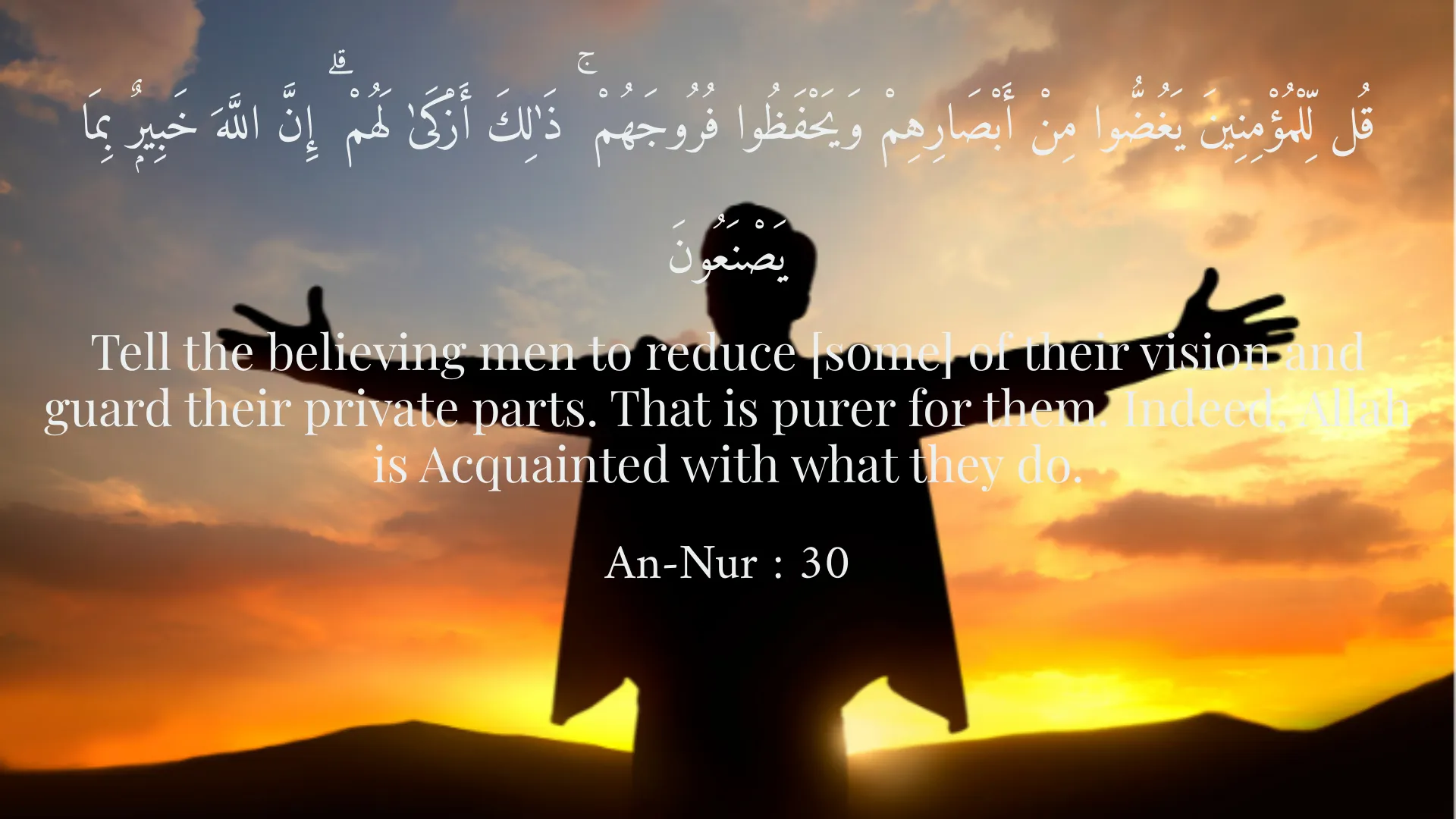
قُل لِّلْمُؤْمِنِينَ يَغُضُّوا مِنْ أَبْصَارِهِمْ وَيَحْفَظُوا فُرُوجَهُمْ ۚ ذَٰلِكَ أَزْكَىٰ لَهُمْ ۗ إِنَّ اللَّهَ خَبِيرٌۭ بِمَا يَصْنَعُونَ
Tell the believing men to reduce [some] of their vision and guard their private parts. That is purer for them. Indeed, Allah is Acquainted with what they do.
An-Nur : 30
وَقُل لِّلمُؤْمِنَاتِ يَغْضُضْنَ مِنْ أَبْصَارِهِنَّ وَيَحْفَظْنَ فُرُوجَهُنَّ وَلَا يُبْدِينَ زِينَتَهُنَّ إِلَّا مَا ظَهَرَ مِنْهَا ۖ وَعَلَيْهِنَّ فِي بُيُوتِهِنَّ وَلَا يُبْدِينَ زِينَتَهُنَّ إِلَّا لِبُعُولَتِهِنَّ أَوْ آبَائِهِنَّ أَوْ آبَاءِ بُعُولَتِهِنَّ أَوْ أَبْنَائِهِنَّ أَوْ أَبْنَاءِ بُعُولَتِهِنَّ أَوْ إِخْوَانِهِنَّ أَوْ بَنِي إِخْوَانِهِنَّ أَوْ بَنِي أَخَوَاتِهِنَّ
And tell the believing women to reduce [some] of their vision and guard their private parts and not expose their adornment except that which [ordinarily] appears thereof.
An-Nur : 31
Short Story
One day, a man visited a religious scholar and asked, 'Does halal gaze have limits?' The scholar smiled and said, 'Indeed, it does. We must be careful to avoid improper and forbidden gazes.' The man listened attentively to the scholar's words and was convinced that halal gaze should be accompanied by caution and respect.