Quranic Answer
In the rich teachings of the Holy Quran, hope is not merely a beautiful and comforting concept; rather, it serves as a vital backbone for survival, resilience, and growth when facing life's toughest crises. The Quran explicitly demonstrates that hope, especially during difficult times, is not a baseless illusion but a powerful reality deeply rooted in the profound understanding of God, His absolute power, and His infinite mercy. This divine book teaches believers that even at the peak of despair and darkness, Allah's helping hand is always near, and from every hardship, a way out exists. One of the most central concepts that gives meaning to hope in crises is 'Tawakkul' – meaning complete and unconditional trust in Allah. In moments of crisis, when humans have exhausted all their efforts and material solutions have reached a dead end, it is only reliance on divine providence that can keep the light of hope shining in the heart. The Holy Quran states: "And whoever fears Allah – He will make for him a way out and will provide for him from where he does not expect. And whoever relies upon Allah – then He is sufficient for him." (At-Talaq, verses 2-3). This verse clearly indicates that for whoever is mindful of Allah and trusts Him, Allah will provide a way out and sustain them from unexpected sources. This promise is an unparalleled source of hope, demonstrating that even in the most challenging circumstances, Allah is All-Powerful to bring about relief in ways that humans cannot even imagine. This Tawakkul transforms hope from a mere wish into an active belief that encourages perseverance and forward movement. Another concept inextricably linked with hope in crises is 'Sabr' (patience). Patience in the Quran is not merely passive endurance but an active resistance and steadfastness against problems, coupled with the hope that divine relief is near. The Quran states: "O you who have believed, seek help through patience and prayer. Indeed, Allah is with the patient." (Al-Baqarah, verse 153). This companionship of Allah with the patient is the highest source of hope. When a person practices patience during crises and seeks assistance through prayer and remembrance of Allah, they feel that they are not alone; a power greater than all problems is supporting them. This feeling of divine support strengthens hope for a better future and enables individuals to find a path to victory and peace from within their difficulties. One of the most definitive Quranic promises that firmly establishes hope in the heart of crises is Allah's declaration in Surah Al-Inshirah: "For indeed, with hardship [will be] ease. Indeed, with hardship [will be] ease." (Al-Inshirah, verses 5-6). This verse is repeated not just once, but twice, to emphasize the certainty of this divine law: with every difficulty, there is ease. This statement promises that no crisis is eternal, and every darkness has an end, leading to light. This divine promise assures humanity that after enduring hardships, relief will come. This inner certainty transforms hope into a driving force that encourages individuals to persevere and redouble their efforts in resolving the crisis, knowing that the outcome of these efforts, combined with divine grace, will ultimately lead to ease and peace. Furthermore, the Holy Quran strongly prohibits 'Ya's' (despair) and considers it a characteristic of disbelievers: "And do not despair of the relief of Allah. Indeed, no one despairs of the relief of Allah except the disbelieving people." (Yusuf, verse 87). Allah's mercy is so vast and boundless that despairing of it is tantamount to ingratitude and a lack of understanding of the Lord. This verse teaches us that even when all doors seem closed, one should not despair of divine relief and mercy. This means that hope is a religious duty that saves a person from falling into the trap of despair and depression, and it provides them with the insight that even in the worst circumstances, there is still room for change and improvement. The stories of the prophets in the Quran are outstanding examples of hope in immense crises. Prophet Yaqub (Jacob), who lost his sons, never despaired of Allah's mercy. Prophet Ayyub (Job), who endured extreme illness and loss of wealth and children, remained patient and never lost hope in God. Prophet Yunus (Jonah), who found the light of hope in the darkness of the fish's belly through remembrance of God and repentance, and was saved. These stories testify that hope in crises not only has meaning but is the path to salvation and victory. These role models remind us that crises are tests of faith and perseverance, and with hope and reliance on God, one can emerge triumphant and attain higher degrees of knowledge and proximity to Allah. In conclusion, having hope in major crises is the essence of a believer's faith and spiritual resilience. This hope empowers an individual not only to endure problems but also to learn from them, grow, and connect to an inner source of strength and to their relationship with God. This hope gives meaning to life and outlines a future where, even after the most tumultuous moments, divine peace and relief await. Therefore, yes, hope in crises not only has meaning but is the most essential tool for navigating through them and reaching the shore of tranquility.
Related Verses
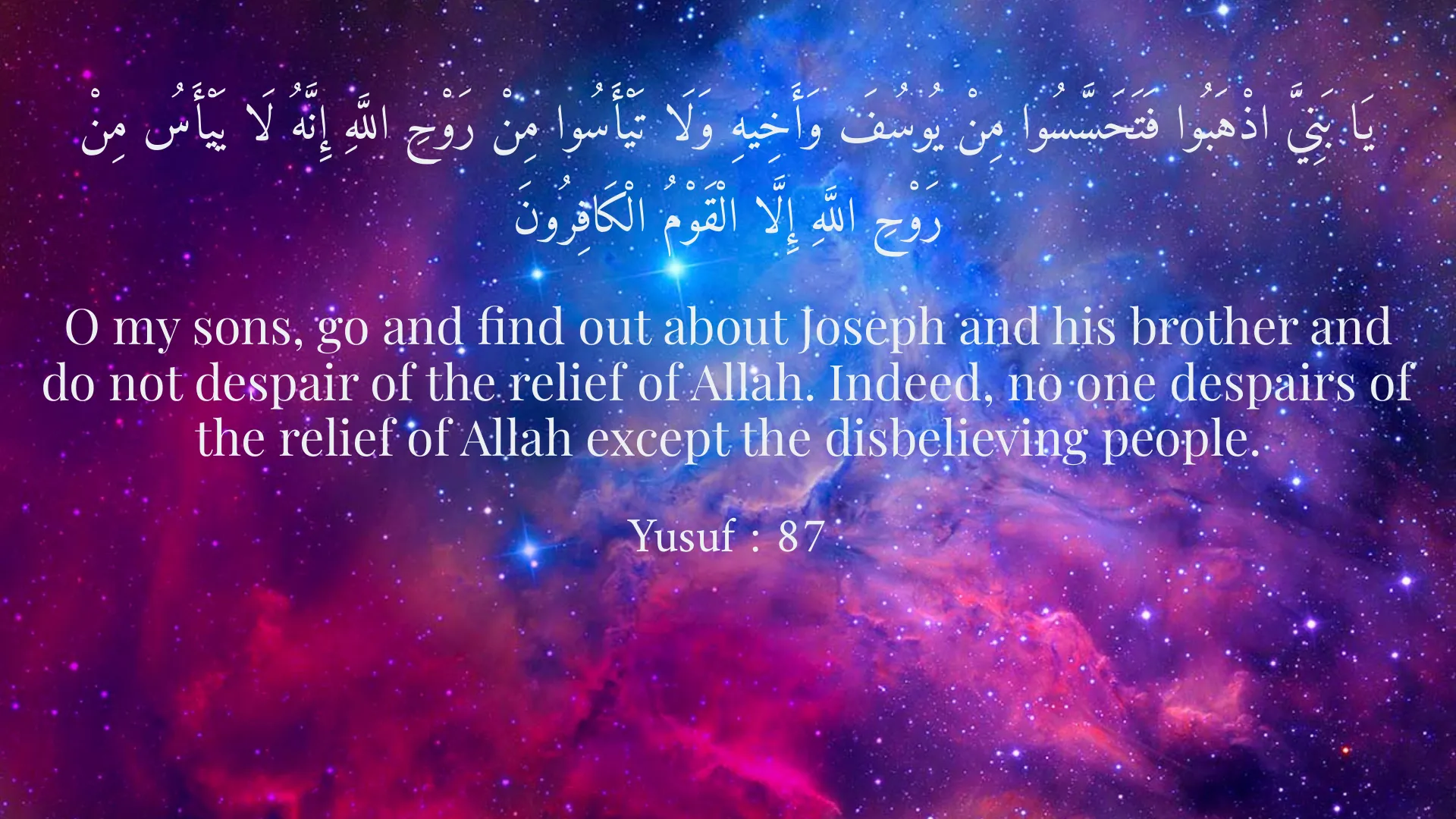
يَا بَنِيَّ اذْهَبُوا فَتَحَسَّسُوا مِنْ يُوسُفَ وَأَخِيهِ وَلَا تَيْأَسُوا مِنْ رَوْحِ اللَّهِ إِنَّهُ لَا يَيْأَسُ مِنْ رَوْحِ اللَّهِ إِلَّا الْقَوْمُ الْكَافِرُونَ
O my sons, go and find out about Joseph and his brother and do not despair of the relief of Allah. Indeed, no one despairs of the relief of Allah except the disbelieving people.
Yusuf : 87
فَإِنَّ مَعَ الْعُسْرِ يُسْرًا
For indeed, with hardship [will be] ease.
Al-Inshirah : 5
إِنَّ مَعَ الْعُسْرِ يُسْرًا
Indeed, with hardship [will be] ease.
Al-Inshirah : 6
وَمَن يَتَّقِ اللَّهَ يَجْعَل لَّهُ مَخْرَجًا
And whoever fears Allah – He will make for him a way out
At-Talaq : 2
وَيَرْزُقْهُ مِنْ حَيْثُ لَا يَحْتَسِبُ ۚ وَمَن يَتَوَكَّلْ عَلَى اللَّهِ فَهُوَ حَسْبُهُ ۚ إِنَّ اللَّهَ بَالِغُ أَمْرِهِ ۚ قَدْ جَعَلَ اللَّهُ لِكُلِّ شَيْءٍ قَدْرًا
And will provide for him from where he does not expect. And whoever relies upon Allah – then He is sufficient for him. Indeed, Allah will accomplish His purpose. Allah has already set for everything a [decreed] extent.
At-Talaq : 3
Short Story
It is narrated that in ancient times, a wealthy merchant's ship was wrecked in a fierce storm during a sea voyage, and he lost all his possessions. Amidst the tumultuous waves, he clung to a plank and, with a thousand hopes, reached the shore. Destitute and alone, he collapsed on the sands, tears streaming from his eyes. But suddenly, he remembered the tales of Saadi, who said: 'Despair is not the key to every treasure; rather, every treasure is opened with hope.' And also, 'Be at the door of hope, for nothing but hope opens the door for the dervish.' He told himself, 'Is it not true that God asks us not to despair of His mercy?' So, he raised his head to the sky and, with a broken but hopeful heart, asked God to open a way. Days passed, and with the same hope and trust, he engaged in a small business. Soon after, due to his honesty and perseverance, people trusted him, and his trade gradually flourished. He not only regained his wealth but also found an inner peace he had never possessed before. He realized that hope in the midst of crisis not only saved his life but also elevated him to a higher level of spiritual understanding.