Quranic Answer
In the Holy Quran, the virtues of aiding others and performing good deeds are underscored as fundamental traits that define Muslims and their faith. Recognizing the importance of altruism, the Quran provides numerous verses that not only encourage such actions but also highlight their significance in the eyes of Allah. One compelling reference can be found in Surah Al-Baqarah, verse 177, which states, 'Doing good and acts of charity are among the characteristics of believers.' This powerful statement emphasizes the essential principle that Muslims have a moral obligation to assist not only the needy but also a broader circle that encompasses family members, friends, and the community at large. The act of giving, be it through financial support, emotional encouragement, or other forms of assistance, is portrayed as a reflection of one's faith and connection to the divine. Moreover, in Surah Al-Imran, verse 134, it is further elaborated that 'believers are those who are patient in times of anger and hardships, and they encourage themselves to do good.' Here, the Quran emphasizes two critical qualities: patience and encouragement. Patience, particularly during challenging times, is a testament to one's strength and resilience. It is through such trials that the true nature of an individual is revealed. The verse suggests that rather than succumbing to despair or yielding to animosity, believers should rise above their adversities and continue to extend kindness and aid to those around them. This approach not only promotes a sense of communal harmony but also provides a pathway to personal growth and spiritual enhancement. The connection between helping others and personal development is profound. Engaging in acts of charity and goodwill can lead to a fortified spirit and robust mental health. Those who give selflessly often experience a sense of fulfillment and tranquility within their hearts. This sentiment is echoed in Islamic teachings, where individuals are encouraged to see charity as a means to cleanse their souls and further their relationship with Allah. Charity, or 'Sadaqah,' in Islam, operates not merely as a transaction of wealth but as a transformative experience wherein both the giver and the receiver are enriched spiritually and emotionally. However, it is crucial to note, as elucidated in Surah Al-Ma'idah, verse 93, that 'Let not hatred of a people prevent you from being just.' This verse serves as a vital reminder that while engaging in charitable acts is commendable, it is equally essential to maintain a sense of justice and fairness in all dealings. The Quran warns against allowing personal biases or grievances to cloud one’s judgment. Upholding justice strengthens social fabric and promotes a culture of mutual respect and understanding. Justice in Islam extends beyond mere fairness in the legal sense; it encompasses empathetic understanding, ethical behavior, and moral integrity. This means that whether dealing with friends, family, or even adversaries, a believer must strive to act justly and kindly, regardless of personal feelings. Such a stance enriches the community and lays the foundation for peaceful coexistence within diverse societies. Another compelling aspect of charity in the Quran is the understanding that good deeds have a ripple effect. When individuals engage in benevolence, it often inspires others to do the same, creating a chain reaction of goodwill and compassion. By positively impacting the lives of others, one not only fulfills their duties as a Muslim but also nurtures the collective spirit of society. The more individuals contribute to the wellbeing of others, the more profound the sense of community and belonging becomes. Furthermore, the significance of making amends for one's misdeeds is highlighted in Islamic teachings, which advocate for a continuous effort to rectify one’s failures through acts of kindness. In the pursuit of betterment, believers are encouraged to actively seek forgiveness for their wrong actions while simultaneously engaging in good deeds. This duality—recognizing faults and striving towards goodness—cultivates humility and fosters a sincere desire for improvement. It is clear that the intertwining concepts of charity, justice, patience, and spiritual growth form the cornerstones of Islamic moral and ethical teachings. Recognizing these connections allows Muslims to navigate the complexities of life while adhering to the values set forth in the Quran. This realization provides believers with the necessary tools to foster a more harmonious community, promoting a culture of mutual support and understanding. In conclusion, embodying the principles of kindness and charity as put forth in the Quran is imperative for Muslims as it directly contributes to both personal and societal well-being. The continuous emphasis on good deeds, patience, and justice encapsulates the essence of Islamic teachings, urging believers to cultivate a spirit of generosity while remaining steadfast in their faith. Recognizing the profound impact of benevolence not only reduces one’s sins but also nourishes the soul, bringing tranquility, peace, and fulfillment into one’s life. By striving to aid others, uphold justice, and seek forgiveness, individuals ultimately draw closer to Allah, reinforcing their commitment to a life rooted in faith and compassion.
Related Verses
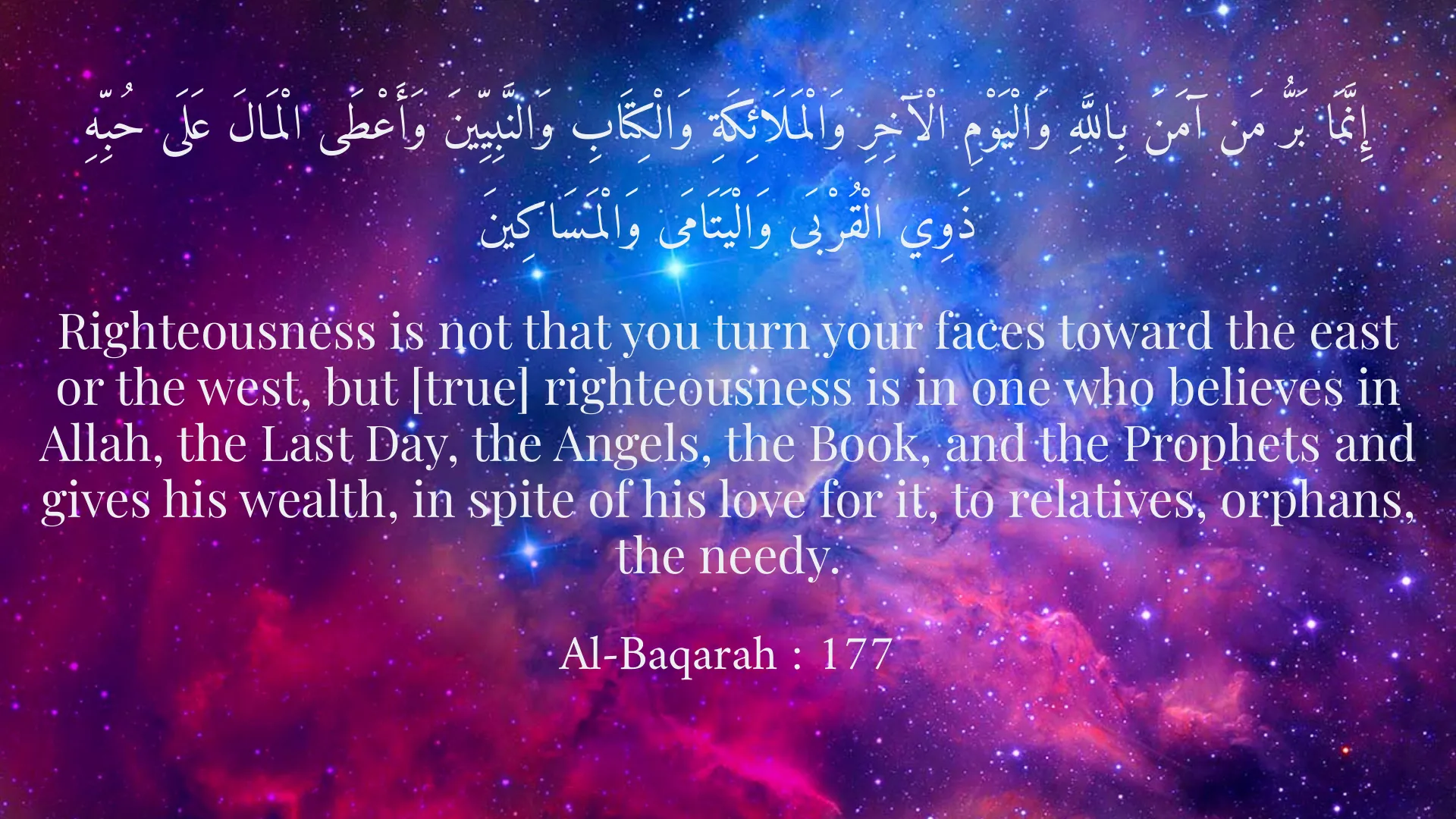
إِنَّمَا بَرُّ مَن آمَنَ بِاللَّهِ وَالْيَوْمِ الْآخِرِ وَالْمَلَائِكَةِ وَالْكِتَابِ وَالنَّبِيِّينَ وَأَعْطَى الْمَالَ عَلَى حُبِّهِ ذَوِي الْقُرْبَى وَالْيَتَامَى وَالْمَسَاكِينَ
Righteousness is not that you turn your faces toward the east or the west, but [true] righteousness is in one who believes in Allah, the Last Day, the Angels, the Book, and the Prophets and gives his wealth, in spite of his love for it, to relatives, orphans, the needy.
Al-Baqarah : 177
الَّذِينَ يُنفِقُونَ فِي السَّرَّاء وَالضَّرَّاء وَالْكَاظِمِينَ الْغَيْظَ وَالْعَافِينَ عَنِ النَّاسِ ۗ وَاللَّهُ يُحِبُّ الْمُحْسِنِينَ
Who spend in the cause of Allah during ease and hardship and who restrain anger and who pardon the people; and Allah loves the doers of good.
Al-Imran : 134
لَّا يَجْرِمَنَّكُمْ شَنَآنُ قَوْمٍ عَلى أَلَّا تَعْدِلُوا ۚ اَعْدِلُوا هُوَ أَقْرَبُ لِلتَّقْوَىٰ ۗ وَاتَّقُوا اللَّهَ إِنَّ اللَّهَ خَبِيرٌ بِمَا تَعْمَلُونَ
Let not the enmity of a people prevent you from being just. Be just; that is nearer to righteousness. And fear Allah; indeed, Allah is Acquainted with what you do.
Al-Ma'idah : 93
Short Story
One day, a man named Ali sat in a temple contemplating the lives of people. He recalled the Quranic verses that said, 'Do good to the people.' Ali decided to help the needy every day. By collecting food and clothes for them, he supported those in need. This act not only alleviated their poverty but also brought Ali inner peace and satisfaction with life.