Quranic Answer
The fundamental question of whether hope in divine mercy can replace righteous deeds and human effort is a crucial topic consistently emphasized in Quranic teachings and Islamic doctrines. The clear and decisive answer from the Holy Quran and the Prophetic tradition is an unequivocal “No.” Hope in God's mercy is not contradictory to action; rather, it is complementary and a driving force behind it. The luminous religion of Islam has always stressed the balance and equilibrium between different aspects of human life, and this balance is clearly evident in the discussion of hope and action. A true Muslim is one who consistently nurtures hope in God's boundless grace and mercy in their heart, while simultaneously never neglecting effort and striving to earn His pleasure and fulfill their religious and worldly duties. These two wings, hope and action, enable humanity to soar towards perfection and ultimate success, and without one, flight becomes difficult or even impossible. The Quran's Emphasis on the Inseparable Link Between Faith and Righteous Deeds: Repeatedly throughout the Holy Quran, “faith” (Iman) and “righteous deeds” (Amal Salih) are mentioned as inextricably linked. This constant repetition underscores the immense importance of these two pillars for human prosperity in both this world and the Hereafter. For instance, in many verses, divine rewards, both worldly and otherworldly, are promised to “those who have believed and done righteous deeds.” This combination signifies that merely claiming faith or solely hoping for divine mercy, without the backing of action and effort, is insufficient. Allah Almighty guides His servants towards diligence and good work and considers righteous deeds a fundamental condition for salvation. Hope without action is not only unproductive but can lead to a form of apathy and laziness, which is condemned in the Quran. This inseparable link highlights human accountability for their choices and actions, reminding them that the path to salvation is an active and dynamic one, not a passive state of being. Hope: A Motivator for Action, Not an Obstacle: Hope in God's boundless mercy is, in essence, a driving force that assists humans in performing good deeds and rectifying mistakes. If a person knows that God is forgiving and merciful, they will not succumb to sin but will strive to return to the path of truth. This hope gives them the courage not to despair from failures and to resume effort with God's assistance. For example, a farmer never sits idly, expecting rain, without plowing the land and planting seeds; rather, through effort and diligence, he prepares the land and then hopes for divine mercy to yield a bountiful harvest. This is the very logic of the Quran. Allah says in the Holy Quran: “And that there is not for man except that for which he strives.” (Surah An-Najm, 53:39). This verse explicitly states that the outcome and reward for each person are the product of their effort and striving. This principle is the basis of human responsibility for their actions and demonstrates that divine mercy, too, operates within its established laws, encompassing those who have earned its eligibility through righteous deeds. It is this hope that grants us the strength to persevere through difficulties and continue on our path, even when immediate results are not apparent. The Concept of Tawakkul (Reliance on God) in Islam: Another key concept sometimes mistakenly conflated with passive hope is “Tawakkul,” which means reliance on and trust in God. However, Tawakkul does not imply abandoning effort and struggle. True Tawakkul is realized when a person exerts all their ability and effort and then entrusts the outcome to God. The Prophet Muhammad (peace be upon him) beautifully illustrated this in a narration when he encountered a person who had left his camel untied, saying, “I have put my trust in Allah.” The Prophet advised him, “Tie it and then trust in Allah.” This narration clearly shows that Tawakkul goes hand-in-hand with “taking the means” (akhdh al-asbab) and practical effort, and is not a substitute for it. This means that Tawakkul demands the utmost human effort and then reliance on God's infinite power to achieve the goal. This active reliance fosters peace of mind and reduces anxiety, as the individual knows they have done their part and entrusted the rest to God's wise decree. Negative Consequences of Hope Without Action: If hope in divine mercy were to replace action, the very philosophy of human creation, the sending of prophets, the revelation of holy books, the commandment to enjoin good and forbid evil, and all divine decrees would become meaningless. Humans would transform into indifferent and irresponsible beings, mistakenly believing that mere hope would lead them to salvation. This way of thinking is not only condemned in Islam but also leads to the corruption of individuals and society. History has shown that nations that have ceased striving and relied solely on luck or unconditional divine mercy have succumbed to decline. God is just and wise, and He never gives reward or punishment without reason. He has established laws and traditions in the universe, and acting in accordance with them leads to results. Neglecting these laws and relying on false hope will only lead to loss and regret. Divine Mercy within the Framework of Action: Divine mercy is boundless and encompasses everything, but in many instances, this mercy flows within the context and channel of human action. God sends His rain of mercy upon land where seeds have been sown to yield a harvest, not on barren land where no effort has been made. Repentance and seeking forgiveness are also actions that a person performs to compensate for past mistakes, and the hope for their acceptance by God is a motivator for these actions. Even divine favors and blessings that sometimes come to someone without apparent merit are, in reality, part of divine wisdom and usually a prelude to action or a test for the servant. This mercy never negates human responsibility; rather, it provides a setting for the manifestation of divine grace and generosity alongside the efforts of His servants. Individual and Social Responsibility: 11. The Holy Quran strongly emphasizes individual human responsibility for their actions. “Every soul, for what it has earned, will be retained.” (Surah Al-Muddaththir, 74:38). This sense of responsibility compels individuals to think, plan, and act. In fact, hope in divine mercy should be the driving force for humans to fulfill their individual and social duties, not a green light for laziness and inaction. In conclusion, it can be stated that hope in God's mercy not only does not replace action but is one of the essential components for performing righteous deeds, perseverance in the path of truth, and combating despair. These two concepts, together, guarantee human prosperity and perfection under divine guidance, making the path of life smoother and more fruitful.
Related Verses
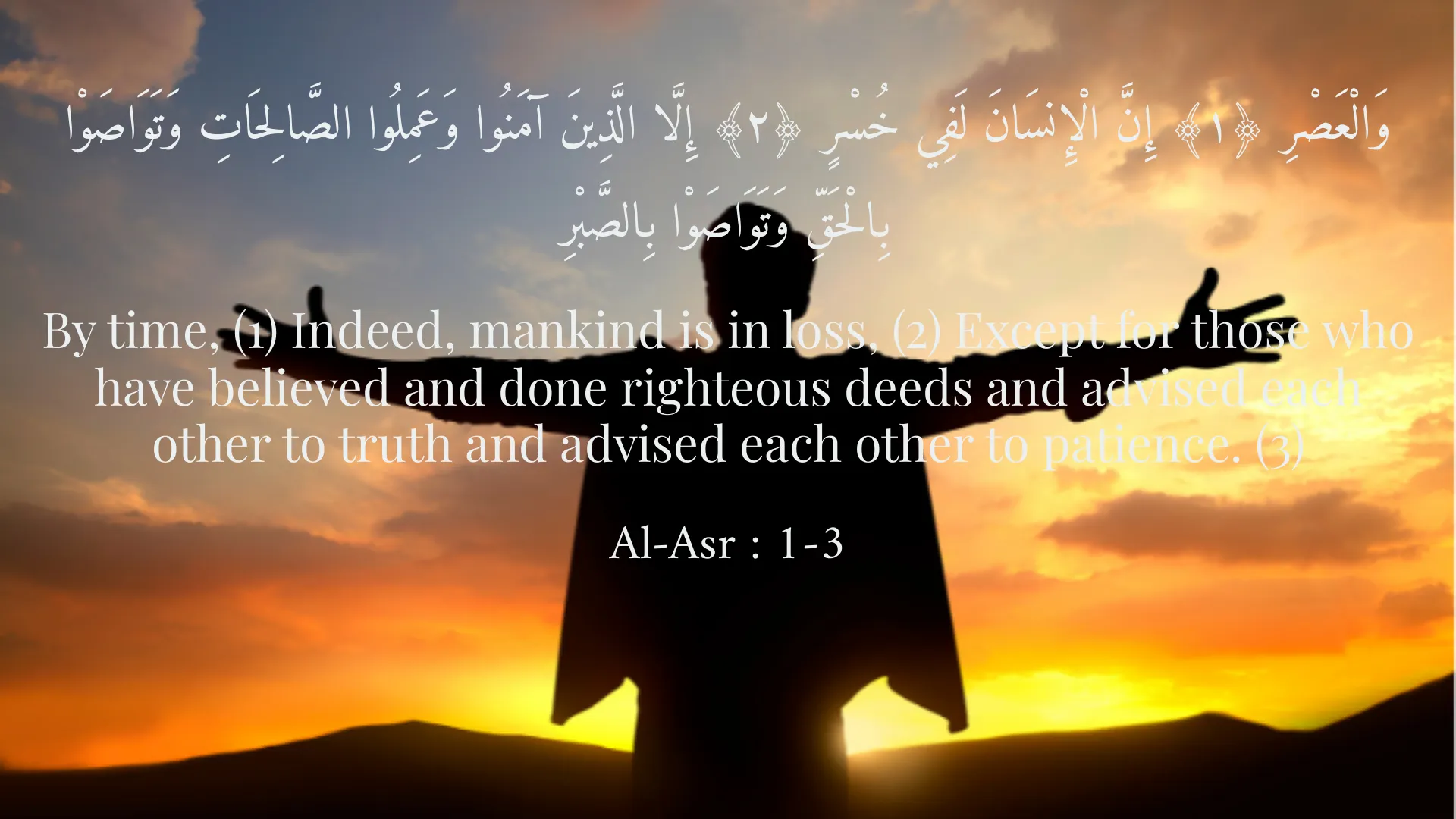
وَالْعَصْرِ ﴿١﴾ إِنَّ الْإِنسَانَ لَفِي خُسْرٍ ﴿٢﴾ إِلَّا الَّذِينَ آمَنُوا وَعَمِلُوا الصَّالِحَاتِ وَتَوَاصَوْا بِالْحَقِّ وَتَوَاصَوْا بِالصَّبْرِ
By time, (1) Indeed, mankind is in loss, (2) Except for those who have believed and done righteous deeds and advised each other to truth and advised each other to patience. (3)
Al-Asr : 1-3
وَأَن لَّيْسَ لِلْإِنسَانِ إِلَّا مَا سَعَىٰ ﴿٣٩﴾ وَأَنَّ سَعْيَهُ سَوْفَ يُرَىٰ ﴿٤٠﴾ ثُمَّ يُجْزَاهُ الْجَزَاءَ الْأَوْفَىٰ ﴿٤١﴾
And that there is not for man except that [good] for which he strives; (39) And that his effort is going to be seen; (40) Then he will be recompensed for it with the fullest recompense. (41)
An-Najm : 39-41
لَهُ مُعَقِّبَاتٌ مِّن بَيْنِ يَدَيْهِ وَمِنْ خَلْفِهِ يَحْفَظُونَهُ مِنْ أَمْرِ اللَّهِ ۗ إِنَّ اللَّهَ لَا يُغَيِّرُ مَا بِقَوْمٍ حَتَّىٰ يُغَيِّرُوا مَا بِأَنفُسِهِمْ ۗ وَإِذَا أَرَادَ اللَّهُ بِقَوْمٍ سُوءًا فَلَا مَرَدَّ لَهُ ۚ وَمَا لَهُم مِّن دُونِهِ مِن وَالٍ
For him [man] are successive [angels] before him and behind him who protect him by the command of Allah. Indeed, Allah will not change the condition of a people until they change what is in themselves. And when Allah intends for a people ill, there is no repelling it. And there is not for them besides Him any patron.
Ar-Ra'd : 11
Short Story
It is narrated that in ancient times, there was a dervish who sat in seclusion, saying, "God is the Provider, and I have placed all my hope in His mercy." He refused to work or earn a living, expecting his sustenance to reach him without any effort. One day, a wise Sheikh passed by and saw him in this state. The Sheikh asked the dervish, "My brother, what has happened to you that you have given up work in this manner?" The dervish replied, "I have sat in reliance on God, and I hope in His boundless mercy to provide for me." The Sheikh smiled and said, "O Dervish, reliance is good, but true reliance is that you tie your camel and then trust in God! An uncultivated land yields no harvest, and an unsought sea yields no pearl. Hope in God's mercy is good, but that mercy descends upon those who gird their loins with effort and put their hands to work. Go and strive, for God does not waste the reward of those who exert themselves, and His mercy flows within the channel of effort." The dervish accepted the Sheikh's advice and thereafter began to work. Through effort and hope, he made a worthy life for himself.