Quranic Answer
The existence of pervasive inequalities and injustices in the world is undoubtedly one of the most challenging philosophical and theological questions for humanity. When we ponder why innocent individuals suffer, or why oppressors sometimes appear to thrive and escape immediate consequences, it is natural for the question to arise: Does this state of affairs imply the absence or inadequacy of Divine justice? From the perspective of the Holy Quran and Islamic teachings, the emphatic answer is no; the injustices observed in this world by no means signify the absence of Divine justice. Instead, a correct understanding of this profound concept requires a deep insight into the various dimensions of Divine wisdom and will, the nature of this world as a realm of trial and test, and Allah’s explicit promises regarding the Day of Judgment. Firstly, the Quran emphatically and repeatedly affirms the absolute justice of Allah (SWT). Allah, the Most High, is the Most Just of all judges and can never commit injustice against anyone. Injustice and oppression are fundamentally alien to the essence of God, and He is utterly free from any imperfection or wrongdoing. Numerous verses articulate this profound truth. For instance, in Surah Yunus (10:44), Allah states: “Indeed, Allah does not wrong people at all, but it is people who wrong themselves.” This verse clearly indicates that the root cause of much of the world’s injustice lies in the actions and choices of human beings themselves, rather than being an act of injustice willed by God. Humans, through their free will, choose paths of good or evil, and they bear the consequences of these choices both in this world and, more fully, in the Hereafter. It is human greed, avarice, selfishness, and thirst for power that lead to oppression and injustice, not any oversight or deficiency on the part of the Creator. Secondly, according to the Quran, this world is fundamentally a temporary abode of trial and test, not the ultimate realm of complete retribution and reward. Allah (SWT) created death and life precisely to test humanity and distinguish those who are best in deeds. Surah Al-Mulk (67:2) proclaims: “He who created death and life to test you [as to] which of you is best in deed—and He is the Exalted in Might, the Forgiving.” Within this arena of divine examination, hardships, suffering, and even injustices inflicted by others can be part of Allah’s test. These trials serve to refine the human soul, reveal one’s patience, faith, resilience, and determination. Those who endure oppression with patience and do not deviate from the path of truth receive immense reward from Allah. This does not imply an endorsement of oppression but rather emphasizes the human capacity for growth and perfection even under challenging circumstances. Thirdly, the full and absolute realization of Divine justice will culminate on the Day of Judgment, known as Yawm al-Hisab (the Day of Reckoning). This earthly life, with its inherent limitations and temporary nature, simply cannot contain the full measure of divine justice and recompense. Many human actions remain hidden in this world, or their complete consequences are not immediately manifest. However, on the Day of Judgment, all veils will be lifted, and every individual will witness firsthand all the good or evil they have done. Surah Al-Kahf (18:49) describes this vividly: “And the record [of deeds] will be placed, and you will see the criminals fearful of what is therein, and they will say, 'Oh, woe to us! What is this book that leaves nothing small or great except that it has enumerated it?' And they will find what they did present [before them]. And your Lord does injustice to no one.” This verse offers profound assurance that no deed, whether small or great, will be overlooked, and no one will ever be wronged. The oppressed will receive their just reward for their patience and endurance, while the oppressors will face the full consequences of their actions. Thus, this fleeting world is merely a prelude to that ultimate and final accounting. Fourthly, a significant portion of the injustices we witness results directly from humanity's failure to adhere to divine laws and their deviation from the path of guidance. When human beings transgress the limits set by Allah, they turn to conflict, warfare, and oppression instead of peace and justice. Corruption, poverty, and many social calamities stem from humanity's unjust behaviors. Allah states in the Quran that He does not change the condition of a people until they change what is in themselves (Ar-Ra'd 13:11). This grants humanity free will and places responsibility squarely on their shoulders. If humanity collectively chooses a path of oppression and corruption, it cannot attribute the blame to Divine justice. In conclusion, the presence of injustices in the world is never an indication of the absence of Divine justice. Rather, these injustices serve as a sobering warning to humanity to reflect, to not transgress divine boundaries, to strive for justice to the best of their abilities, and to remember that the ultimate reckoning awaits. This understanding instills hope that no right will be lost, and no injustice will go unaddressed. Faith in Divine justice not only brings solace to the oppressed but also instills a profound fear in the hearts of oppressors that none of their deeds will remain hidden. This perspective empowers believers to stand firm with patience and perseverance in the face of adversities and never to despair of the Lord’s mercy and justice, for Allah has stated: “But perhaps you hate a thing and it is good for you; and perhaps you love a thing and it is bad for you. And Allah knows, while you know not.” (Al-Baqarah 2:216) This verse further emphasizes that there is often a hidden wisdom in phenomena that might not be immediately comprehensible to us. Therefore, let us look upon this world with a confident heart and a discerning eye, knowing that Allah is the Most Just and never wrongs His servants, and that ultimately, everything moves towards His absolute justice.
Related Verses
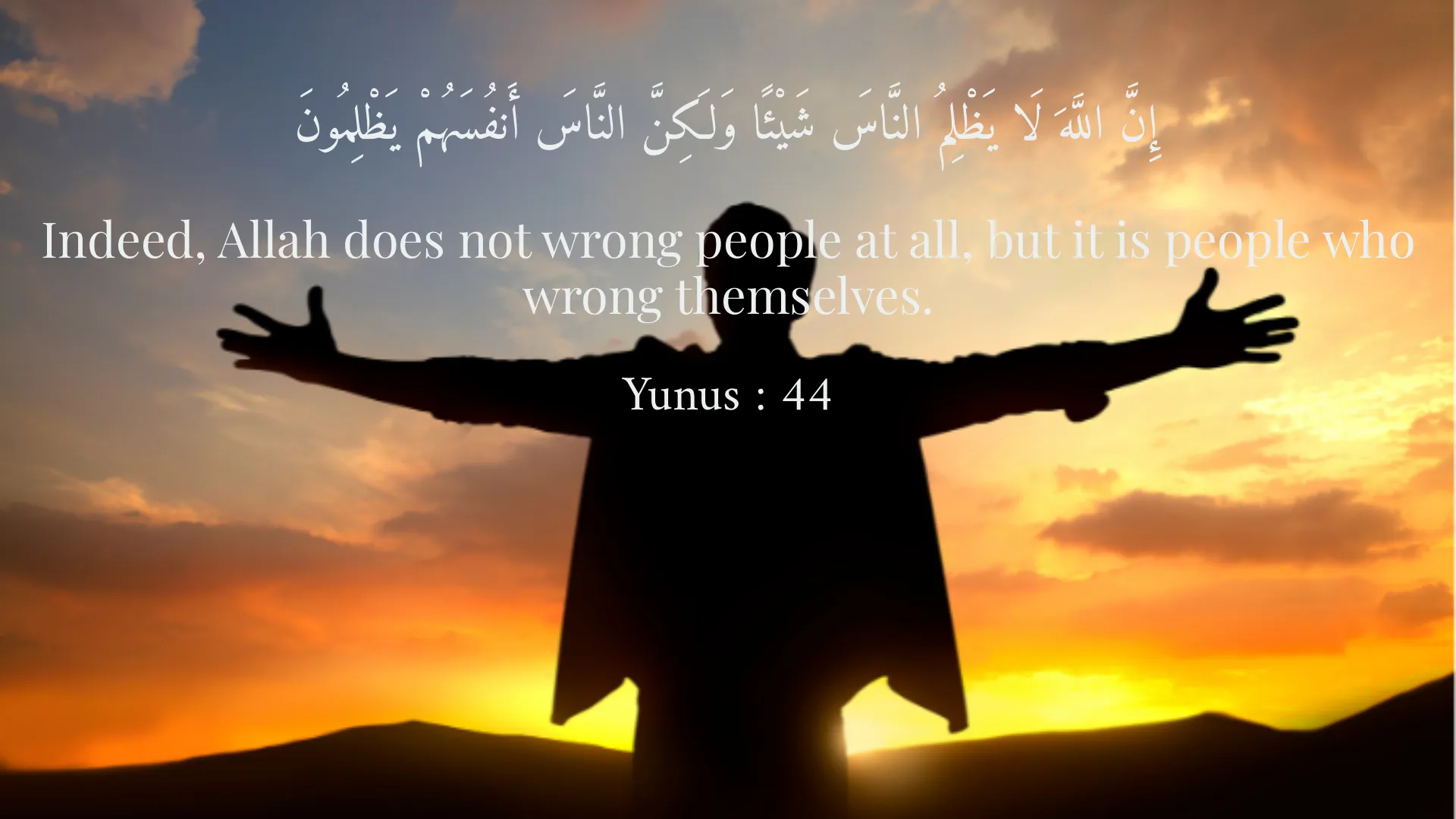
إِنَّ اللَّهَ لَا يَظْلِمُ النَّاسَ شَيْئًا وَلَكِنَّ النَّاسَ أَنفُسَهُمْ يَظْلِمُونَ
Indeed, Allah does not wrong people at all, but it is people who wrong themselves.
Yunus : 44
وَوُضِعَ الْكِتَابُ فَتَرَى الْمُجْرِمِينَ مُشْفِقِينَ مِمَّا فِيهِ وَيَقُولُونَ يَا وَيْلَتَنَا مَا لِهَٰذَا الْكِتَابِ لَا يُغَادِرُ صَغِيرَةً وَلَا كَبِيرَةً إِلَّا أَحْصَاهَا ۚ وَوَجَدُوا مَا عَمِلُوا حَاضِرًا ۗ وَلَا يَظْلِمُ رَبُّكَ أَحَدًا
And the record [of deeds] will be placed, and you will see the criminals fearful of what is therein, and they will say, 'Oh, woe to us! What is this book that leaves nothing small or great except that it has enumerated it?' And they will find what they did present [before them]. And your Lord does injustice to no one.
Al-Kahf : 49
الَّذِي خَلَقَ الْمَوْتَ وَالْحَيَاةَ لِيَبْلُوَكُمْ أَيُّكُمْ أَحْسَنُ عَمَلًا ۚ وَهُوَ الْعَزِيزُ الْغَفُورُ
He who created death and life to test you [as to] which of you is best in deed—and He is the Exalted in Might, the Forgiving.
Al-Mulk : 2
Short Story
In Saadi's Golestan, it is told that one day, a humble villager owned a small plot of land which he diligently cultivated with great effort. The tyrannical village chief coveted his land and seized it by force. The villager, with a broken heart and tearful eyes, sought justice from the judge, but the judge, fearing the chief, offered no help. The oppressed villager raised his head to the sky and prayed, 'O Lord! You are a witness to the injustice inflicted upon me. I have no helper left but You.' He returned home and continued his work, seeking lawful sustenance with patience and trust in God. Not long after, a great blight befell the chief's crops, and his wealth began to dwindle. On the other hand, through the blessings of the villager's patience and prayers, his dry land was watered by merciful rains, yielding a bountiful harvest. One day, people saw the chief, impoverished and desperate, seeking refuge with the very villager he had wronged. Then everyone understood that although Divine justice may sometimes be veiled by time, it is never absent and will one day reveal the truth, reclaiming the right of the oppressed from the oppressor.